NCRP’s Response to Regressive SCOTUS 2026 Decisions
Indigenous sovereignty. Reproductive justice. Birthright citizenship. Trans rights. Voting rights. Civil rights.
Whether the decisions were favorable or unfavorable, the cases of the 2026 Supreme Court session are not isolated. These rulings are just the latest example of the impressive decades-long tactics by regressive funders. For more than a generation, regressive funders have provided patient, flexible capital to not only pursue their less just vision of the world, but to weather setbacks long enough to bring the vision to fruition.
In this spirit, NCRP welcomes the Supreme Court’s decision to preserve the Indian Child Welfare Act (ICWA) through Reyelts v. State of Minnesota. This ruling is a necessary step towards recognizing the wellbeing of Indigenous kids, the sovereignty of Native tribes, and the consensus of constitutional scholars. Yet as we celebrate, we must remember: this verdict does not erase the ongoing legacy of colonial theft, violence, and broken promises to Indigenous communities. This regressive court strategy has stalled for now, but this case does not exist in a vacuum. NCRP has been watching. Right-wing advocates like the Goldwater Institute received steady funding to drive this case over and over again, receiving $11 million in contributions in 2024 alone.
The answer is not episodic funding, it’s generational investment into Indigenous leaders and organizers.
While ICWA was maintained, First Choice Women’s Resource Centers v. Davenport passed in an unanimous decision. This decision authored by Justice Neil Gorsuch shifts how accountability happens. It will make investigating the deceptive behaviors of crisis pregnancy centers even more difficult.
In response to this loss for the Reproductive Justice movement, NCRP will continue to examine funder ecosystems, and collect publicly available data through community-centered resource approaches. Reproductive Justice leaders have always had to innovate through the harshest of environments; they have the wisdom and know how to fight this battle, but they require deeper investment to do the work.
The philanthropic sector needs to listen and take their role seriously. Funders must move resources to long-term research capacity, regional data collection, legal partnerships, comms infrastructure and the development of frontline efforts and strategies.

The Supreme Court case of Trump v. Barbara challenging birthright citizenship was technically upheld birthright citizenship in a 6-3 vote. With this slight margin, progressive philanthropists should take heed – funders need to increase giving and move money more quickly and more equitably. As part of our regressive philanthropy initiative, NCRP observed eight anti-immigration organizations who either filed or organized around amicus briefs on Trump v. Barbara. Combined these organizations’ assets totaled over $51 million dollars in 2022. These eight anti-immigration nonprofits received an average of 66% of their funding as general operating support. Comparatively, from 2010-2022 funding for the entire immigrant serving ecosystem received about 36% of their funding as general operating support. Trump v. Barbara was the largest de-documentation effort in modern U.S. history. With its unconstitutional attack on the ideals this country, it attempted to abandon the American humanitarian commitments to millions of immigrants – families who have helped build the fabric of this country itself.
In the West Virginia v. B.P.J. and Little v. Hecox, the Supreme Court in a 6-3 vote banned trans athletes from participating in girls and women’s sports. This decision strongholds the 29 states that have already banned athletes on the state level. This ruling is not about athletics; it is about narrowing civil rights protections. It is discrimination and fear mongering for young trans athletes. In this 6-3 vote, a different issue has taken on the same regressive infrastructure.
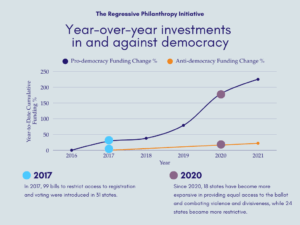
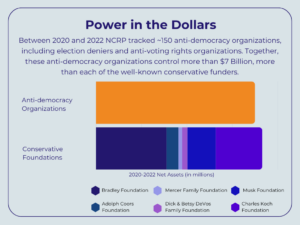
While all these cases are treated as separate policy fights, they are financed by the same machine that wants to tear away at progressive values. Philanthropy cannot afford to be complacent, siloed, or afraid in this moment. Progressive, centrist, and nonpartisan philanthropy must take a lesson from the regressive opposition. Regressive philanthropy thinks in decades. They fund movements, not just moments. They invest in infrastructure and legal defense. They commit to long-term funding, and they work across different movements to attack.
Regressive philanthropy has spent decades building this infrastructure and it’s working. Progressive philanthropy has a responsibility to operate differently than its status quo. It needs to invest in the people, collaborative infrastructures, research, and organizing that are capable of shaping the decades ahead. Funder’s strategy for protecting the Constitution – in service of justice, equity, and democracy for all Americans – has to be a sustained and long-term investment, not just a response to crises, election years, or Supreme Court decisions.