Creative and Intentional Resourcing
In 2021, Walton, along with key frontline Climate Justice leaders, played a key role in helping to reallocate $141 million from the Bezos Earth Fund to frontline accountable intermediaries, with The Solutions Project (TSP) receiving $43 million themselves. Additionally, TSP co-developed three movement support funds with frontline organizations, The Justice 40 Accelerator, Communicating Our Power Fund and The Fund for Frontline Power (A note that this is 100% governed and stewarded by grassroots organizations and leaders and is being held at TSP at the request of those organizations).
These funds were developed in partnership with movement groups such as the Climate Justice Alliance and Groundswell. These partnerships help build trust and deepen the commitment that TSP has in ensuring that these funds go directly to frontline, grassroots organizations.
TSP focuses on granting multi-year, unrestricted grants whenever possible. And they work to be emergent and nimble when events such as climate disasters happen, working to get money on the ground quickly. They also lean heavily into resourcing narrative power and strategy, amplifying work and stories to further their advocacy for climate action, policy changes and funding.
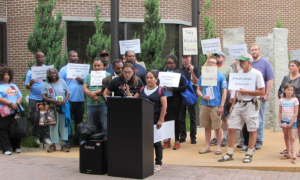
The impact of these practices is huge. One of TSP’s grantees, Soulardarity based in Highland Park, MI ran a community-controlled energy democracy campaign to install thousands of solar powered streetlights after the original ones were taken away. These streetlights will not only provide energy cost savings for years to come, but the campaign helped to strengthen community cohesion and power. Frontline grantees know what they need and how to be responsive to the multifaceted desires of their communities even when those desires/needs do not fit into a narrowly defined grant portfolio.
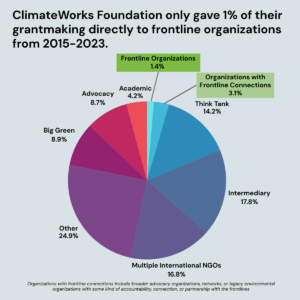
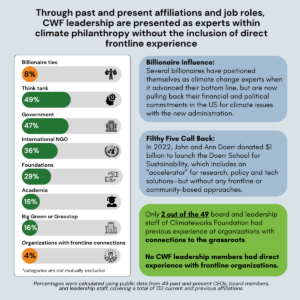
Walton also hopes that movement accountable intermediaries can be more organized and strategic, continuing to show up courageously as a necessary force of the philanthropic sector. Because while TSP has moved upwards of $60 million in 2025 (with a milestone of $100 million more) to upwards of 350 frontline-led organizations, there are much larger climate focused intermediaries in the ecosystem moving three to four times that amount of money, who are not working directly with frontline groups.
By working in collaboration with like-minded collaborative funds, funders like TSP help make movement accountable funding the norm instead of an outlier. Additionally, Walton stresses that in being a movement-accountable intermediary, TSP needs to fundraise every year. This can mean getting creative and working to build partnerships between grantees and non-traditional institutions, sectors, and people to bring in additional funding. Walton elaborates, “It’s important to understand that moving resources is expansive and multidimensional, meaning it can look like moving money, making connections to other funders and opportunities, sharing our platform, paying for a grantee to attend a conference or a training, etc. It’s showing up when it counts and matters.”
An example of how TSP shares their platform is how they proudly amplify numerous frontline solutions oriented case studies to signal to other climate funders that frontline communities have always had the solutions, and those solutions are having tremendous impact on people and the planet.
Navigating the Political Landscape
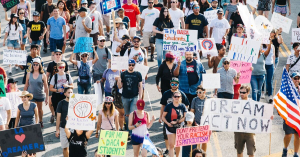
In 2025, as the federal administration began to roll back climate protections and slash previously awarded funding; TSP launched the We Love People & Planet: Stand for Climate Justice Campaign with over 100 organizations, foundations, and individuals committing to show a “united front for climate solutions.” Signatories promised to amplify frontline solutions that include the following:
- Implement solutions that increase clean energy, air, and water and meet community needs.
- Increase investments, action, and policies for climate solutions that improve people’s lives.
- Protect climate gains and wins.
- Uplift and tell stories that show our collective power to create the future we want.
- Support and fund those most affected by the climate crisis.
While these objectives may seem simple, it is important to acknowledge the conditions that movement groups are facing under this federal regime, while funders with very little to lose are protecting their wealth out of fear and complying in advance. Refusing to back down and boldly continuing to support those who are actually vulnerable is deeply needed during these times.

Building Deep Relationships
When I asked Walton what is one thing that other funder intermediaries could learn from TSP, she said, “While we are not institutional philanthropy, it is important that we still show up in a space that recognizes that there may be a perceived power differential. The onus is on us to invest the time, energy, and resources to foster an actual relationship where our grantees feel safe and comfortable to ask us questions, to admit not knowing, or to share their missteps and mistakes, without a punitive response. It’s on us to ensure that our grantees understand that their voice and experience truly matters to us – not just when things are going well or according to plan, but how do we respond with care and support when things may not be.”
Furthermore, Walton continues, “Many movement-accountable intermediaries are led by former grassroots organizers who have decades of experience, relationships, expertise, and understanding of what it takes to do the work on the ground. Therefore, the expression of movement accountable strategies and approaches often stems from empathetic leadership.”
Frontline accountable intermediaries work directly with movement groups to meet their needs as they evolve. Their role is to directly support these communities without relying on their own agenda or biases. They understand that philanthropy as it exists now is not sustainable. They recognize the importance and validity of frontline-led solutions and work to amplify them while also partnering with other aligned funders to move those resources further.
The Solutions Project has been building and experimenting for over twelve years, honoring their commitment to largely fund climate and environmental justice organizations led by Black people, Indigenous people, and other people of color whose communities are at the frontlines of racism, poverty, and pollution. Over the years, they have launched several campaigns and continue to learn and grow from the outcomes. But two things have always been clear: that resourcing and building deep intentional relationships with those most impacted by the climate crisis is the clearest way to mitigate it.
Editor’s Note: This is Part Two of a continued conversation with The Solutions Project’s Executive Director Gloria Walton. This continues NCRP’s series highlighting the importance of frontline and movement accountable intermediaries. There will be three more pieces coming out this year, each continuing to showcase how funders and other funder intermediaries can shift their practices to resource communities on the ground directly. Click here to read Part One