Resources that Make Climate Justice Work
We have heard it all before: “well, if we had more funding, we would do x” or “we had a lot of momentum going on this project, but it was only funded for a year, so we have to focus on other priorities.” In the eleven years I’ve spent in the climate justice movement space, I have grown tired of hearing this common refrain.
In the philanthropic space, the conversations amongst progressive funders and funder organizers were similar. These conversations included conference workshops, hours-long sessions and working groups with slightly modified configurations of the same folks jumping between Zoom calls and various retreat centers around the country.
This is not to say that those gatherings were not productive. I did participate in some convenings that were and still are deep, and meaningful. There are funders doing the work of engaging in intentional solidarity with frontline organizers on the ground. They are funding way above the five percent threshold, spending down their endowments and experimenting with creative ways to get work funded –all while living under oppressive conditions upheld by governmental and private sectors.
One cannot help but be inspired by those funders whose praxis is equitable wealth redistribution and who are organizing to create the conditions where philanthropy will no longer be needed in its current form. And still, progress is ultimately a drop in the bucket given what the frontlines are up against. This is not a new revelation. In the past four years, I along with countless others have written about it here, and here, and here.
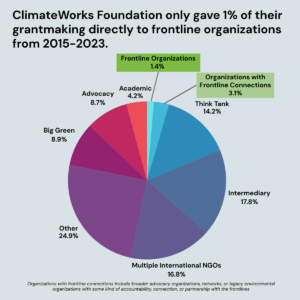
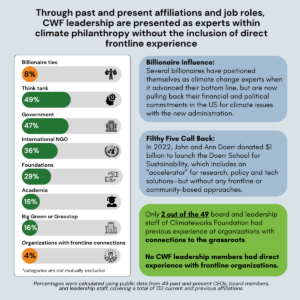
In the 2023 Challenging the Power of Billionaire Philanthropy in the Climate Funding Space campaign, the NCRP Climate Justice and Just Transition team turned its lens on climate focused funder intermediaries with the purpose of showcasing how the sector can become more frontline accountable. It is more than apparent by now that we need all hands on deck if we are going to have any chance at mitigating the worst of the climate crisis.
Therefore, this piece is not going to focus on the reasons why the frontlines need more and longer-term resourcing. I will not be spending a lot of time detailing the conditions that led us to this moment of predictable funder backlash and retention. There are plenty of pieces lifting up the problems. Here are a few to read if you are interested. Instead, I want to focus on the intermediary funders who are getting it right, with the intention of showcasing some tangible solutions for other funders working to be more accountable to frontline grassroots communities.
True Frontline Accountability
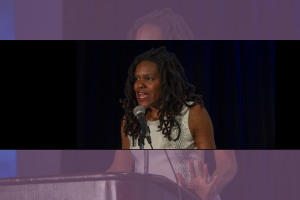
In August 2025, I had the immense pleasure of speaking with Gloria Walton, the President and CEO of The Solutions Project (TSP); a frontline accountable funder intermediary founded in 2013. TSP is working to accelerate a just transition to a regenerative economy by funding and amplifying climate solutions initiated by disinvested communities – Black, Indigenous, immigrant, women and communities of color – who are closest to the adverse impacts of climate change and therefore often best placed to solve and address them. We discussed what being frontline accountable means to Walton and TSP, how TSP is showing up in this moment and how institutional funders and intermediaries can apply these lessons to their own resourcing practice. The rest of this piece will include takeaways from that conversation.
It is important to define what a funder intermediary is and how to distinguish between a frontline accountable intermediary versus one that is not. In 2017, an article from Peak Grantmaking defined intermediaries as “mission-driven organizations that aim to more effectively link donors (individuals, foundations, and corporations) with organizations and individuals delivering charitable services.” On the surface, intermediaries are collaborative funds or re-granting organizations who fundraise from donors and institutional funders with the purpose of granting those funds out to various non-profits.
Frontline accountable intermediaries do a lot more than that. As alluded to above, frontline organizations have been deeply underfunded for decades, with few institutional funders and donors moving money directly to those groups. And while many frontline groups prefer funding directly from institutional philanthropy, frontline accountable intermediaries offer a good alternative.

In response, Walton states, “If funding directly from institutional philanthropy is the preference, it’s because it’s the dominant theory of philanthropy that we know, but the reality is that these are historically and present-day underinvested and disinvested organizations, that’s why they shouldn’t be tasked to choose between institutional funding or movement accountable intermediaries. They need direct funding from both.”
A 2024 article in the Stanford Social Innovation Review written by several frontline accountable intermediary leaders defined their institutions as “organizations that help allocate funding to people-powered activism.” Furthermore, “These organizations came to life from movements, and [their] ultimate aim is to reduce philanthropic infrastructure.”
Intermediaries are ultimately accountable to their funders while frontline accountable intermediaries are accountable to their grantees aka frontline, grassroots organizations.
As Walton states, “We recognize that people at the frontline of the climate crisis best understand the problems and conditions of their communities, and what solutions their communities need. Therefore, being a movement accountable intermediary means trusting their expertise, experience, leadership, and their strategic vision. Our movement is currently experiencing unprecedented threats, from escalating climate disasters, shrinking federal support and philanthropic pullback, to political volatility, attacks on democracy, and increasing burnout for frontline leaders. That’s why serving as a collaborative fund is more catalytic and essential than ever.”
In my conversation with Walton, it was clear that this sentiment rang true for her and is how TSP operates. Walton comes from movement work, starting in the economic justice space in the early 2000s in South Central Los Angeles. When it soon became clear that climate justice was deeply intertwined with the economy and all forms of justice, her focus became resourcing the power building and organizing of Black and Brown frontline communities working to end the climate crisis.
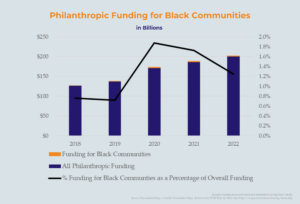
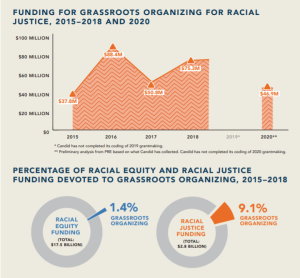
Throughout our discussion, racial justice was a central theme. We talked about the performative solidarity of 2020 when many foundations increased their payouts temporarily to fund more Black, brown and Indigenous led organizations and how that funding has all but dried up five years later under the threat of fascism, despite communities on the ground needing these resources now more than ever. To Walton, funders tend to fund what they value, and BIPOC, frontline led solutions are not always the first priority.
Editor’s Note: This is Part One of Two of NCRP’s conversation with The Solutions Project’s Executive Director Gloria Walton. Click here to follow along for Part Two where we dive into The Solutions Project’s Creative and Intentional Resourcing.