
Overview of Regressive Philanthropy Initiative
What is the problem?
From the Civil Rights Movement to today, philanthropy has played an important role in advancing a healthy and representative democracy and supporting movements that uplift the needs of those with the least amount of power, wealth and opportunity in American society.
But that’s not the whole story.
Foundations and giving vehicles like donor-advised funds are also being used to attack representative democracy and attempt to reverse progress on racial, gender and economic justice in the United States. There are thousands of funders who use the tools of philanthropy to maintain their own disproportionate wealth and power and undermine or roll back efforts for a more democratic and just society.
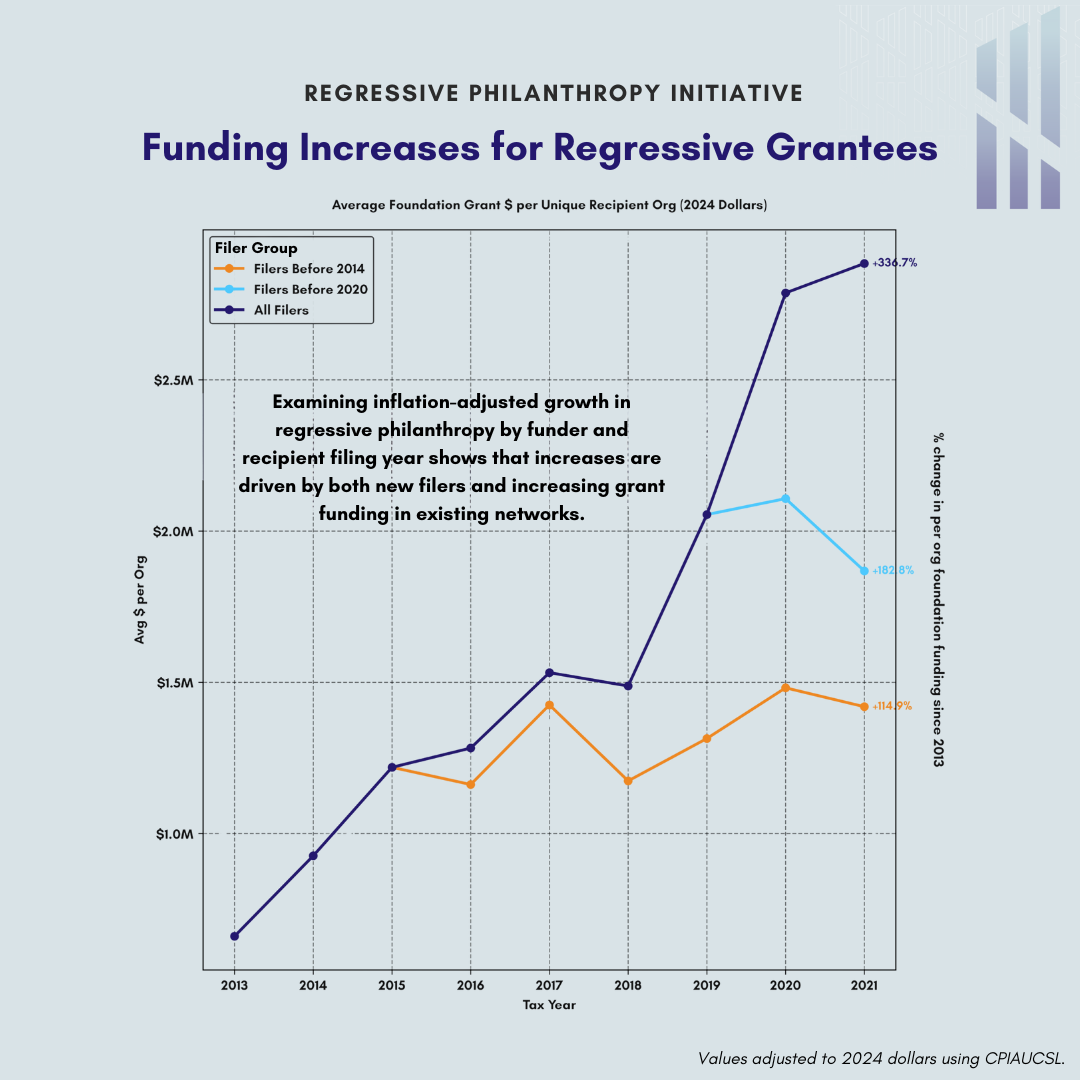
What NCRP calls “Regressive Philanthropy” – philanthropic giving designed to resist progress, maintain inequities and ultimately take us backwards as a society – has played a significant role shaping the authoritarian present. Across multiple issue areas, regressive philanthropy funders are often giving more effectively than funders who support justice and equality. Policies that threaten public health, due process, an independent judiciary, a diverse civil society and basic human rights will be expanded and entrenched – unless funders start resourcing movements with long-term flexible funding.
What kinds of regressive funders are we studying?
NCRP is starting with a focus on the anti-democracy, anti-LGBTQ+ and anti-immigration issue areas based on the salience of these areas in the current political moment. NCRP believes that attacks against queer, trans and immigrant communities are being leveraged to undermine democracy.
Using existing knowledge and relationships with allied movement thinkers, NCRP began to plot the ecosystems of individuals and institutions that are using philanthropy to push back against a multiracial, inclusive democracy. NCRP is documenting the amount of money, the source, what types of nonprofits are receiving, which kinds of contributions and what has made these investments so successful.
What can NCRP allied funders do about it?
The increasing volume of far-right messages feels shocking to funders with a commitment to social justice. But funders that remove explicit references to BIPOC, trans and immigrant communities from funding priorities are doing the work of regressive leaders for them. Without targeted universalism, those already disproportionately impacted are pushed further to the fringes of society.
This current constitutional crisis is not the product of a single historical moment or a presidential administration. Many of the through lines NCRP reported on in Axis of Ideology 30 years ago have remained the same. Conservative funders are increasingly providing more general operating support over time to influence as many people as possible.
To work toward a shared vision with clear goals supported by consistent narratives, progressive intellectuals and funders need to work with and be led by community demands. Progressive infrastructure needs a deep investment directed toward a shared vision.
Learning from the trust and deep pockets that regressive philanthropists show their grantees wouldn’t just reverse the erosion of human rights, but would also build an inclusive world. Progressive funders should fund progressive organizations as if they want these movements to thrive and last. The goal is not to copy regressive philanthropy’s playbook, but to recognize that traditions and giving practices that funders impose and firmly uphold are not the only way. As always, NCRP wants to see allied funders fund more multiyear, general operating support grants. For those already there, NCRP calls for philanthropy to make the following investments:
- Consistently invest in leaders with lived experience over time, especially leaders of color and those most affected by issues we hope to change.
- Invest in key states where regressive movements are strong and unchallenged, even if that means funding across state lines.
- Similarly, eliminate strict barriers and restrictions on funding specific issue areas.
- Invest in narrative ecosystems that underlie successful culture change and power building.
- Commit to move money quickly and more equitably to increase impact and influence communities most impacted by injustice.
About the movement
Nearly 30 years after NCRP first documented the “strategic philanthropy of conservative foundations” in Sally Covington’s landmark study and 15 years since the Supreme Court demolished election spending rules in favor of corporate personhood with Citizens United v. FEC, the space for right-wing donors to finance anti-democratic civil society has exploded.
While the anti-democratic movement has grown in size and sophistication, much of the through lines NCRP reported on 30 years ago have remained the same. Regressive philanthropy is modeling how effective trusting aligned, grassroots-issue-focused leaders can be for conservative funders in achieving right-wing goals.
Allied funders that share NCRP’s vision – that frontline movements fighting to restore and advance our democracy operate in abundance versus constant survival mode – need to stop resourcing grantees from a reactionary position. We need deep investment in power-building infrastructure directed toward a shared progressive vision.
Read Covington’s “Moving a Public Policy Agenda” to learn more.
What we know
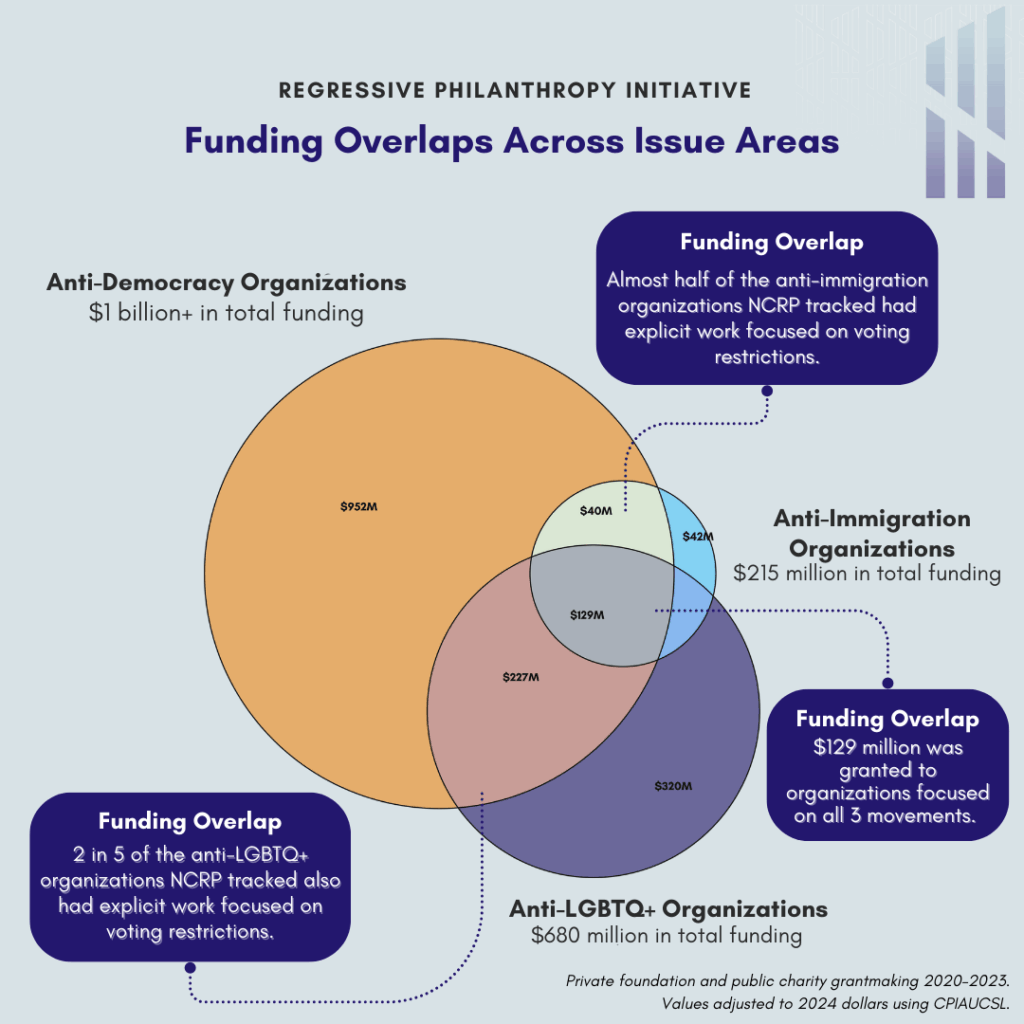
NCRP tracked 5,600 private and public funders between 2020 and 2023. In that time, $1.4 billion in total foundation funding went to 203 election denial and anti-voting rights organizations.
These organizations have deep connections to the attacks on human rights of LGBTQ+ people and/or immigrants. Out of the anti-LGBTQ+ organizations NCRP tracked, 2 of 5 also had explicit work focused on voting restrictions. Additionally, almost half of the anti-immigration organizations that NCRP tracked had explicit work focused on voting restrictions.
Why it matters
Allied funders who care about the fabric of American democracy should be looking to support and strengthen democratic institutions with multi-year grantmaking strategies that help build local power through a series of elections in every cycle, not just in presidential election years.
Philanthropists with regressive policy preferences have been highly effective in supporting the goals of a polarizing right-wing agenda. These funders have done so primarily by giving multi-year, unrestricted funding to “anti-movement” leaders and focusing on long-term, nonlinear change.
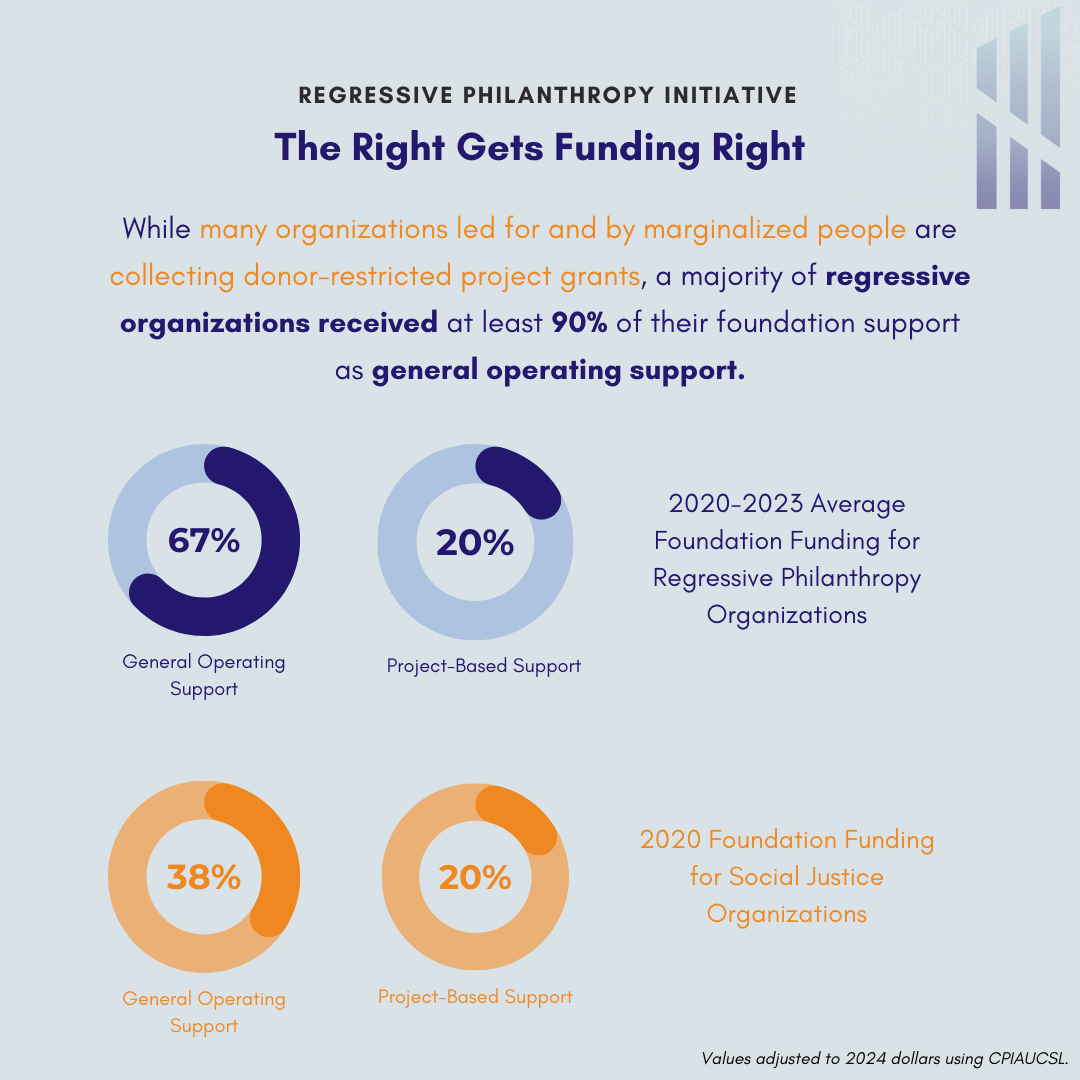
Between 2020 and 2023, 65% of all foundation funding for these anti-democracy organizations was given as unrestricted general support, and only 22% of that foundation funding was granted for a specific program, project, or campaign. Comparatively, during the pandemic in 2020, only about 38% of foundation funding for social justice was given as unrestricted general support.
About the movement
The Spring 2015 Supreme Court decision Obergefell v. Hodges ended marriage discrimination across the United States. By then, the groundwork had already been laid for North Carolina’s House Bill 2, which passed in March of 2016 and became the first of many attempts to pre-empt local anti-discrimination ordinances and ban transgender people from bathrooms. Policies that conservative leaders and activists market as “strengthening family values” and “protecting women” are really an attempt to enforce the patriarchy, erase LGBTQ+ communities and histories, and even eliminate LGBTQ+ people from public life. As trans leaders warned us: It started with bathrooms, but it has not ended there. Since then, the results of a well-financed 60-year campaign to roll back major movement-won advances made on racial, gender and economic justice have continued to unfold.
In more recent years, this focus on trans people and gender overall has been a result of resourced conservative activists, established think tanks, and investments in consistent narrative messaging and its testing over time. Subtle-but-consistent efforts have accumulated to a place where now we see that more than 100 anti-trans state-level measures were passed in 2022 alone.
Organizations of, by and for the LGBTQ+ community need resources and protection. Allied philanthropic leaders should not only be showing their support through multi-year unrestricted dollars, but through their leadership and advocacy.
What we know
NCRP tracked 4,000 private and public funders between 2020 and 2023. In that time, $680 million in total foundation funding went to 156 organizations focused on denying LGBTQ+ people’s equality, experiences and lives. According to Funders for LGBTQ Issues’ most recent tracking report, more than half of the top 20 donors for LGBTQ+ issues decreased their giving in 2020 from 2018. “For every $100 awarded by U.S. foundations in 2020, only 23 cents specifically supported LGBTQ+ issues.”
Between 2020 and 2023, 64% of all foundation funding for these anti-LGBTQ+ organizations was given as unrestricted general support, and only 18% of that foundation funding was granted for a specific program, project or campaign. Comparatively, during the pandemic in 2020, only about 38% of funding for social justice was given as unrestricted general support.
Why it matters
More than a quarter (27%) of the anti-LGBTQ+ organizations that NCRP tracked were nationally focused. Of the local state-based organizations we tracked, 32 states were represented by at least 1 organization focused on the anti-LGBTQ+ movement. Unsurprisingly, some of the states with the most dedicated organizations are also the states with the highest negative policy tallies. A key lesson emerging in real time is that legislative wins begin with building local community power.
About the movement
In 2015, 2 years after comprehensive immigration reform failed in the House of Representatives, President Trump began his first successful presidential campaign with an infamous speech dehumanizing and slandering millions of immigrants living in the United States. Since then, attacks on the humanity of immigrants and refugees have escalated in mass media, and the number of policies that impact the safety and security of new Americans has significantly increased. For years, NCRP has reported on the insignificant amount of funding that moves in support and solidarity of immigrant and refugee communities.
Research analysis used in the Regressive Philanthropic Initiative shows that though less dedicated funding for the anti-immigration movement has been detected, this funding is also deeply connected to the anti-democracy movement. Almost half – 43% – of the anti-immigration organizations tracked by NCRP also had explicit work on election denial and/or anti-voting rights.
Every federal policy push, narrative campaign and legal strategy ultimately relies on grassroots community-driven groups to build the power and political will for change. Funding that supports immigrant communities is deeply intertwined with funding that supports American democracy – and it should be funded that way.
What we know
NCRP tracked 1,300 private and public funders between 2020 and 2023. In that time, $215 million in total foundation funding went to 46 organizations focused on inhumane policies and criminalizing legal immigration avenues. During that time, 67% of all foundation funding for these anti-immigration organizations was unrestricted general support, and only 22% of that foundation funding was granted for a specific program, project or campaign. Conversely, funding to explicitly benefit immigrants and refugees only grew from 1.3% of all foundation funding in 2011-2015 to 1.8% in 2016-2020. In those years, “money for movement advocacy and organizing never exceeded 0.4% of U.S. foundation funding.” During the pandemic in 2020, only about 38% of funding for social justice movement organizations was given as unrestricted general support. Given that 14% of the people living in the United States were born abroad, this continued underfunding is striking and a missed opportunity.
Why it matters
About half (53%) of the anti-immigration organizations that NCRP tracked were nationally focused. Of the local state-based organizations we tracked, 15 total states were represented by at least 1 organization focused on anti-immigration. Unsurprisingly, this included many of the states that are considered to have the strongest anti-immigration laws. However, it also included well-funded organizations that are in states that are not widely considered hostile to immigrants, such as Michigan – a key presidential swing state.
“The Plot Against Immigrants” shows that the anti-immigration movement is not isolated to one part of the country, and it is not operating in a silo. NCRP’s expanding research contributes a funding analysis on existing efforts that document the profound risks immigrant and refugee communities face.
- The Rise of Regressive Philanthropy in the 21st Century by Katherine Ponce
- NCRP Research on Funding for Anti-Democracy Organizations by Katherine Ponce
- Right-Wing Donors and Foundations Spent $1 Billion to Keep People From Voting Last Year by Aaron Dorfman, NCRP
- The philanthropic strategies and networks attacking our democracy by Katherine Ponce, NCRP
- Axis of Ideology by Jeff Krehely, Meaghan House and Emily Kernan, NCRP
- Moving a Public Policy Agenda: The Strategic Philanthropy of Conservative Foundations, Sally Covington, NCRP
- Who Is Targeting State Supreme Courts to Limit Our Freedoms by Proteus Fund
- Inside the “Private and Confidential” Conservative Group That Promises to “Crush Liberal Dominance”, by Andy Kroll and Andrea Bernstein, ProPublica, and Nick Surgey, Documented
- How billionaire Charles Koch’s network won a 40-year war to curb regulation, By Justin Jouvenal, Jon Swaine and Ann E. Marimow, Washington Post
More about the data
NCRP is producing original research that reveals the funding patterns and practices of regressive philanthropy in key issue areas. This work helps values-aligned funders better understand what their grantees are up against and the importance of supporting organizing, advocacy and movement work on the issues they care about.
This project reflects NCRP’s role in the sector: revealing truths about philanthropy, sparking necessary conversations, and holding funders accountable to serving the public good and the needs of communities with the least wealth and opportunity.
Using internet research and IRS Form 990 keyword analysis, NCRP researchers assembled a list of organizations that advocate for policies that undermine our democracy, the human rights of LGBTQ+ people or immigrants, or all 3. Some examples included:
- Laws that make it harder to vote
- Policies that make LGBTQ+ people less safe at work and school
- Policies that make the immigration process less humane or punish immigrants for their status, or both
Based on this list of nonprofit names, NCRP tabled Form 990 data published by Giving Tuesday to match filings by these anti-democracy, anti-LGBTQ+ and anti-immigration organizations to filings from their institutional funders. Anti-democracy organizations’ EINs were used to match public charity funder filings, and normalized, cleaned organizational names were used to match private foundation funder filers.
NCRP hopes our Regressive Philanthropy Research Initiative will inform and strengthen your own strategies and efforts to advance equity and community power. If you do use our findings, please use the following citation to help amplify and sustain this work: The National Committee for Responsive Philanthropy. (2025, April 16). The Regressive Philanthropy Initiative. https://ncrp.org/the-regressive-philanthropy-initiative/
Stay informed
NCRP research and analysis continues as we grow our knowledge of ecosystems of individuals and institutions who are interested in using philanthropy to maintain their own disproportionate wealth and power and undermine or roll back efforts for a more democratic and just society.
Read more about the Regressive Philanthropy Initiative or follow NCRP on: