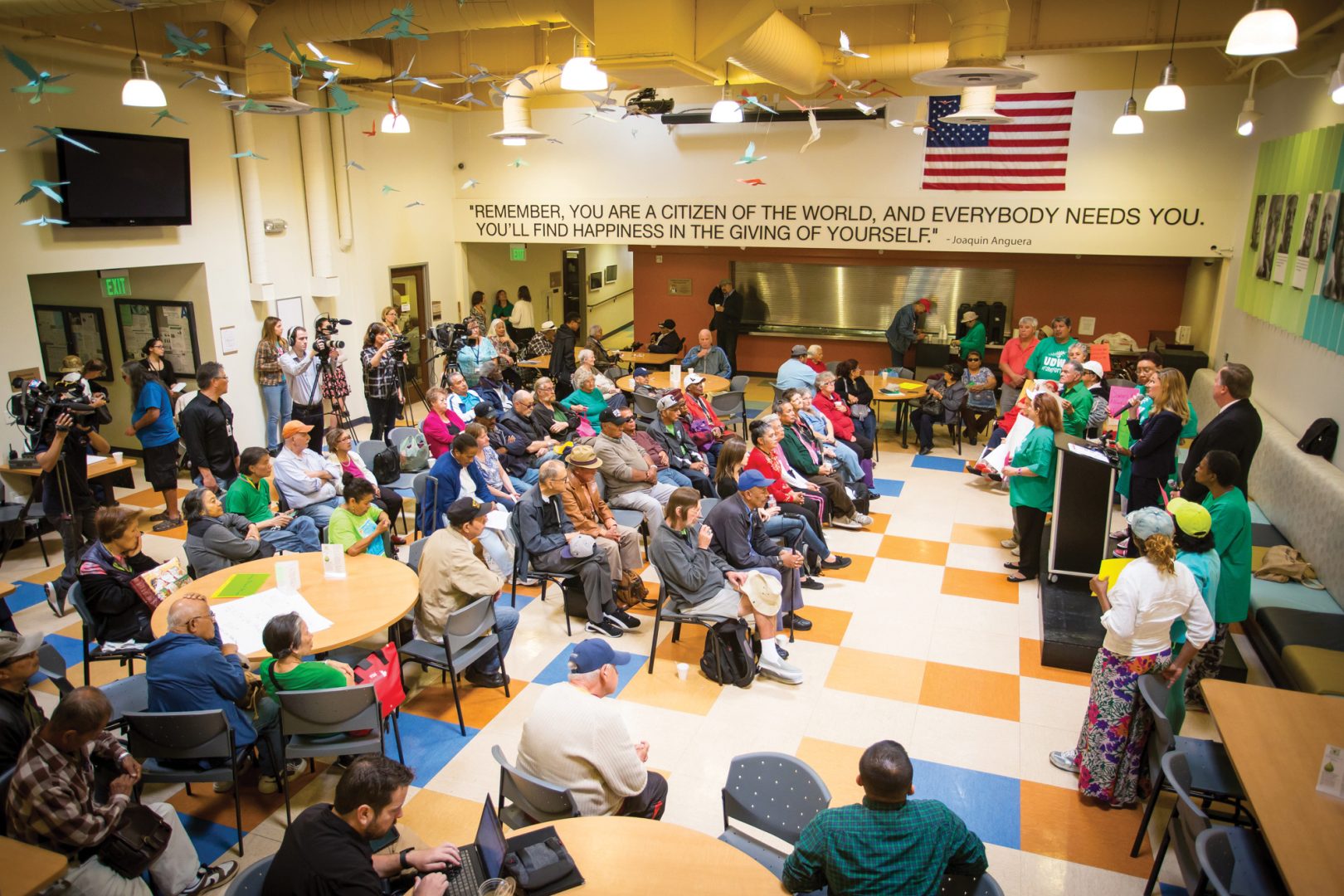
Despite the GOP seemingly lacking the votes to repeal the Affordable Care Act (ACA), ACA isn’t out of the woods just yet. Nor are Medicaid and Medicare.

How do we stay in front of protecting affordable health care for the communities that we serve?

NCRP’s new brief “Foundations, Donors and Health Policy” is a handy resource for grantmakers and donors who are not yet sure how to respond to attempts to un-do recent advances in health equity.

The brief is not just for “health funders.”

“Whether or not your giving focuses specifically on health issues, it is likely that the current federal and state policy proposals and debates have implications for your causes and communities,” writes Lisa Ranghelli, author of the brief and senior director at NCRP.

Do you care about people with disabilities? The elderly? Racial equity? Gender equity? Creating jobs?

Regressive health policies will have an impact on these and other issues.


The guide includes seven concrete and effective actions you can take now to help protect the health and well-being of our communities.


Action #3: Elevate stories of impact

Fund efforts to gather and tell the stories of how federal and state health programs are good for families and communities.

Keep reading


Not a funder?

Then help us get this to the hands of grantmakers and donors so they can start thinking about how to put their money behind the health of our communities.

We can’t afford to stay on the sidelines.

Imagine a world where all families have access to quality, affordable health care and all communities are thriving.

Learn and be inspired by what some funders and nonprofits are already doing to help make this a reality. You can, too.

Jennifer Choi is vice president and chief content officer at NCRP. Follow @jennychoinews and @NCRP on Twitter.


Photo courtesy of SEIU.

Do you remember a time when you prompted a “bless your heart” from a Southern friend, family member or colleague? It’s one of those phrases that packs several sentences’ worth of meaning into three little words. It could mean anything from an expression of sympathy or concern to pointing out well-meaning naiveté.

Earlier this month, I joined my colleagues Jeanné Isler, Stephanie Peng and Ben Barge, along with dozens of Southern funders and grantees in Charleston, South Carolina, for Grantmakers for Southern Progress’ first annual Gathering. The energy in the room was electric – I think just about all of us left South Carolina with a renewed sense of excitement about the South’s potential to change the country and the world in the coming decades. But I was bound to get hit with a “bless your heart” at some point, given all I have been learning from our Southern partners.

I had a whole slew of energizing and productive conversations in Charleston about the best way to utilize the more than 100 interviews NCRP collected during the research process for our new report series “As the South Grows” and how we could continue conversations with Southern and national funders about increasing support for equity and justice.

You’ll be hearing a lot more from NCRP, GSP and our allies over the next six months and beyond about what we heard in the South. For now though, one conversation I had last week stands out. It was the most recent in a handful of examples of when I’ve caught myself doing some of the very things we encourage funders NOT to do when they engage with Southern leaders and nonprofits.

A program officer from one of the Southern funders with whom we’ve been working over the course of the “As the South Goes” research process attended the Gathering. This program officer has been immensely helpful pointing us in the right directions for our outreach and interview processes, and she has two decades of experience in philanthropy in her Southern community. For the purposes of this blog post, let’s call her Rae.

On the last day of the Gathering – all fired up about the sessions and conversations I’d had in Charleston – I saw Rae getting her lunch. I said “hello,” and asked if I could follow her to her table and eat with her; I had some ideas to run by her. I’d gotten in my head over the previous weeks that a peer funder of hers, a foundation in her community, was an important target for our “As the South Grows” campaign.

This funder is relatively large, and there had been talk among NCRP’s staff about how to use “As the South Grows” as an entry point to begin shifting their grantmaking toward greater investments in equity and justice. How could we target this foundation?, I asked Rae. How can we use “As the South Grows” to persuade them to move more money for social justice? How could Rae and her colleagues help us?

Rae chuckled, and said warmly but assertively that I was welcome to waste my time if I wanted. The subtext, as is so often the case when Southerners confront well-meaning Northerners, was something in the area of “bless your heart.” The funder in question was, for the foreseeable future, immovable, Rae added. If we really wanted to punish ourselves we could go ahead, but there were other, better prospects for moving money in her community.

At this point I realized I’d tread down the same problematic path that so many funders and especially national organizations like ours do when they work in the South. I’d come to this expert on her community and on philanthropy in her community especially with a specific agenda in mind and asked her to help do the work. Race played a role too. Rae is a Black woman; I’m a white man. I’ve been conditioned to assume my ideas will be heard and validated, even when they come from a place of inexperience as this one did.

I paused a beat and reoriented myself. I’d gone about this wrong, I said, and I was sorry. I asked Rae what her vision was for philanthropy in her community, and how NCRP and the “As the South Grows” project could plug into and boost that vision. From this point, Rae spoke at length about the foundations in her community who were ready to hear NCRP and GSP’s message – ready largely because of the hard organizing work Rae and her network had put in for years getting them to that point.

If I was willing, Rae and her colleagues would set up conversations with these other funders and bring in NCRP to support their message. Rae had a vision and a plan, and I’m glad I caught myself before I left the conversation without asking her to include us in it.

Probably the most important lesson we hope As the South Grows will communicate to funders is that listening and learning – from both sides of the table – is crucial to sustainable partnerships in the South.

The work of “As the South Grows” is just beginning, and there will be more opportunities for NCRP to walk the talk, so to speak, as we learn and grow into this work in the South. I speak for Jeanné, Stephanie, Ben and myself when I say we left Charleston grateful for the continued grace we’ve been shown by Southern leaders, for the continued opportunity to learn from them and for the “bless your hearts” along the way that let us know when we’ve headed down the wrong path.

Ryan Schlegel is senior research and policy associate at NCRP. Follow @NCRP on Twitter.

Is your foundation prioritizing leaders and organizations that have the trust of the communities you serve? Or perhaps your nonprofit feels that donors simply “don’t get it” and are hindering instead of helping positive change from taking place?

NCRP and Grantmakers for Southern Progress have put together a list of five key Do’s and five key Don’ts for foundations and donors to have the greatest impact in the communities they serve.

You can find these Do’s and Don’ts and other important recommendations in our latest report, “As the South Grows: On Fertile Soil.”

We hope “As the South Grows” inspires you to look at the South as a ripe opportunity for impact and a source for ideas on how to deepen donor investments, collaboration and partnerships wherever you are.

Does your foundation or those in your area invest in the South in ways that promote strong, vibrant communities where all residents thrive?

If not, you’re not alone.

“Many philanthropists choose not to invest in Southern communities or choose short-term opportunities that undermine the long-term capacity of Southern nonprofits. Other funders invest in what they think is ‘safer’ direct service work. While aid to those in need is undoubtedly critical, only investments in systemic change can achieve widespread, deep impact in the region.”

– LaTosha Brown and Aaron Dorfman
in “
Foreword” of As the South Grows: On Fertile Soil


You can do something about this now.

Read the stories of four nonprofit leaders from the Deep South and how they are standing up for the well-being of communities of color, the poor, women, immigrants and other vulnerable populations in NCRP’s newest report As the South Grows: On Fertile Soil.

Like many of their colleagues, these activists face opposition that have considerably deeper pockets in their work for racial, economic and social justice. And oftentimes, they see very little philanthropic support.

We can learn much from these Southern leaders.

“Our new national reality of unified, reactionary, anti-democratic government has been a reality for Southerners off and on for more than a generation. Therefore, national and non-Southern organizations have much to learn from their Southern counterparts.”

– LaTosha Brown and Aaron Dorfman
in “
Foreword” of As the South Grows: On Fertile Soil


Learn about:

We hope “As the South Grows” inspires you to look at the South as a fertile ground for deeper investments, collaboration and partnerships.


Yna C. Moore is senior director of communications at the National Committee for Responsive Philanthropy (NCRP). Follow @ynamoore and @NCRP on Twitter.

Photo by Wendy Ettinger, 2016. Used with permission.

If you’re a regular at NCRP’s blog (If so, thank you!), you probably know by now that most of the country’s largest foundations aren’t giving in ways that maximize the good that their grant dollars can bring.

You saw this play out in Pennies for Progress, where my colleague Ryan Schlegel shared that less than a third of the $236.9 billion in total grants from these funders between 2003-2013 went towards efforts that explicitly benefit the poor, people of color, LGBTQI communities and other vulnerable groups.

And even less – only 10 percent – was given to support efforts seeking long-term equitable solutions to the challenges our communities are facing such as racial injustice, health inequities and poverty.

You saw similar findings in subsequent blog posts about California-, New York– and Michigan-based foundations. There were some bright spots in all three cases, with a number of foundations stepping up for their communities.

So let’s look at Illinois, where you can find 98 grantmakers that made the Foundation Center’s FC1000 list.

% of total grants that explicitly benefit underserved communities 2003-2013

Did Illinois’s largest foundations provide more or less grants to efforts that explicitly benefitted the poor, women and girls, LGBTQI communities and other vulnerable populations?

How does Illinois stack up?

Illinois is home to a vibrant nonprofit community and civically engaged citizens working on a range of issues from boosting quality public schools and ending gun violence in Chicago, and good government and campaign finance reform efforts throughout the state of Illinois. Perhaps the state’s largest foundations bucked the national trend?

Not so. In fact, only 21 percent of the total grant dollars awarded by Illinois’ top foundations explicitly benefitted underserved communities during the same period.

% of total grants that explicitly benefit underserved communities 2003-2013 with Illinois

However, a number of foundations stepped up by allocating at least 50 percent or more of their grant dollars in ways that benefit the state’s vulnerable communities.

Which of Illinois’ largest foundations gave the most share of their grant dollars and total grant dollars for underserved communities from 2003-2013?

Foundation Name Type of foundation Share of grant dollars for underserved Total grant dollars for underserved (US$)
The Oprah Winfrey Foundation IN 72% 28,714,898
Polk Bros. Foundation, Inc. IN 58% 18,276,000
Howard G. Buffett Foundation IN 57% 47,009,119
Michael Reese Health Trust IN 57% 28,154,575
Lloyd A. Fry Foundation IN 45% 34,061,480
The Retirement Research Foundation IN 44% 29,732,982
The John D. and Catherine T. MacArthur Foundation IN 44% 504,130,500
Beatrice P. Delany Charitable Trust IN 41% 29,920,000
The Chicago Community Trust CM 36% 178,251,840
The Joyce Foundation IN 34% 96,517,018
The Allstate Foundation CS 16% 57,033,968
Irving Harris Foundation IN 10% 30,613,584
Circle of Service Foundation IN 6% 42,749,719
Arie and Ida Crown Memorial IN 6% 40,314,613
Based on Foundation Center’s FC1000 data.

Legend: IN=independent foundation; CM=community foundation; CS=corporate foundation


Only one foundation gave more than a quarter of their grant dollars to efforts that seek to long-term solutions to economic, social and environmental injustices.

Which of California’s largest foundation allocated the most share of grant dollars and total grant dollars to programs that sought long-term solutions to social inequities and injustice, 2003-2013?
Foundation Name Type of Foundation Share of grant dollars for systems change strategies Total grant dollars for systems change strategies (US$)
The Joyce Foundation IN 34% 126,021,799
The John D. and Catherine T. MacArthur Foundation IN 23% 267,877,126
The Spencer Foundation IN 19% 20,788,620
The Allstate Foundation CS 16% 22,535,779
Polk Bros. Foundation, Inc. IN 13% 26,028,500
Roderick MacArthur Foundation IN 12% 5,171,169
Lloyd A. Fry Foundation IN 12% 8,922,331
State Farm Companies Foundation CS 11% 14,505,420
Michael Reese Health Trust IN 10% 5,221,632
Irving Harris Foundation IN 10% 13,115,450
The Chicago Community Trust CM 9% 47,099,415
Arie and Ida Crown Memorial IN 6% 9,037,447
Based on Foundation Center’s FC1000 data.

Legend: IN=independent foundation; CM=community foundation; CS=corporate foundation

Were you surprised by seeing The Allstate Foundation, a corporate foundation, make both lists?

In Pennies for Progress, Ryan found that a number of corporate foundations were among the largest contributors to funding efforts that target marginalized communities across the country. They also devoted a higher share of their grant dollars to these efforts.

Check out “Are corporate and community foundations investing in underserved communities?” and “Which types of foundations are giving most to underserved communities” from Pennies for Progress.

What do you think of our findings? Are you astonished (or not) by any of the foundations on this list?

Yna C. Moore is senior director of communications at the National Committee for Responsive Philanthropy (NCRP). Follow @ynamoore and @NCRP on Twitter.

A week ago, Grantmakers Concerned with Immigrants and Refugees issued a powerful joint statement calling on funders to take a stand against President Trump’s executive orders on immigrants and refugees. Since then, 140 foundations have signed on, and NCRP is proud to have signed through the CHANGE Philanthropy network.

For us it’s simple: We believe we’re stronger when we put love before fear and when philanthropy devotes its resources to make that vision a reality. This is also personal for us. These orders target our families, our friends, our board members, our colleagues and our next door neighbors.

It’s personal for many in the philanthropic community. Yet the vast majority of foundations and major donors have stayed silent, with giving unchanged.

If you’re one of these funders and you disagree with the President’s latest actions, let’s consider what’s holding you back. Does it have to do with fear, as David Callahan at Inside Philanthropy suggests? Is it a question of workload or inertia? Maybe you’re unsure how to begin.

I’ve been a staff member at a medium-sized foundation, and I remember all the reasons we have not to act. When you’re in charge of thousands, or millions, of dollars, every step can feel weighted. “What if we make the wrong grant?,” I’d think. What if we say something controversial and someone in power targets our grantees? What if I piss off that board member I don’t see eye to eye with and there goes my docket?

During one of these spirals, a wise grantee reminded me of something blindingly obvious: The stakes we feel in philanthropy, even on our worst day, are nothing compared with the stakes felt every day by a teenager whose parents have been suddenly deported, or a mother struggling to escape a civil war with her child, or an undocumented student who can’t go to college, or a citizen thrown off an airplane for speaking the language they grew up with. It’s nothing compared to a business owner who can’t get a driver’s license, or a domestic worker without basic employment protections, or a young queer DREAMer who bravely comes out twice.

Silence, I know, feels strategic. Today it’s a luxury none of us can afford.

Over the last couple of weeks, I’ve spoken with leaders working on immigrant and refugee rights about their experiences with philanthropy. They include long-time legal service providers and community organizers who just received their 501c3 status. I asked them what they wish philanthropists knew. Here’s what they said:

  1. Now is the time to act. The longer philanthropy holds back, the harder it will be for communities to prepare, to persevere and to fight back.
  2. Resistance is an ecosystem, and all of it needs support. Community organizing and direct action build power, making real change possible. Legal services change lives, offering access for the most vulnerable populations seeking relief. As government actions threaten more families and agency programs get cut, these needs will grow.
  3. Immigration isn’t “one” issue, but a thousand. If you care about education, health, economic development, the arts, the environment – there’s work for you to do here.
  4. There’s no “single immigrant or refugee story.” The narrative includes new arrivals and folks who can trace their heritage back generations; refugees who are black, white and brown; and Jews, Muslims, Christians and more from the Mediterranean, Caribbean, Middle East, Asia, Latin America, Africa and beyond.
  5. Be flexible with your funding. This is not the time for onerous reporting requirements, or hyper-specific program grants. General operating support enables people to work effectively. Future historians will care about whether we all took action, not the percentage spent on “overhead.”
  6. Finally, if you’ve joined the choir, help recruit more singers. Call on your philanthropic peers, privately and publicly, to join you.

Ready to dig in? There’s work to be done. GCIR has tons of great resources to help you start, as does NCRP. Your dollars and your actions have more influence than you think. Now is the time to use them.

Ben Barge is senior associate for learning and engagement at NCRP. Follow @NCRP on Twitter.

California is a philanthropy powerhouse in its own right, with 256 of the country’s largest foundations calling it home.

The state is also a leader in many progressive efforts such as minimum wage, universal access to quality health care and immigrant rights.

Recently, we looked at New York’s and Michigan’s largest foundations and found that the majority gave less than half of total grant dollars to programs that directly benefit underserved communities from 2003-2013. Also, in both instances, only a fraction of these foundations supported efforts to engage these communities in solving pressing social problems.

Is California any different?

Sadly, it is not, according to my colleague, Ryan Schlegel. Ryan, who wrote NCRP’s Pennies for Progress report, once again looked at Foundation Center’s FC1000 to find that only 22 percent of the $35.7 billion in total grants from these funders went towards supporting efforts that explicitly target people of color, LGBTQI community, domestic workers and other vulnerable populations.

However, some of these foundations stepped up by allocating at least 50 percent or more of their total grant dollars during that period in ways that benefit these communities.

Foundation Name Share of grant dollars for underserved Total grant dollars for underserved
Craig H. Neilsen Foundation 96%  $              54,281,713
The Christensen Fund 87%  $               7,929,370
The California Wellness Foundation 84%  $           399,073,000
Phoebe Snow Foundation 81%  $            109,905,631
The California Endowment* 79%  $        1,030,259,687
Levi Strauss Foundation* 76%  $              24,192,174
Blue Shield of California Foundation* 70%  $            193,181,798
Evelyn and Walter Haas, Jr. Fund* 69%  $            214,292,802
California Community Foundation* 67%  $             96,740,764
Weingart Foundation 67%  $            251,762,166
Wells Fargo Foundation 55%  $            389,512,789
Based on Foundation Center’s FC1000 data.


Likewise, a number of these large foundations gave 25 percent or more of grant dollars in support of work that seeks long-term equitable solutions such as through advocacy, community organizing and other strategies.

Which of California’s largest foundation allocated the most share of grant dollars to programs that sought long-term solutions to social inequities and injustice, 2003-2013?
Foundation Name Share of grant dollars for systems change strategies Total grant dollars for systems change strategies
Sea Change Foundation 58%  $          96,904,350
Evelyn and Walter Haas, Jr. Fund* 56%  $        173,382,494
Phoebe Snow Foundation 50%  $          67,525,456
Omidyar Network Fund, Inc. 46%  $          59,030,016
The James Irvine Foundation 41%  $        285,748,808
The Christensen Fund 36%  $             3,271,600
Stuart Foundation 35%  $          56,877,418
Sierra Health Foundation 35%  $             7,596,895
The California Endowment* 34%  $        443,535,694
Wallace Alexander Gerbode Foundation 33%  $             7,947,772
Based on Foundation Center’s FC1000 data.

*The foundations highlighted above are recipients of the NCRP Impact Awards.

Surprised to find Wells Fargo Foundation on the list of top givers to underserved communities, considering the bank’s role in the collapse of the real estate market?

Interestingly, Ryan found that a number of corporate foundations were among the largest contributors to funding for marginalized communities across the country. Check out “Are corporate and community foundations investing in underserved communities?” from Pennies for Progress.

Additionally, Ryan noted in Pennies for Progress that “Between 2003 and 2013, corporate grantmakers surged ahead of their independent counterparts when it came to their share of grant dollars devoted to benefitting underserved communities.” (Check out “Which types of foundations are giving most to underserved communities.”)

What do you think of our findings? Are you surprised (or not) by any of the foundations on this list?

Yna C. Moore is senior director of communications at the National Committee for Responsive Philanthropy (NCRP). Follow @ynamoore and @NCRP on Twitter.

Michigan has some of the country’s largest and well-known foundations. A number helped Detroit climb out of bankruptcy through the “Grand Bargain.”

So I asked my colleague, Ryan Schlegel to look at Foundation Center’s FC1000 data that was the basis of NCRP’s Pennies for Progress report to identify which of Michigan’s largest foundations gave most to underserved communities and social justice. (Last week, we looked at New York’s largest foundations.)

Underserved communities and finding long-term systemic solutions were not priorities

Michigan’s 66 foundations that are considered among the country’s largest gave more than $10.3 billion in total grants for U.S.-based programs from 2003-2013.

Only 31 percent of this amount went towards programs that directly benefit the lower-income people, people of color or other underserved populations hit hard by the recession. Less than a handful of the state’s largest foundations gave 50 percent or more of their grant dollars during the period.

Support for advocacy, community organizing and other efforts that engage citizens to come up with long-term solutions to systemic injustices and inequities were even lower, with only two foundations giving 25 percent or more.

Which Michigan-based foundation gave the most in support of underserved communities, 2003-2013?
Foundation Name Share of grant dollars for underserved
Manoogian Simone Foundation 79%
The Skillman Foundation 60%
Charles Stewart Mott Foundation 57%
W. K. Kellogg Foundation 55%
McGregor Fund 43%
Fremont Area Community Foundation 35%
The Kresge Foundation 34%
Kalamazoo Community Foundation 33%
Comerica Charitable Foundation 33%
Ruth Mott Foundation 31%
Based on Foundation Center’s FC1000 data.


Which Michigan-based foundation gave most to find long-term solutions to social inequities and injustice, 2003-2013
Foundation Name  Share of grant dollars for systems change strategies
The Skillman Foundation 36%
W. K. Kellogg Foundation 32%
Charles Stewart Mott Foundation 18%
Earhart Foundation 10%
The Kresge Foundation 9%
General Motors Foundation, Inc. 8%
Ford Motor Company Fund 8%
DTE Energy Foundation 7%
The Chrysler Foundation 7%
McGregor Fund 6%
Based on Foundation Center’s FC100 data.

However, there were some improvements during the period studied. The Kresge Foundation “has moved 180 degrees from risk avoidance to risk pursuit,” which has put it on “a path toward achieving significant impact in underserved communities,” according to our 2015 Philamplify report on the foundation.

The big picture

Don’t forget to check out Pennies for Progress: A decade of boom for philanthropy, a bust for social justice for national-level findings and analyses.

What do you think of our findings? Are you surprised (or not) by any of the foundations on this list?

Yna C. Moore is senior director of communications at the National Committee for Responsive Philanthropy (NCRP). Follow @ynamoore and @NCRP on Twitter.

Last year was a challenging, and at times unbearable, year for marginalized members of our community. Dec. 12 marked the six-month anniversary of the devastating tragedy at Pulse nightclub in Orlando targeting LGBTQ people of color – a moment that left many shell shocked, traumatized and in a state of uncertainty.

Those feelings resurfaced the morning after the elections. The same people that the Pulse shooting targeted, our Latinx and undocumented families, friends, neighbors and their loved ones, and all those that suffered from the effects of xenophobia, Islamophobia and racism that were promoted on the national stage and spread into our local community, are left wondering what will become of their lives come Jan. 20.

As we prepare for the challenges ahead for the people that mirror those from the Pulse tragedy and their families living with anxiety and insecurity in an America where hate speech and violence have been normalized, we reflect on the lessons we’ve learned from that moment when leaders in philanthropy and the community unified following the Pulse tragedy to thoughtfully support those most deeply and directly impacted on their long journey of healing and empowerment.

The Contigo Fund, an initiative of Our Fund Foundation, was born out of that need and purpose. Because a national coalition of foundations – including the Ford Foundation, the Open Society Foundations, the W.K. Kellogg Foundation, the Arcus Foundation, the Annie E. Casey Foundation, the Robert Wood Johnson Foundation, the Executives’ Alliance to Expand Opportunities for Boys and Men of Color and Our Fund Foundation – stepped forward to be responsive to the communities most directly impacted, an often underserved community has critical resources necessary to support the most marginalized and oppressed as they recover and in anticipation of the challenging days ahead.

Following the tragedy, a team of representatives from foundations, in partnership with members of the local community, teamed up to carefully conduct a philanthropic community needs assessment interviewing local philanthropic and nonprofit leaders and, most importantly, members of the community who were directly and deeply affected by the tragedy.

The assessment provided us perspective on conditions prior to and following the Pulse massacre, recognizing the longstanding institutional inequalities that existed before the shooting, and were terribly exacerbated by the shooting, as well as the significant disparities communities of color in Florida face. Through extensive community feedback, the Contigo Fund was born with a vital purpose and developed principles and goals to guide its efforts.

Guiding Principles:

  • We honor the identities and lived experiences of those taken from us. A majority of those affected were of Latinx and African diaspora backgrounds. Some were undocumented. More than half were under 30, with the youngest victim being just 18.
  • We recognize the significant disparities faced by our communities shaped by longstanding institutional inequalities. We will work to address these disparities.
  • We trust that transformative and lasting change can occur if communities unify. The fund seeks to build bridges across Central Florida’s diverse communities and to raise awareness of homophobia, transphobia, Islamophobia, racism and other forms of bigotry that divide our communities.

Three Main Goals:

  1. Support the efforts of those that were predominantly impacted by the Pulse tragedy, including advancing the causes of our communities and particularly efforts led by and for by leaders who represent our communities.
  2. Strengthen Central Florida by building bridges among its diverse and marginalized communities.
  3. Address the ripple effects of the Pulse tragedy, particularly involving issues of Islamophobia, xenophobia and racism.

To accomplish our goals, we prioritized identifying authentic leadership from the local community that could work with Our Fund Foundation and the community to lay the groundwork to thoughtfully create a community-led participatory grant making model.

In addition, we determined, based on our on-the-ground assessment, that we needed to develop a process for proactive grantmaking to sustain a relatively small number of emerging groups and key organizations while we develop a more robust grant distribution program driven by the local community.

We quickly developed a rapid response fund as an emergency fund supporting emerging leaders, groups, organizations and coalitions. The focus was to help grow and sustain these emerging, nascent efforts that did not exist prior to the tragedy due to the scarcity resources.

We determined that we would identify and recruit a Grant Committee of 12 extraordinary leaders to guide the distribution of the grants and that it would be made up of leaders from the local community and include those most impacted by the tragedy. Seventy-five percent of the members are LGBTQ people of color with representation from the Latinx, Black, transgender, undocumented and immigrant communities. Through their input we established the grant committee’s purpose, goals and structure, and the scope of the request for proposals application and decision-making process for a more robust grant distribution.

Our experience holds various lessons learned and best practices of how national funders can positively show up in Southern communities. We have developed an innovative model that is community-driven, intersectional and focused on long-term impact and on healing a community wounded by a tragedy that includes several unique components:

  • A participatory grantmaking model in which members of the communities most impacted by the tragedy drive decisions.
  • Rapid response funding that provides flexible support for organizations to facilitate community healing and recovery.
  • A capacity-building strategy that works to assure that the response to the tragedy is not only short-term but also fosters a sustainable infrastructure for social change and empowerment of the region’s marginalized communities.

Orlando’s philanthropic efforts are a model on how funders can proactively and thoughtfully respond to a tragedy and work to rebuild and meaningfully transform a fractured community following a crisis by centering those most affected and those most likely to be left out of the conversation and decision-making process.

Marco Antonio Quiroga is the program director at Contigo Fund

The Funders Concerned About AIDS conference last month was both inspiring and sobering.

I was encouraged to learn that HIV-related grantmaking grew 10 percent from 2014 to 2015, outpacing overall foundation giving. Long-term investments in syringe access programs have helped reduce the incidence of HIV infections caused by dirty needles from one in three, to one in 10 new infections. Yet the ongoing needs for such support far outstrip the resources available from the Syringe Access Fund.

I was excited to hear the Obama Administration’s first out transgender person to serve as the White House’s LGBT liaison, who convened trans women of color to hear their concerns. On the other hand, I also learned that trans and LGBT immigrants held in detention by Obama’s Immigration Control and Enforcement bureau (ICE) – after fleeing violence and discrimination in their home countries – are reportedly experiencing harsh and unsafe conditions.

For better or worse, HIV and AIDS were under the radar of the major party candidates during the election, escaping the media glare. Yet the Affordable Care Act (ACA), which was very much the subject of political debate and will most likely be repealed by the incoming Congress, has enabled at least 90,000 people living with HIV to get health coverage. The ACA forbids insurers from denying coverage due to pre-existing conditions, a crucial provision not only for people with HIV/AIDS but also for transgender individuals, for whom transitioning has been considered a “pre-existing condition.”

And women are at serious risk if the ACA is repealed and/or Medicaid is targeted for cuts. A speaker reported that currently one in five women receives health coverage through Medicaid. For women of color the proportion is even higher.

It was inspiring to learn that government health programs, hard won by advocacy, combined with innovative foundation-funded nonprofit programs, have helped curb HIV infections and increase access to health care. That this could all unravel in the next few years is dispiriting.

Yet the FCAA conference left me hopeful for several reasons, and I urge others in philanthropy to similarly draw inspiration:

1. Many speakers emphasized the intersectionality of their work and relationships. Even government agencies are coordinating more among themselves. Unity and collaboration will be essential to challenging and weathering any attacks on the health care safety net.

2. HIV/AIDS advocates and funders are clear-eyed, creative and bold. This is a tight knit community that had to fight just to have the very existence of this ravaging disease be acknowledged, that has long demanded government and private sector action but didn’t wait for it to come. As one speaker said, “There is no box” anymore; the new policy environment will require bravely thinking and acting outside the box.

3. Today women of color, trans leaders and marginalized LGBTQ individuals, such as formerly incarcerated, are some of the strongest voices for change. And FCAA is one of the few funder conferences to be so inclusive of these historically disenfranchised constituencies. All of philanthropy will need to partner with and support grassroots leaders to build inclusive, powerful movements that can fight for justice in the coming years.

FCAA has already formed an advocacy network in response to the new political landscape, and its first webinar is on January 30th. What are other affinity groups doing to help their members keep up with policy developments and take action? Let us know in the comments section or on Twitter.

Lisa Ranghelli is senior director of assessment and special projects for the National Committee for Responsive Philanthropy. Follow her on Twitter and see her and other live tweets of the FCAA conference on Storify.