In our recently released summer edition of “Responsive Philanthropy,” I wrote about why W.K. Kellogg Foundation (WKKF) believes racial healing can transform the nation and how WKKF is attempting “…to acknowledge the wrongs of the past, while addressing the consequences of those wrongs” through its Truth, Racial Healing and Transformation (TRHT) effort.

The story focused on how leaders in Buffalo, Dallas and Louisiana are implementing TRHT. Chicago is another of TRHT’s 14 sites that sees unique opportunities in this model.

Grace Hou, president of Woods Fund Chicago, believes that TRHT will lead to a change in the outcomes for people of color in the region. Woods Fund has long been committed to prioritizing racial equity, as have their TRHT partners. Terry Mazany of Chicago Community Trust, Angelique Power of Field Foundation and Grace leveraged their relationships to quickly build a 16-person coalition to implement TRHT, and everyone they asked said yes. Grace observed that there is so much despair related to the impact of race on policies and people, and the audacity of this goal represents hope.

I was struck by the powerful cohesion among the coalition that attended the WKKF’s TRHT summit in December 2016, but Grace noted that some of the members who attended had never met before. The convening provided an opportunity to practice and bond using the head and heart model that reflects the pillars of narrative change and healing. The experience changed the way that Grace looked at racial equity work; as a former public policy servant she focused on the data, but didn’t always bring enough of her own vulnerability to the work. She said, “Digesting our own roles and figuring out how others can be brought to the table is important.” Now she believes that engaging the head and the heart can capture people who understand the data, and compel them to commit to the marathon of addressing structural racism.

The “Travelers,” as the coalition calls itself, met in January with other Chicagoans in the WKKF network. They did a healing circle to establish a strong relationship among themselves, and then worked together to host a city wide day of healing on April 4th with about 150 people. Now, with the TRHT grant they are hiring staff to coordinate design teams for narrative change, racial healing, and law and policy. Grace noted that it can be risky for a private foundation to lead a process that requires such vulnerability, but it is worth the risk.

Despite the optimism surrounding THRT from grant recipients in the 14 sites, each person acknowledged serious obstacles. One criticism is that TRHT, and specifically “racial healing,” is not systemic. Grace noted that she and others from Chicago were skeptical at the beginning of the summit with the framing of healing. But she believes that everyone who experiences healing circles can immediately understand their value. Now she, her colleagues in Chicago and leaders in the other sites are committed to supporting and modelling the healing practices that have the potential for lasting transformation in our communities.

How does your institution explore the risks of vulnerability and collaboration in your practices and grantmaking? How have you incorporated an honest acknowledgement of historical wrongs in your work? Share with us and your peers on Twitter and Facebook.

Jeanné Isler is NCRP’s vice president and chief engagement officer. Follow @j_lachapel and @NCRP on Twitter.
How can funders make their grantmaking more transparent and inclusive while tackling the unequal power dynamic in philanthropy?

With more and more conversations around equity taking place in the sector, community-led grantmaking has proven to be a powerful way to address inequity from within, and in the process, center community members who are most marginalized.

To delve into the “how” of this democratic approach, in late August NCRP co-hosted Pass the Reins: Shifting Decision-Making Power in Philanthropy with the Indie Philanthropy Initiative, Grassroots Grantmakers and GrantCraft, a service of Foundation Center. Below is a recap, along with the video recording of the entire webinar.

Four different models

Moderated by Jennifer Near, general coordinator of the Building Equity and Alignment for Impact Initiative, the webinar featured speakers from four community-led grantmaking models:

  • Maria De La Cruz, associate executive director at Headwaters Foundation for Justice
    Headwaters’ funding model places community leadership at the center of the grantmaking process, recognizing that collective impact requires collective learning and mutual investment. Minnesotans who are on the front lines of social justice are trusted to guide the foundation’s decision-making. The foundation also participates in
    The Giving Project. Its most recent cohort of 20-25 residents raised more than $200,000 over six months, which was then disbursed as two-year grants to nine organizations.
  • Theresa Trujillo, community partner for southeast Colorado at The Colorado Trust
    Through its Community Partnerships grantmaking initiative, The Colorado Trust seeks to encourage and strengthen community-led solutions and funding initiatives to advance health equity. The foundation has embraced a unique staff model by shifting from “program officers” to “community partners” to build strong partnerships in six regions across the state and help organize, encourage and empower resident-led initiatives.
  • Liane Stegmaier, vice president of communications and strategies at Brooklyn Community Foundation
    Following its innovative community engagement project, Brooklyn Insights, the Brooklyn Community Foundation launched a resident-led investment program called Neighborhood Strength to empower local changemakers in the Crown Heights neighborhood. The initiative brings together community members to identify and direct funding to solutions that target significant local challenges. The foundation hired an experienced community organizer to facilitate the process, including three visioning sessions and the creation of a 17-member advisory council.
  • Cortez Wright, activist grantmaking advisory panelist at the Third Wave Fund
    Third Wave Fund’s gender justice grantmaking approach centers young women of color, queer and trans youth of color, and allows their vision to take center stage. Its Activist Grantmaking Advisory Panel plays a major role in deciding which emerging gender justice organizations will receive long-term funding and technical assistance through the Grow Power Fund. More than 100 people from across the country applied to serve on the panel, and six were chosen and compensated for their role. In 2016, the inaugural members awarded multi-year support to six groups.

The conversation was particularly salient given the rising tide of neo-Nazism and white nationalist violence in our country. As NCRP’s chief executive Aaron Dorfman recently wrote in response to the events in Charlottesville, it’s vital that funders use their grant dollars to bolster grassroots groups and protect threatened communities, on those communities’ terms.

For additional context, Jennifer shared:

“White supremacy is not just about extremism and violence … it’s about control and the expectation that some of us earn the position to broker and determine social change and how resources flow on behalf of others. If we’re genuine about wanting to shift the legacy of systemic and historical racism in this country and confront white supremacy, then we need to be serious about who has voice, agency and control over how resources are allocated.”

Shared learnings

In the discussion, the speakers shared lessons, benefits and outcomes from their approaches to community-led grantmaking. They emphasized the importance of active recruitment, trust-building, compensation, language access, evaluation and a commitment to difficult conversations.

The audience was also invited to weigh in on what’s needed to activate and expand participatory grantmaking in the sector. Among the 130 attendees who participated in the poll, the top answer was “political education for board an executive leadership.”

What resources and other funding models inspire you to shift power and democratize the control of resources in philanthropy?

Keep the conversation going on Twitter using #ShiftPower, and share your questions and stories with GrantCraft for the participatory grantmaking guide that’s in development! View the webinar recording and contact Jen Bokoff at jen@foundationcenter.org to learn more.

Caitlin Duffy is senior associate for learning and engagement at the National Committee for Responsive Philanthropy (NCRP). Follow @NCRP and @DuffyInDC on Twitter.

What movement do you feel most passionate about? Health? Education? Environment? Criminal Justice? LGBTQ? What does that movement need in order to flourish? How do you think philanthropy can help?

We need you to tell us what NCRP, and foundations and other funders can do to support these movements in the near-term and during the next 10 years.

One of the goals of NCRP’s new strategic framework is:

“Over the next 10 years we want to ensure that social movements – especially those led by the people most affected by disparities and inequality – have the philanthropic resources they need to win significant victories that make our society fairer and more just and democratic.”

There are differences among the many movements working to address inequities and injustice in specific issue areas such as health, education and environment.

Join us in this conversation.

Tweet us @NCRP, post on our Facebook page or email us at community@ncrp.org.

To learn more, check out our #MovementMoney launch video.

Jack Rome is communications intern at NCRP. Follow @NCRP on Twitter.

Image by Mark Dixon. Used under Creative Commons license.

Is your foundation investing in a diversity of assets across the communities it serves? Does your organization struggle to get funding because of perceived capacity restraints?

In our first As the South Grows report, “As the South Grows: On Fertile Soil,” NCRP and Grantmakers for Southern Progress revealed five key Do’s and five key Don’ts for how foundations and donors can invest in existing capacity to build power in the communities they serve.

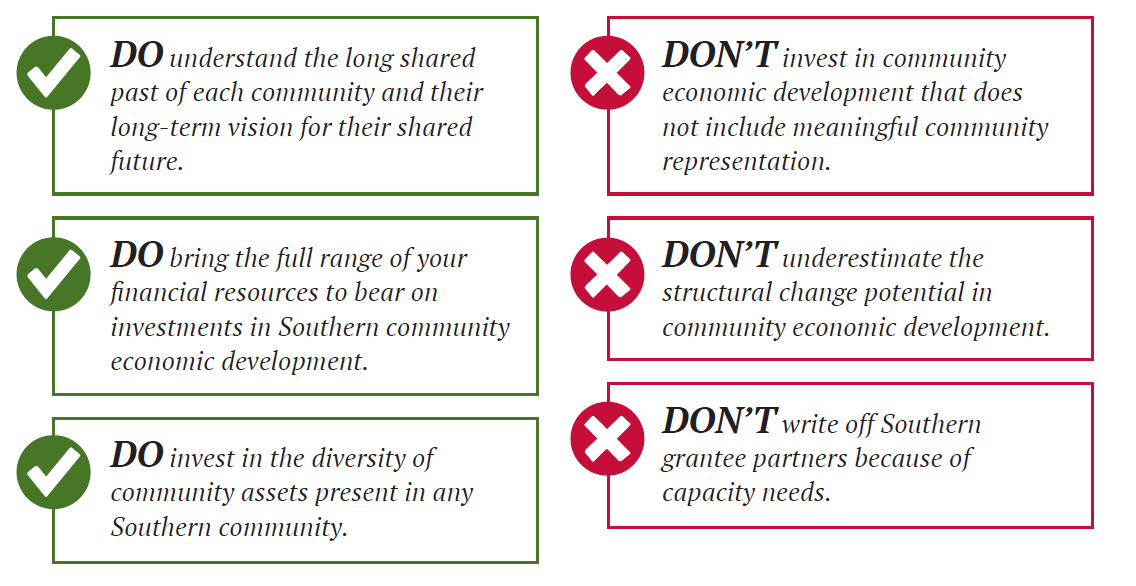
The second and latest As the South Grows report, “As the South Grows: Strong Roots” unveiled three additional Do’s and three additional Don’ts to help foundations and donors build wealth in local economies.

DOs and DONTs
We hope the As the South Grows series inspires you to take a serious look at investing in wealth- and power-building in Southern communities.

As the South Grows: Strong Roots coverDo you work at or with a national foundation investing in systemic change? Does your program include wealth- and power-building in the South? If not, your efforts may not bring sustained change.

Our latest report, “As the South Grows: Strong Roots,” details how foundations can make lasting investments in wealth-building in the South. It profiles six community, foundation and nonprofit leaders in the South, specifically the Coal Country of Kentucky and the coastal Lowcountry of South Carolina, to highlight opportunities for foundations and philanthropists to build Southern wealth by investing in local assets and capacity.

As Karen Watson of the Positive Action Committee said in our recent webinar on philanthropy in the South, as long as the South is underfunded, regressive policies will take root in the South and then spread nationwide. 


Learn about:
  • Six community leadersSix Southern leaders working to increase local assets and capacity, and protect existing ones.
  • Three Do’s and Three Don’ts for grantmakers interested in investing in wealth- and capacity-building in the South.
  • Four tips funders can take to get started with engaging with and investing in equitable economic development in Southern communities.

As the South Grows: Strong Roots” is the second report in the five-part As the South Grows series. The third report will be released in the fall.

We hope “As the South Grows” inspires you to look at the South as an important opportunity for deeper engagement, investment and partnerships.


Jennifer Choi is vice president and chief content officer at National Committee for Responsive Philanthropy (NCRP). Follow @jennychoinews and @NCRP on Twitter. 

“How do we respond to our new political and social reality?” Many in philanthropy are grappling with this question at this very moment.

Some foundations have taken bold steps in providing much-needed funding to groups working on the ground to mobilize and organize communities against harmful policies. More are either still trying to figure out what to do or are opting to take a wait-and-see approach. But there is an urgency for grantmakers to get involved.

“Time and again in our nation’s history, philanthropy has demonstrated its power and potential to help solve urgent problems and ensure that this country lives up to its democratic ideals,” writes Aaron Dorfman, president of the National Committee for Responsive Philanthropy (NCRP), for the group’s journal “Responsive Philanthropy.” “Now could be another of those times.”

The spring edition of “Responsive Philanthropy” highlights some of the different ways that funders can make a difference in communities and issues they care about.

Can philanthropy help rebuild trust in news and the public square?

Josh Stearns, an associate director at Democracy Fund, writes about the prevalence of misinformation and why it’s important for our country to reclaim “truth” and regain trust in our democratic institutions, including the press. He shares some of the innovative trust-building efforts underway and how grantmakers can support them.

In today’s complex and uncertain times, philanthropy associations and networks are more vital than ever

Forum of Regional Associations of Grantmakers chief executive David Biemesderfer highlights the various leadership roles of associations, affinity groups and other philanthropic networks. For example, he writes that these organizations can help foundations in getting more involved in policy and advocacy “while learning from experts and sharing with colleagues within a critical state and local context.”

Long-term general support: The elusive Bigfoot in philanthropy

Nonprofits across the country, especially those fighting the resistance, continue to need long-term, general support. Yet these grants are nearly as rare as the mythical Bigfoot. So NCRP asks its nonprofit members: “Why do you think funders shy away from awarding flexible, multi-year grants?” And how would they respond to these concerns?

Rebuilding the middle: How United Ways and foundations can get in the fight to bring communities together

Pete Manzo, chief executive of United Ways of California, believes that it is possible and important to find common ground to ensure that our communities to thrive. Philanthropy has an important role to play, he says, such as by advocating for policy changes “that can increase the odds of success for the people and communities we serve.”

Funding change in the Deep South

There’s a need for more philanthropic investments in the South. Bill Bynum, a board member of NCRP, shares lessons for foundations based on his experience leading HOPE, a Mississippi-based community development credit union serving families and businesses in the region.

Member Spotlight: The Economic Policy Institute

EPI, based in Washington, D.C., aims to “inform and empower individuals to seek solutions that ensure broadly shared prosperity and opportunity.” Members of its Economic Analysis and Research Network (EARN) in 43 states produce research and conduct policy advocacy at state and local levels to improve the economic security of low- and middle-income working people.

Responsive Philanthropy articles are available at no cost on NCRP’s website. NCRP members receive hard copies for free.

Let us know what you think of these stories in the comments or on Twitter @NCRP.

In a beautiful display of Southern hospitality, all of the nearly 150 attendees of the Grantmakers for Southern Progress (GSP) gathering in Charleston, South Carolina, in April were asked to introduce themselves and name the place from which they or their families hail. Normally a tedious task, it struck me how many people in the room either once lived in the American South or readily cited the strands of their family that called this region their home.

While the South is not a monolith, the room glowed with a shared sense of what it meant to be in this place at this time in our country’s history. If nothing else, perhaps it was LaTosha Brown’s, GSP’s Coordinator, warm response to each person, “Welcome, we are glad to have you!”

Listening to everyone’s lineage grounded my own roots in the South (having grown up in Tennessee), and further ignited my passion in the Solutions Project Southern grantmaking portfolio. The customs, mannerisms, identity and values that I learned; the family trips to the Gulf Coast, Smoky Mountains and Atlanta; and even lyrics to the state song, “Rocky Top Tennessee” would be drawn upon as I helped launch Solutions Project’s Southern portfolio.

When Solutions Project’s grantmaking team first discussed the potential to extend our mission of 100 percent clean energy for 100 percent of the people to the South, we received the proverbial side eye. Concerns about potential impact, capacity and ability to “win” quickly arose.

Even in the face of significant life-costing and wealth-draining disasters, the South has not been terribly friendly to climate and clean energy policy. In the aftermath of the presidential election, many national funders are also being reminded of the political, social and cultural power of the South. Recognizing this power, we decided to invest in the region through a process that allowed us to unpack our assumptions, ground our values and analyze the research in the As the South Goes report.

For example, our Fighter Fund rapid response grantmaking program supports grassroots and frontline groups fighting for climate justice. Additionally, we have resourced community rooted leaders who are organizing a strong resistance and serving as a force for justice.

In partnership with other local and national funders, we’ve provided hundreds of thousands of dollars in multi-year general operating commitments and supported the emergence of regional collaboratives that are centering equity, such as the Advancing Equity and Opportunity initiative. We’ve already seen the impact of these modest, yet flexible and powerful resources. Our funding in the South is by far some of our most interesting and rewarding work.

The National Committee for Responsive Philanthropy’s As the South Grows report shows funding in the South is urgent, impactful, beautiful and necessary, along with validating the dynamics the Solutions Project has experienced. Already we’ve seen the following reflections:

1. Value Deep Relationships: Growing up in the South, I learned the adage, “it takes three dinners to get anything done.” It’s amazing how handy this nugget has been to our work and a refreshing change of pace. For those funders interested in expanding to the South, be ready to spend time in community and to open your heart to developing deep connections with others.

2. Understand Capacity and Recognize Strength: One myth that continues to plague the region is a belief that there is a lack of capacity for progressive work. I want to challenge the notion of capacity (i.e. expectation to execute) and juxtapose it to strength (i.e.. power and unique position to make progress or resist). The region shows strength and resilience despite longtime philanthropic disinvestment, with thoughtful work occurring in a number of states. Where would the South be if groups hadn’t resisted the dangerous policies of many legislators and governors? The Civil Rights Movement was born in the American South and now is the opportunity to support another major movement. Now is the time to move beyond concerns of capacity as defined by a formal nonprofit management education and instead build the strength of those working to create a just and sustainable future.

3. Challenge Your Definition of Risk: Whereas the path to progressive policy victory in blue states may seem clearer, funding in the South can be categorized as “risky.” However, the South provides a space to explore how those same policies can be applied in more politically polarized contexts. We have the opportunity to expand the definitions of impact and success to include deeper, richer nuances of the work. At the Solutions Project, those nuances make us smarter and more thoughtful in our funding roles elsewhere in the country.

In her closing remarks at the GSP gathering, Lavastian Glenn, program director at the Mary Reynolds Babcock Foundation, rightly described their funding as “legacy work,” which resonated in many ways. For Solutions Project, our Southern strategies will be a core part of the legacy we leave with both our grantee partners and other funders who come to the region inspired by our actions.

If Solutions Project did not begin funding in the South, our strategy to accelerate the transition to clean energy would be missing critical pillars. For me, it’s a personal legacy that desires to support a part of this country that has given me so much and is immensely important to our national politics. For those looking to be bold and grow in this political moment, I invite you to support the American South. “Welcome, we are glad to have you!”

Tyler Nickerson serves as the director of investments and state strategy at the Solutions Project. Follow @tylerwnickerson on Twitter.

Photo by Khanrak, used under Creative Commons license.

Will history look favorably at philanthropy’s efforts to protect and promote equity during the Trump Administration?

Attendees of the Northern California Grantmakers Association’s annual conference were treated to a rousing debate over this very question. The panelists were a group of inspiring and passionate leaders from the sector: Cathy Cha of the Evelyn and Walter Haas Jr. Fund, Jacqueline Martinez Garcel of Latino Community Foundation, Lateefah Simon of Akonadi Foundation and NCRP’s Aaron Dorfman.

The verdict from the nearly 400-person audience was a resounding “No.”

If you missed it or would like to relive the experience, NCG recently posted a video of The Great Debate on its website.

Many commentators, including NCRP and various authors we’ve featured on this blog and our journal, have penned articles about what the foundations and the whole sector should do in this current moment.

And indeed, Aaron and Cathy shared during the debate how a number of foundations have stepped up in their leadership and commitment to vulnerable communities. But, as Jacqueline and Lateefah highlighted, there are many ways that the sector is still falling short of its potential for impact.

A time for soul-searching

In The Chronicle of Philanthropy, Cathy, Jacqueline, Lateefah and Aaron invited foundation leaders to look inward and ask themselves: Is my foundation responding appropriately? Is it doing enough? How can we challenge ourselves to do more?

They offer five guiding questions, among them:

  • Are we dedicating serious money so grantees have the resources they truly need?
  • Are we investing in building the power of people of color and women?
  • Are we moving money quickly?

And NCRP’s Jenny Choi encouraged grantmakers to be “bold, thoughtful and inclusive” in a Center for Effective Philanthropy blog post.

What do you think?

I hope you’ll check out these thoughtful resources and share with us your own ideas for what effective, high-impact philanthropy looks like in these times.

Yna C. Moore is senior director of communications at NCRP. Follow @ynamoore and @NCRP on Twitter.