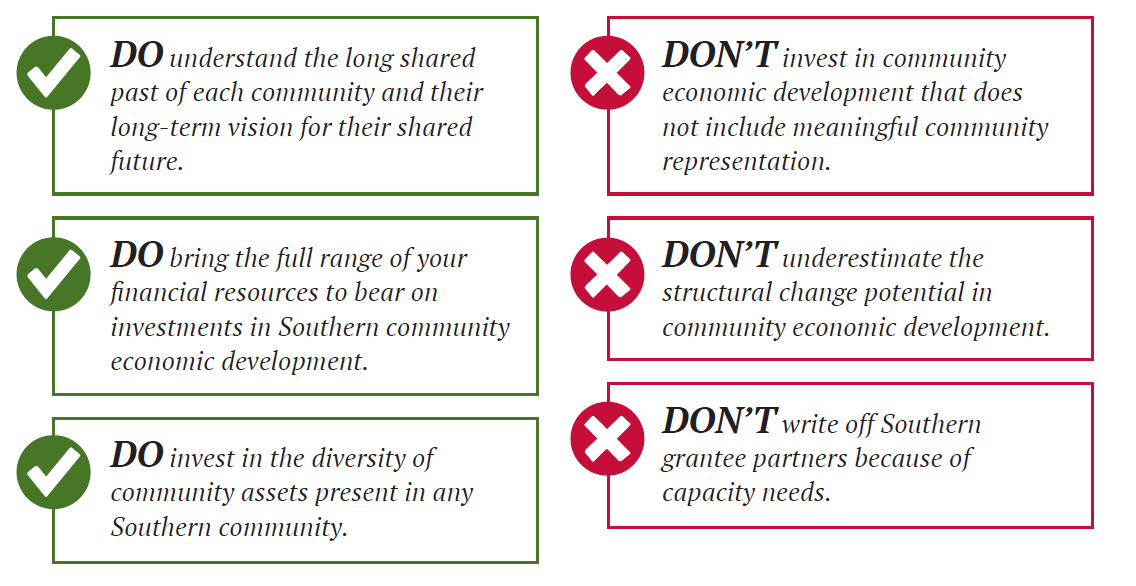
6 (more) do’s and don’ts for foundations and donors
Is your foundation investing in a diversity of assets across the communities it serves? Does your organization struggle to get funding because of perceived capacity restraints?
— Schott Foundation for Public Education (@SchottFound) June 28, 2017
How can foundations support communities to build wealth that is protective of local culture? Read @NCRP report: https://t.co/kNmKN7Jkgh
— Marguerite Casey Foundation (@CaseyGrants) June 30, 2017
As grantmakers show increased interest in funding Southern partners, it’s important to ask: What’s different about relationship-building and racial justice work in the American South? How can national funders be responsive and impactful in operationalizing their desire to support the region?
Recognizing that the South is already home to a strong ecosystem of people-of-color (POC)-led philanthropic institutions that can help drive resources for racial and social justice, on June 14th NCRP co-hosted “The Color of Philanthropy: Southern Leaders, National Potential” with ABFE, the Southeastern Council of Foundations and Grantmakers for Southern Progress.
The webinar explored the crucial role of POC-led philanthropy in the South and how national grantmakers can learn from and partner with these institutions for significant impact not only in the Southern region, but nationally.
Moderated by Takema Robinson, CEO and principal of Converge Consulting and director of the Greater New Orleans Funders Network(@Takema_Robinson), the discussion featured insights from:
Flozell Daniels, Jr., president and CEO of the Foundation for Louisiana (@FlozellDaniels)
Felecia Lucky, executive director of the Black Belt Community Foundation (@fjonesF)
Karen Watson, executive director of the Positive Action Committee
Fernando Cuevas, executive director of the Southern Partners Fund
The conversation built ondo’s and don’tsfor Southern philanthropic investments articulated in the first report from As the South Grows, a joint campaign between NCRP and Grantmakers for Southern Progress (GSP) to attract more foundation support for work that leads to equity and systemic change in the South. The first report in in the series, “On Fertile Soil,” explores power-building among marginalized communities in the Alabama Black Belt and the Mississippi Delta.
KEY TAKE-AWAYS
1. Relationships: Work in the South requires presence, proactive relationship-building and deep connection to community. Southern philanthropic partners, particularly those that represent the communities they serve, have the reach and cultural competency to ensure trust and sustainability.
2. True partnership: Southern leaders directly affected by inequity and injustice need to be real partners in designing and implementing social change efforts. Funders must engage in a dialogue with community to be effective in the South, and local philanthropies rooted in community can help build that bridge.
"Partnerships won't thrive when somebody who doesn’t even know the work decides what the work is." –Karen Watson #FundSouth
3. Sustainability: Funding to the South has remained a trickle – despite the fact that more people live in the South than in any other region of the country – and it often comes in the form of short-term investments with top-down agendas about what the work should look like. Systemic change and capacity building in the South require a long-term approach from funders, with trust in community-led decision making. Place-based intermediaries can support the flow of resources.
4. Ground zero: It is important for funders to recognize the South not only for its assets and legacy of civil rights infrastructure, but also as the birthplace of many reactionary leaders and laws. Crowd favorite Karen Watson observed:
“Look at how much regressive policy is being led by Southern politicians, and look at their access to the presidential administration. When people get ready to be regressive, they go and get Southern politicians. The [federal] policies we find ourselves organizing against are often policies started in the South and because the rural South remains underfunded, there was not enough organizing to stop the policies when they started in the rural South. So they spread across the state and region and eventually became some aspect of national policy. Funders need to understand that as long as they keep underfunding the South, they will keep birthing this behavior that will spread nationwide.”
National and non-Southern organizations have much to learn from Southern counterparts who have played important roles in combatting and defeating racist and regressive policy, both regionally and nationally. Our featured speakers encouraged funders to listen to and learn from Southern leaders who represent marginalized communities, and to be prepared to make sustained investments not just of grantmaking capital, but of relationship and reputational capital.
Thank you again to our co-hosts, moderator and featured speakers, and to those who joined us for the rich discussion. We encourage funders and nonprofit partners to share the webinar recording and continue the conversation on high-impact philanthropy in the South. And stay tuned for the next installment in the As the South Grows series on Appalachian Kentucky and the Low Country of South Carolina, set to be released on June 26!
Thank you to Ryan Schlegel and Stephanie Peng for their help with the webinar and this post.
“It is a poignant honor to receive the 2013 Impact Award from the NCRP, a fearless and values-driven watchdog of foundations. NCRP’s benchmarks … serve as a mirror to examine how the Levi Strauss Foundation lives up to our own values and aspirations – empathy, integrity, originality and courage.”
Daniel Lee Executive Director Levi Strauss Foundation – 2013 Awardee
Recognizing the best of the best
Since 2013, the National Committee for Responsive Philanthropy has celebrated funders that have shown leadership, innovation and commitment to solving the country’s toughest problems through its annual Impact Awards.
But the 2017 Awards will be different. We have seen tremendous need – and an opportunity – for our country’s grantmakers to use smart and effective strategies to have lasting positive impact.
Regretfully, for many funders it’s “business as usual.” Some have decided to wait it out while others adopted small measures, perhaps fearing potential fall out or the risk of failing.
But there are those that have taken bigger steps than ever before to strengthen communities and promote opportunity and justice for all. Help us celebrate these foundations that stepped up to answer the call.
Nominate winners for our four new award categories:
The “Smashing Silos” Award for Intersectional Grantmaking
The “Get Up, Stand Up” Award for Rapid Response Grantmaking
The “Changing Course” Award for Incorporating Feedback
The “Mover and Shaker” Award for Bold Peer Organizing
“At Liberty Hill, we put the ‘social’ in ‘social justice’ – and we love any chance to celebrate with other leaders in the fight for justice and equality. We are organizers, donor-activists and allies, and to us, this is a meaningful award because it’s from a group we hold in high esteem for its brave work to strengthen social justice philanthropy.”
Shane Murphy Goldsmith
President & CEO
Liberty Hill Foundation – 2014 Awardee
High-impact philanthropy changes the world
NCRP Impact Awardees are role models for others funders so that they, too, can achieve positive lasting impact especially during this critical moment in our history.
Imagine a world where grantmakers act boldly to make headway on education outcomes, health care, economic security, racial equity and more. We need your help to make this happen.
“How do we respond to our new political and social reality?” Many in philanthropy are grappling with this question at this very moment.
Some foundations have taken bold steps in providing much-needed funding to groups working on the ground to mobilize and organize communities against harmful policies. More are either still trying to figure out what to do or are opting to take a wait-and-see approach. But there is an urgency for grantmakers to get involved.
“Time and again in our nation’s history, philanthropy has demonstrated its power and potential to help solve urgent problems and ensure that this country lives up to its democratic ideals,” writes Aaron Dorfman, president of the National Committee for Responsive Philanthropy (NCRP), for the group’s journal “Responsive Philanthropy.” “Now could be another of those times.”
The spring edition of “Responsive Philanthropy” highlights some of the different ways that funders can make a difference in communities and issues they care about.
Josh Stearns, an associate director at Democracy Fund, writes about the prevalence of misinformation and why it’s important for our country to reclaim “truth” and regain trust in our democratic institutions, including the press. He shares some of the innovative trust-building efforts underway and how grantmakers can support them.
Forum of Regional Associations of Grantmakers chief executive David Biemesderfer highlights the various leadership roles of associations, affinity groups and other philanthropic networks. For example, he writes that these organizations can help foundations in getting more involved in policy and advocacy “while learning from experts and sharing with colleagues within a critical state and local context.”
Nonprofits across the country, especially those fighting the resistance, continue to need long-term, general support. Yet these grants are nearly as rare as the mythical Bigfoot. So NCRP asks its nonprofit members: “Why do you think funders shy away from awarding flexible, multi-year grants?” And how would they respond to these concerns?
Pete Manzo, chief executive of United Ways of California, believes that it is possible and important to find common ground to ensure that our communities to thrive. Philanthropy has an important role to play, he says, such as by advocating for policy changes “that can increase the odds of success for the people and communities we serve.”
There’s a need for more philanthropic investments in the South. Bill Bynum, a board member of NCRP, shares lessons for foundations based on his experience leading HOPE, a Mississippi-based community development credit union serving families and businesses in the region.
EPI, based in Washington, D.C., aims to “inform and empower individuals to seek solutions that ensure broadly shared prosperity and opportunity.” Members of its Economic Analysis and Research Network (EARN) in 43 states produce research and conduct policy advocacy at state and local levels to improve the economic security of low- and middle-income working people.
Let us know what you think of these stories in the comments or on Twitter @NCRP.
Will history look favorably at philanthropy’s efforts to protect and promote equity during the Trump Administration?
Attendees of the Northern California Grantmakers Association’s annual conference were treated to a rousing debate over this very question. The panelists were a group of inspiring and passionate leaders from the sector: Cathy Cha of the Evelyn and Walter Haas Jr. Fund, Jacqueline Martinez Garcel of Latino Community Foundation, Lateefah Simon of Akonadi Foundation and NCRP’s Aaron Dorfman.
The verdict from the nearly 400-person audience was a resounding “No.”
If you missed it or would like to relive the experience, NCG recently posted avideo of The Great Debate on its website.
Many commentators, including NCRP and various authors we’ve featured onthisblogand ourjournal, have penned articles about what the foundations and the whole sector should do in this current moment.
And indeed, Aaron and Cathy shared during the debate how a number of foundations have stepped up in their leadership and commitment to vulnerable communities. But, as Jacqueline and Lateefah highlighted, there are many ways that the sector is still falling short of its potential for impact.
A time for soul-searching
InThe Chronicle of Philanthropy, Cathy, Jacqueline, Lateefah and Aaron invited foundation leaders to look inward and ask themselves: Is my foundation responding appropriately? Is it doing enough? How can we challenge ourselves to do more?
They offer five guiding questions, among them:
Are we dedicating serious money so grantees have the resources they truly need?
Are we investing in building the power of people of color and women?
I hope you’ll check out these thoughtful resources and share with us your own ideas for what effective, high-impact philanthropy looks like in these times.
Yna C. Moore is senior director of communications at NCRP. Follow@ynamooreand@NCRPon Twitter.
In a recent piece inthe Chronicle of Philanthropy, sector leaders, including NCRP President and CEO Aaron Dorfman, asked if foundations are doing enough to respond to the challenges posed by the Trump administration. They mentioned foundations that, in addition to their grantmaking dollars, have used their influence to uphold their values. The Wallace Global Fund, for example,fired its law firm, which also represents the new president.
In refusing to do business with firms that undermine what your foundation stands for, we can also look beyond law firms to the money managers who’ve fueled Trump’s rise to power. A next step we’re hoping to see is for foundations to stop investing with hedge funds and private equity firms that use their earnings to work against everything many funders hold dear.
Aligning investment strategies with foundation values isn’t a new concept. Some140 foundationshave pulled investments out of fossil fuel companies, and The California Endowment joinedan increasing numberof universities and municipalities indivesting from private prisoncorporations. Foundation endowments are among the largest institutional investors employing major hedge fund and private equity firms who’ve been central to President Trump’s rise to power.
Stephen Lerner, a fellow at Georgetown University’s Kalmanovitz Initiative for Labor and the Working Poor, put it this way:
“Increasing numbers of bankers, hedge fund and private equity managers are supporting and collaborating with Trump, hoping to cash in on his presidency. Beyond searching for tax breaks, and gutting laws designed to protect workers and consumers, they hope to profit off of private prisons, detention centers and other policies that endanger immigrants, people of color and threaten the climate. This is a critical moment for endowments and philanthropy to stop enabling Trump and his racist policies. It is a form of assisted suicide to invest in funds whose managers, policies, investments and actions are in direct conflict with the missions of their organizations. By refusing to invest in, and divesting from, funds managed by collaborators with Trump, philanthropy can send a powerful moral and financial message by cutting off capital to those who profit off of hate.”
Some of the top hedge funds and private equity investors who support Trump and also manage major foundation investments include Blackstone Group’sSteve SchwarzmanandSteve Feinbergof Cerberus Capital Management.
Probably most notorious for having compared the Obama administration’s proposal to increase taxes on private equity managers like himself toHitler’s invasion of Poland, Schwartzman wastapped to headTrump’s Strategic and Policy Forum andstands to benefitpersonally for policies on which he’s advising the president. He donated $250,000 to Trump’s inaugural committee. Schwarzman is CEO of the Blackstone Group, which manages funds from some of the largest foundation endowments in the country.
Feinberg’s Cerberus Capital Management and invests endowment funds for the largest foundations. A major Trump campaign contributor and economic advisor, his firm has profited handily fromsales of semi-automatic riflesof the type used in the Sandy Hook massacre.
If the foundation’s moral values aren’t enough to motivate you to stop enriching these money managers, consider this: they’re also ripping you off. As Warren Buffett noted in arecent letter to investors: “When trillions of dollars are managed by Wall Streeters charging high fees, it will usually be the managers who reap outsized profits, not the clients. Both large and small investors should stick with low-cost index funds.”
Two organizations that research and map the financial and political interrelationships areHedge ClippersandLittleSis.
Is your philanthropy doing business with these firms? Which foundation will be the first to publicly pull its investments?
Dan Petegorsky is NCRP’s senior fellow and director of public policy. Follow@NCRPon Twitter.
What do social justice movements need from philanthropy especially in these times when equity, justice and inclusion are being challenged in our communities and our country?
More than 300 foundation and nonprofit leaders grappled with this question during aseries of events around NCRP’s new strategic framework. And we think it’s important to hear from our nonprofit members, supporters, readers and our online community.
NCRP’sstrategic framework, which will guide our work for the next 10 years, has an ambitious goal:
“Over the next 10 years we want to ensure that social movements – especially those led by the people most affected by disparities and inequality – have the philanthropic resources they need to win significant victories that make our society fairer and more just and democratic.”
So we’re initiating #MovementMoney, a series of videos and conversations to help us answer two critical questions that will inform NCRP’s work in pursuit of bold outcomes:
How can philanthropy best support movements?
And what can NCRP do to help them do this well?
In thefirst installment of the #MovementMoney Series (video below), Jeanné Isler, NCRP’s vice president and chief engagement officer, asks “What do you think?”
Share your thoughts in the comments below! You also can tweet @NCRP or post on Facebook (be sure to use the hashtag #MovementMoney) or email us atcommunity[at]ncrp.org.
Please encourage others to do the same. We believe that it’s important for foundations, donors and NCRP to hear from the communities we serve.
We will compile answers we’ve received and share those with you in the next installment of the series to continue the conversation around these questions.
We look forward to hearing from you!
Jack Rome is a communications intern atNCRP. Follow@NCRPon Twitter.
Despite the GOP seemingly lacking the votes to repeal the Affordable Care Act (ACA), ACA isn’t out of the woods just yet. Nor are Medicaid and Medicare.
How do we stay in front of protecting affordable health care for the communities that we serve?
NCRP’s new brief “Foundations, Donors and Health Policy” is a handy resource for grantmakers and donors who are not yet sure how to respond to attempts to un-do recent advances in health equity.
The brief is not just for “health funders.”
“Whether or not your giving focuses specifically on health issues, it is likely that the current federal and state policy proposals and debates have implications for your causes and communities,” writes Lisa Ranghelli, author of the brief and senior director at NCRP.
Do you care about people with disabilities? The elderly? Racial equity? Gender equity? Creating jobs?
Regressive health policies will have an impact on these and other issues.
Then help us get this to the hands of grantmakers and donors so they can start thinking about how to put their money behind the health of our communities.
Jennifer Choi is vice president and chief content officer at NCRP. Follow @jennychoinews and @NCRP on Twitter.
Photo courtesy of SEIU.
When I was a kid, I sometimes paced around my room at night thinking about all the responses I wanted to give to things people said to me throughout the day. I usually promised myself that next time I was in a similar situation, I would use the clever lines that I had held back. Of course, life rarely puts you in the exact same situation twice, so most of my witty lines went unused.
Sometimes you only have one opportunity to say what you really think, and when you are engaging in a relationship with people or organizations who have more power or resources than you do, it’s even more important to take the opportunities to give feedback as they arise.
Many of us struggle to do that – I certainly have in my career serving in a variety of nonprofit organizations. But there’s an opportunity to shift the larger dynamics between funders and nonprofits in the long term if more us are courageous and say what is really on our minds (in a constructive way, of course).
Over the years, NCRP has offered insight to nonprofits about how we can all have more courageous conversations with funders. Here are a few of the themes we’ve heard and suggested:
1. Remember that you know things that they don’t. You are the expert in your work.
In relationships of mutual respect, both parties know that the other offers something of value and that they can learn from one another. Remind yourself of this to build confidence and prepare yourself to give honest feedback to funders.
2. Seek to understand their priorities – as individuals and as organizations. Ask your program officer about their interests and passions.
The better you understand your program officer and the funding organization, the better you can relate your work and your feedback to their priorities.
3. Invite them to experience your work first hand.
Your experience, and the experiences of the people you serve, are critical pieces of information for funders. But not every funder prioritizes time to learn about your work first hand. Take initiative to invite them to see what you do, especially if it will reinforce a perspective that the funder isn’t seeing.
4. Be specific, but constructive.
Critical feedback is hard to give and to receive, and being specific helps communication on both ends. Share your observations and how behavior or language impacted or triggered you, and, if you can, offer solutions or alternatives. Resources from sector groups likeNCRP, Center for Effective PhilanthropyandExponent Philanthropy, and from nonprofit leaders like bloggerVu Lee, can help provide context for a courageous conversation.
5. Be “kind” – not “nice” just for the sake of politeness.
Being “nice” can lead us to avoid telling hard truths or addressing conflicts. However, we can share feedback in a way that respectfully explains harmful impacts whether it was intended or not.
6. Identify and communicate your self-interest beyond the grant, i.e. introductions to other funders, technical assistance, capacity building resources, etc.
Even if your primary relationship with a funder centers on grants, remember that the funder may have other resources that can be helpful to you. Your requests, and your constructive feedback, can include references to these resources.
Even if we practice these habits, feedback conversations can still be challenging. But without more courageous conversations, the harmful power dynamics between grantmakers and nonprofits will persist, stunting the benefits we collectively seek for our communities.
We recently had a conversation with an organization that had been receiving program funding for three years, but as they waited for their renewal, the foundation providing the support became increasingly unresponsive. After a few months the foundation’s president requested a phone call, during which they said that they’d likely be pulling funding for the program in question. The foundation head proceeded to ask questions about the organization’s other programs that the staff member found random and confusing.
Our nonprofit friend wished they could have been honest about how pulling funding would leave them in a lurch and directly ask why the funder was inquiring about other programs. Given the power dynamic and surprise of the unwelcome news, the nonprofit didn’t feel like they were in a position to have this courageous conversation.
How would you provide feedback in this situation? What has helped you have courageous conversations with funders? Let us know below or onTwitterif you have additional suggestions for how nonprofits can approach direct feedback to improve philanthropy.
Jeanné Isler is vice president and chief engagement officer at the National Committee for Responsive Philanthropy. Thanks to senior associate for learning and engagement Caitlin Duffy for support with this post. Follow @j_lachapel and@NCRPon Twitter.
Do you remember a time when you prompted a “bless your heart” from a Southern friend, family member or colleague? It’s one of those phrases that packs several sentences’ worth of meaning into three little words. It could mean anything from an expression of sympathy or concern to pointing out well-meaning naiveté.
Earlier this month, I joined my colleagues Jeanné Isler, Stephanie Peng and Ben Barge, along with dozens of Southern funders and grantees in Charleston, South Carolina, forGrantmakers for Southern Progress’ first annual Gathering. The energy in the room was electric – I think just about all of us left South Carolina with a renewed sense of excitement about the South’s potential to change the country and the world in the coming decades. But I was bound to get hit with a “bless your heart” at some point, given all I have been learning from our Southern partners.
I had a whole slew of energizing and productive conversations in Charleston about the best way to utilize the more than 100 interviews NCRP collected during the research process for our new report series “As the South Grows” and how we could continue conversations with Southern and national funders about increasing support for equity and justice.
You’ll be hearing a lot more from NCRP, GSP and our allies over the next six months and beyond about what we heard in the South. For now though, one conversation I had last week stands out. It was the most recent in a handful of examples of when I’ve caught myself doing some of the very things we encourage funders NOT to do when they engage with Southern leaders and nonprofits.
A program officer from one of the Southern funders with whom we’ve been working over the course of the “As the South Goes” research process attended the Gathering. This program officer has been immensely helpful pointing us in the right directions for our outreach and interview processes, and she has two decades of experience in philanthropy in her Southern community. For the purposes of this blog post, let’s call her Rae.
On the last day of the Gathering – all fired up about the sessions and conversations I’d had in Charleston – I saw Rae getting her lunch. I said “hello,” and asked if I could follow her to her table and eat with her; I had some ideas to run by her. I’d gotten in my head over the previous weeks that a peer funder of hers, a foundation in her community, was an important target for our “As the South Grows” campaign.
This funder is relatively large, and there had been talk among NCRP’s staff about how to use “As the South Grows” as an entry point to begin shifting their grantmaking toward greater investments in equity and justice. How could we target this foundation?, I asked Rae. How can we use “As the South Grows” to persuade them to move more money for social justice? How could Rae and her colleagues help us?
Rae chuckled, and said warmly but assertively that I was welcome to waste my time if I wanted. The subtext, as is so often the case when Southerners confront well-meaning Northerners, was something in the area of “bless your heart.” The funder in question was, for the foreseeable future, immovable, Rae added. If we really wanted to punish ourselves we could go ahead, but there were other, better prospects for moving money in her community.
At this point I realized I’d tread down the same problematic path that so many funders and especially national organizations like ours do when they work in the South. I’d come to this expert on her community and on philanthropy in her community especially with a specific agenda in mind and asked her to help do the work. Race played a role too. Rae is a Black woman; I’m a white man. I’ve been conditioned to assume my ideas will be heard and validated, even when they come from a place of inexperience as this one did.
I paused a beat and reoriented myself. I’d gone about this wrong, I said, and I was sorry. I asked Rae what her vision was for philanthropy in her community, and how NCRP and the “As the South Grows” project could plug into and boost that vision. From this point, Rae spoke at length about the foundations in her community who were ready to hear NCRP and GSP’s message – ready largely because of the hard organizing work Rae and her network had put in for years getting them to that point.
If I was willing, Rae and her colleagues would set up conversations with these other funders and bring in NCRP to support their message. Rae had a vision and a plan, and I’m glad I caught myself before I left the conversation without asking her to include us in it.
Probably the most important lesson we hope As the South Grows will communicate to funders is that listening and learning – from both sides of the table – is crucial to sustainable partnerships in the South.
The work of “As the South Grows” is just beginning, and there will be more opportunities for NCRP to walk the talk, so to speak, as we learn and grow into this work in the South. I speak for Jeanné, Stephanie, Ben and myself when I say we left Charleston grateful for the continued grace we’ve been shown by Southern leaders, for the continued opportunity to learn from them and for the “bless your hearts” along the way that let us know when we’ve headed down the wrong path.
Ryan Schlegel is senior research and policy associate at NCRP. Follow@NCRPon Twitter.