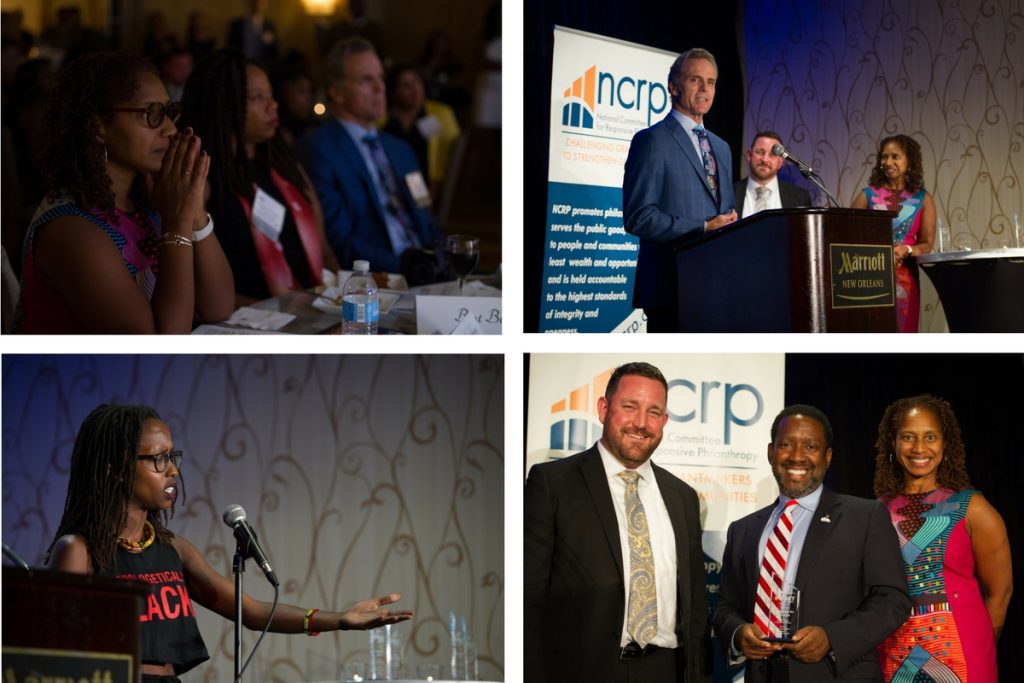
As the historic 2017 Atlantic hurricane season has demonstrated, extreme weather events can have devastating impacts. And such events are becoming more and more common as the effects of climate change take hold. But those impacts are heightened in the American South, which sits on the front lines of the global climate crisis.

Our newest report, “As the South Grows: Weathering the Storm,” explores opportunities for philanthropy to invest in environmental, racial and climate justice in the South. Using examples in Eastern North Carolina and Southern Louisiana, the report details how the organizing and mobilizing of Southerners around these issues is not matched by foundation investment in their communities.


Learn about:

As the South Grows: Weathering the Storm” is the third report in the five-part As the South Grows series. The fourth report will be released in February.

We hope “As the South Grows” inspires you to look at the South as an important opportunity for deeper engagement, investment and partnerships.

Yna C. Moore is senior director of communications at NCRP. Follow @ynamoore and @NCRP on Twitter.

Last year at Thanksgiving, we asked NCRP staff: What are you thankful for in philanthropy this holiday season?

While it is great to count our blessings and appreciate what we have, it’s also important to turn that thanks into something actionable. This year, we’re focusing on funders and how they can show that they value their grantees.

The gut reaction may be to think that grantees should be grateful to funders for the resources that fund infrastructure and projects, but it’s vital for us to realize that funders owe even more thanks to their grantees.

Nonprofits have their eyes and ears on the ground. They are in our communities providing services, organizing stakeholders, spearheading campaigns and more. Grantees provide funders greater understanding of the critical issues that funders and grantees care about.

So, what are some creative ways funders can show appreciation to their grantees this Thanksgiving season? Here’s how NCRP staff responded:

“Given that it’s the year’s end, I think funders could give surprise grants to their grantees, or others who narrowly missed being selected as a part of the year’s portfolio.”

– Jeanné Isler, Vice President and Chief Engagement Officer

“Introduce them to other potential funders, too.”

– Aaron Dorfman, President and CEO

“This might sound strange, but show appreciation by leaving them alone! Grantee organizations work really hard with often scarce philanthropic resources. The best way for a funder to show their gratitude this Thanksgiving season is by staying out of their grantees’ ways – let them do their work and be ready to have a conversation about more funding when the time is right.”

– Ryan Schlegel, Senior Associate for Research and Public Policy

“Funders can show appreciation to their grantees by first, thanking them for all they do and second, asking them: ‘What three things could I do that would help you be even more impactful?’ And of course, actually do some of those things.”

– Lisa Ranghelli, Senior Director of Assessment and Special Projects

“Post success themed ‘spotlights’ on social media on grantee organizations or individual people. It is a nice, simple way to show appreciation.”

– Sophia Cole, Events Intern

“Funders need to be intentional with their promises and put their money where their mouth is. Then, challenge grantees to hold them accountable. At this 2017 Thanksgiving, the X Foundation pledges to:

  • Listen more
  • Trust the expertise of community leaders
  • Make room at the table to include the quiet and the voiceless whom we serve
  • Really, really be intentional about the foundation’s representation of the mosaic
  • Understand that good leadership is shared leadership
  • Step away from behind the big desk and into the community more often”

– Beverley Samuda-Wylder, Director of Human Resources and Administration

“If you’re a place-based funder or have a set of grantees in a specific place, help build community by inviting them to a happy hour with free food and drink! Check out what Vu Le has to say about the power of happy hours.”

– Caitlin Duffy, Senior Associate for Learning and Engagement

“Be an advocate for your grantees’ work: Rally other funders and important decision-makers to join you in building power among folks who live daily with the problems they’re trying to solve.”

– Ben Barge, Senior Associate for Learning and Engagement

What are other ways funders can show appreciation to their grantees this Thanksgiving season?

Jack Rome is the communications intern at NCRP. Follow @NCRP on Twitter.
Power dynamics are the most significant source of tension in building trust and healthy relationships for better place-based funding by national funders. It’s touchy and no one really wants to name it, but it’s true: It’s very difficult for funders and grantees to be honest and lean into tough conversations about solving complex problems when a pronounced power dynamic exists between them. And it really gets in the way of good work.

The Democracy Fund’s Public Square Program just released a paper raising the issue of power dynamics between funder and nonprofit organizations, and even between national and local funders regarding national foundations and place-based philanthropy.

The paper also details best practices around national funding in local news projects, namely setting the stage for healthy, equitable partnerships between national and local players on local issues. It captures the Democracy Fund’s learnings from its earlier partnership with the Geraldine R. Dodge Foundation and its Local News Lab and the fund’s efforts to replicate this work in different cities across the country.

Full disclosure: I’ve worked with Associate Director of the Public Square Program Josh Stearns in the community journalism space since my days at Chicago Public Media and his days at Free Press, and we’ve long grappled with community space and building trust. I appreciate the empathetic perspective Josh has gained by going from the nonprofit space to the funder space and now, from local funder to the national funder space, applying the lessons he’s learned in navigating all sorts of roles.

I applaud seeing a national funder implore other national funders to have humility, and be transparent, communicative and clear about their roles in partnership with local players. You don’t often see that in practice because it implies that funders will consider giving up some power and control for the greater good.

At NCRP, we recommend national funders go even further to ensure that their strategies are relevant in the local landscape:

1. Utilize an equity lens on how we define “readiness” and “experts” and who we choose to invite to the table in high-stakes, decision-making conversations.

The paper discusses the importance of ensuring that local communities have a level of readiness that is conducive to broader capacity building with a national partner. But more importantly, foundations must be mindful of their own cultural, establishment-based norms of “respectability” that can get in the way of uncovering true community champions who are amazingly talented and have considerable credibility and real capacity to lead on-the-ground efforts.

These heroes are in their work for a reason, and sometimes that means they’ve never really engaged with a foundation before to support their work because they are savvy, enterprising and committed to their cause.

If we’re truly talking about community credibility, it’s important to explicitly seek out and invite community leaders (people who already have the community’s trust and reflect the community both demographically and through its values) to play a key role in the decision-making process. These leaders often fall outside of foundations’ radars. It is still too rare to see a majority of these community leaders have any real agency in high-stakes conversations solving complex community problems. By being more inclusive, foundations can be smarter, more responsible and thoughtful partners in efforts to improve and strengthen communities.

Often funders can get presumptive or even lazy about sending invitations beyond the usual suspects and those outside of their comfort zones in community collaborative conversations. It’s critical to continue to interrogate how and why they make the decisions that they do when they identify partners in their work.

2. Remember that this requires courage. Lean into discomfort.

Part of being brave is the willingness to give up and share power, and to build power from within communities. That bravery invites grantees, nonprofit organizations and community stakeholders to fully participate in honest and constructive conversations.

If the conversations are not getting to the heart of a real tension, it’s difficult to nurture authentic and sustainable growth. The trust that grows from experiencing and working through conflict in the context of an environment where resources are scarce is the basis of transformative change. So sophisticated facilitation skills are key and should not occur cheaply or half-heartedly.

We’ve continued to learn and apply these lessons through our As the South Grows initiative – where we, as a national organization, are learning to build trust with our rural partners on the ground to inform best practices on funding in the South.

We’re also collecting lessons learned from our Philamplify initiative to identify the most effective ways that funders can meaningfully shift power for stronger communities in the form of an assessment toolkit. Stay tuned for more info on both soon!

 Jennifer Choi is NCRP’s vice president and chief content officer. Follow @jennychoinews and @NCRP on Twitter.

Image by JD Hancock. Modified under Creative Commons license.

We’re excited to announce that yesterday Reverend Starsky Wilson, president and CEO of Deaconess Foundation in St. Louis, Missouri, was elected unanimously as the new chair of NCRP’s board, succeeding Sherece West-Scantlebury. Sherece, who leads Winthrop Rockefeller Foundation, served as NCRP’s board chair for the past four years.

“The work of NCRP is needed now more than ever. Reverend Wilson’s leadership and commitment to social justice will enhance NCRP’s efforts to ensure our nation’s social movements are getting the philanthropic dollars they need to succeed.”

– Sherece West-Scantlebury, President and CEO, Winthrop Rockefeller Foundation

“I am humbled to be asked to lead NCRP’s board at this important time. Philanthropy has an important role to play in helping our nation confront racial injustice and economic inequality. I am excited to work with such a remarkable group of nonprofit and foundation leaders committed to ensuring that philanthropy lives up to its highest aspirations – as transformational agents of just, equitable social change.”

– Reverend Starsky Wilson, President and CEO, Deaconess Foundation

We’re also thrilled to share that five foundation leaders will be joining NCRP’s dynamic and diverse board:

  • Sharon Alpert, President and CEO, Nathan Cummings Foundation
  • Jocelyn Sargent, Executive Director, Hyams Foundation
  • Joseph Scantlebury, Vice President for Program and Strategy (Places), W.K. Kellogg Foundation
  • Pamela Shifman, Executive Director, NoVo Foundation
  • Lateefah Simon, President, Akonadi Foundation

Under Sherece’s leadership, NCRP crafted a bold strategic framework that advocates for the kind of philanthropy that prioritizes and empowers underserved and marginalized communities, and seeks to solve long-term inequities and injustice. We pushed foundations to be more transparent, open and inclusive of stakeholder feedback in strategies and processes. We highlighted the untapped potential and capacity for meaningful philanthropic impact in the South. We examined the latest social justice giving trends among the country’s largest foundations.

New Leadership

In addition to Sherece terming of after nine years on NCRP’s board, other board members have stepped down due to term limits or other factors, including: Bill Bynum, CEO of HOPE Credit Union; Trista Harris, president of Minnesota Council on Foundations; Priscilla Hung, deputy director of Move to End Violence; and Gara LaMarche, president of the Democracy Alliance.

The board also elected other new officers, including: Daniel Lee, executive director of the Levi Strauss Foundation, as the new vice-chair; and Cristina Jiménez, executive director and co-founder of United We Dream, as the new secretary. Vivek Malhotra continues as treasurer and Cynthia Renfro, principal of Civic Consulting, was re-elected as at-large delegate to the executive committee.

“Everyone at NCRP is extremely grateful to Sherece, Bill, Trista, Priscilla and Gara for sharing their time, passion and wisdom. They each helped make NCRP a stronger and better organization, and we will miss them.

“I am excited to work with the incoming new board members. These are people I’ve long admired for their leadership and commitment to high-impact, responsive philanthropy. Fresh perspectives like theirs will bring a lot to the organization.”

– ­Aaron Dorfman, President and CEO, NCRP

Meet our board members!
View the complete list of NCRP’s board of directors.

The historic Hurricanes Harvey, Irma and Maria have weakened or dissipated. But communities are just beginning to come to grips with the devastation caused by these storms measured in lives lost, properties damaged and communities displaced.

As grantmakers respond to this and future natural disasters, funders’ goal must not be to restore the status quo that endangers marginalized communities by stranding them in flood-prone neighborhoods and sub-standard housing. Instead, it must stand ready to provide financial aid for immediate survival and infrastructure needs and for long-term physical, emotional and communal rebuilding. We must be ready not just to rebuild houses and bridges, but to rebuild the power and elevate the voice of marginalized communities who were disproportionately impacted by the storms.

Lesson from Katrina, Sandy and Matthew: Don’t leave underserved communities behind

“Many families [in Houston’s Fifth Ward] are already challenged economically. We are concerned particularly that aid and insurance relief has been a one-size-fits-all approach for communities that is not based on that community’s needs. [Harvey recovery] could be an opportunity to further gentrify the community because many homes in the area are total losses, but the amount of aid is inadequate for them to rebuild.

It is imperative that organizations and funders support grassroots organizations on the ground with direct connections to those families who are impacted and put together programs that will increase their capacity to be able to rebuild. It is my prayer that we will use the lessons of Katrina and Sandy to make sure underserved communities are not left behind.”

– Kathy F. Payton, CEO of the Fifth Ward Community Redevelopment Corporation.

Funders need to be ready to do short-term and long-term Southern grantmaking well in response to Harvey and Irma and other future environmental disasters. But what does “doing it well” actually look like?

NCRP has been engaged for the last 18 months in an ongoing partnership with Grantmakers for Southern Progress to highlight the opportunities for investment in long-term structural change work in the South in our As the South Grows series. Despite the historic lack of philanthropic investments in the region and in the face of entrenched, racialized poverty, Southern communities stand ready to build movements for justice that have the potential to change the country.

The third report in the series, coming out this fall, will elevate the stories of Southern activists working at the intersection of economic, racial and climate justice. It will include lessons from marginalized Southern communities on the frontlines of climate change and their cross-issue, cross-constituency strategies to break the hold that extractive and exploitative industry has on our politics – a hold that exacerbates the already catastrophic effects of environmental degradation and climate change each day.

It will include concrete and actionable tips for grantmakers and donors who want to do short-term and long-term environment and climate philanthropy in the South “well.”

We are eager to share that report with you, even as our hearts have grown heavy over the last few weeks as its timeliness became clear. So please stay tuned. Sign up to receive the announcement and other important news from NCRP.

Three opportunities for funders to respond “well” now

Community leaders in Houston have begun collecting philanthropic investments for long-term healing and rebuilding through the Hurricane Harvey Community Relief Fund.

In Florida, communities are coming together and have formed the Hurricane Irma Community Recovery Fund to ensure that the communities most impacted will receive the resources and support they need for long-term rebuilding.

Relief efforts in Puerto Rico have just begun, but already the Hurricane Maria Community Recovery Fund has been set up to begin collecting donations for “immediate relief, recovery, and equitable rebuilding.”

Fear and hope for solutions

When we spoke to climate and environment activists in the South, the trauma of past storms and fear of what is to come was threaded through our interviews.

What dominated those conversations, though, was not sorrow, but the conviction that Southern communities have the solutions to the climate challenges we all face.

It seems sometimes that history is speeding up, our past it catching up to us, and the future holds unprecedented threats. Philanthropy’s response in the South and elsewhere must be unprecedented too.

Ryan Schlegel is senior research and policy associate at NCRP. Follow @ncrp on Twitter.

Today a long-awaited recording goes live from an event we recently co-hosted with Grantmakers for Southern Progress, Ms. Foundation for Women, Mary Reynolds Babcock Foundation and NoVo Foundation at the Ford Foundation in New York: “As the South Grows: Roots of the Resistance.” When you watch it, you’ll hear a lot of people reference the “timekeeper in the back” – a.k.a, me.

I play that role in many events I manage. And with every conversation, I know we’re working with borrowed time. From the speakers on stage to the audience in the room, we only have so many chances to get it right.

We held this event because philanthropy, too, is working with borrowed time. It’s clear that progress on any issue we care about is at risk, not only in short-term losses but in long-term missed opportunity. What fewer seem to realize is that there is no Trump without a Sessions; no national strategy without a Southern analysis; and no winning solution without centering the Southern women, girls, and especially women and girls of color giving their lives to make the nation better for all of us.

The very communities grantmakers least expect to steward their resources have long pioneered how to survive and thrive in 2017. Yet philanthropy invests just two cents in places like Selma, Alabama, and the Mississippi Delta for every dollar spent per capita on New York City – and less than one cent for advocacy and power-building.

This can and must change. Below are seven quotes from the event that speak to the deep opportunities for national progress available when funders invest in a just South. It is followed by the video recording of the entire event. I highly recommend watching the video in its entirety because a single quote does none of these speakers justice.

  • “Why should you invest in the South? In a lot of ways we are political trailblazers. We are the testing ground for policy, state and federal, that land at your front door. … Those of us who’ve been countering, surviving and thriving in those same environments are quite frankly national teachers of resistance.” – Natalie Collier, director and founder, The Lighthouse at the Margaret Walker Center
  • “If you don’t care about women, you don’t care about children. So we said: What would it look like to put forth a policy agenda that put women in the center of that debate?” – Cassandra Welchlin, director of the Mississippi Women’s Economic Security Initiative at the Mississippi Low-Income Child Care Initiative
  • “Trust me to measure it, and watch what we can give you because if we can change a law that’s about targeting poor people and sex work in the most conservative and racist state in this country, then trust us to move other things.” –Deon Haywood, executive director, Women with a Vision New Orleans
  • “Eight out of 10 times in the South there is existing capacity on the ground doing real systems change work. It doesn’t mean it’s everywhere, and it doesn’t mean it looks the same across the South or even within the same state, but it takes landing there and building relationships.” – Justin Maxson, executive director, Mary Reynolds Babcock Foundation
  • “Not only do we have to believe and support and get behind local leadership in movements, we have to get behind and support local philanthropic leadership.” – Tynesha McHarris, Fellow for Advancing Adolescent Girls Rights, NoVo Foundation
  • “When your colleagues say, ‘I’m not sure, I don’t know,’ really explore the place of the ‘I don’t know.’ … The South is our north star right now in terms of what we can learn and how we can organize in this political movement.” – Aleyamma Mathew, director of women’s economic justice, Foundation for Women
  • “I had a lot of assumptions about what was happening in the South. … Those assumptions could not be more wrong. It’s not a place of deficit, it’s a place of incredible organizing – in fact a hotbed of creative organizing.” – Brook Kelly-Green, program officer for gender, racial and ethnic justice, Ford Foundation

“As the South Grows: Roots of the Resistance,” a conversation co-hosted by NCRP, Grantmakers for Southern Progress, NoVo Foundation, Ms. Foundation for Women and Mary Reynolds Babcock Foundation at the Ford Foundation on July 7, 2017. Video courtesy of Ford Foundation.

We’re all on the clock. As the words sink in, I invite you to reflect on one question: How will you use our time?

Whether you’re a Southern foundation exploring advocacy, a national funder exploring Southern investments, or a Southern nonprofit or activist wondering what all this means for you, please get in touch with me at bbarge[at]ncrp.org. I’m excited to work with you.

Ben Barge is senior associate for learning and engagement at NCRP. Follow @NCRP on Twitter.

We’re excited to announce the 2017 NCRP Impact Awardees!

This year’s awards are special because of the challenging environment our communities are facing. These grantmakers serve as examples of bold, high-impact giving that puts emphasis on leading by example, being true partners to communities they serve and standing up for the most marginalized.

Meet the awardees

Join us in congratulating the 2017 NCRP Impact Awardees:

Foundation for Louisiana
The “Mover and Shaker” Award for bold peer organizing
This community foundation based in Baton Rouge is being honored for using its influence and expertise to address critical issues in the state, particularly its efforts around criminal justice reform.

Groundswell Fund
The “Smashing Silos” Award for intersectional grantmaking
This public grantmaking charity in Oakland, the largest funder of the reproductive justice movement in the U.S., is being honored for its intersectional partnership with grassroots racial, gender and LGBTQ justice leaders.

Meyer Memorial Trust
The “Changing Course” Award for incorporating feedback
This private foundation in Portland, Oregon is being honored for its stakeholder-driven reflection and learning to explicitly focus on equity in its operations and grantmaking.

Solutions Project
The “Get Up, Stand Up” Award for rapid-response grantmaking
This public charity co-founded by celebrity activist Mark Ruffalo is being honored for providing some of the first rapid-response funding to indigenous efforts against the Dakota Access Pipeline in Standing Rock.

Find Out More

Spread the inspiration!

Help encourage grantmakers in your community to aspire for lasting positive impact. Share the news about the awardees and use them as examples of what’s possible.

The NCRP Impact Awards is about inspiring smart philanthropy that empowers communities for lasting positive results. Thank you for helping us make this a reality.

Jeanné Isler is VP and chief engagement officer of NCRP. Follow @j_lachapel and @ncrp on Twitter.

Aaron DorfmanNow is not the time for the philanthropic sector to hide behind a false perception of neutrality.

Some foundation staff and leaders may decide this weekend’s events and others like them are irrelevant to their grantmaking, or that to engage their foundation on issues of political extremism is to jeopardize their institution’s role as mediator, convener or dispassionate investor in the public good. This decision would be irresponsible and wrong on the facts.

There can be no neutrality in a nation where well-organized violent demonstrations and the federal government itself actively retrench centuries of structural racism and inequality.

The lesson in Charlottesville is clear: The nation’s philanthropic sector must deploy all the resources at its disposal to counter the rising tide of neo-Nazism and white nationalist violence. That means deploying a foundation’s public leadership role, its convening power, its invested assets and its grantmaking dollars to protect threatened communities – and to do so on those communities’ terms.

Here are just a few ways the philanthropic sector can meet the challenge of this moment and ensure they are among the forces for good at a time when the forces of violent oppression are gathering strength:

1. White foundation staff and leaders must speak out.

It is crucial for white foundation leaders to be vocal about their personal and institutional opposition to white nationalist politics and polices. This means not just condemning violence, but confronting the myriad ways white supremacy impacts our communities, our institutions and our grantmaking itself.

People of color are putting their careers and often their bodies on the line – white allies in leadership positions must join them.

2. Philanthropists must invest in ways to attract new people to the resistance.

Foundations and major donors can help create avenues for participation for people and communities who have to date not been involved in the movement to oppose white supremacy. The violent far right presents a threat to our democracy and to our safety. All of us are at risk.

Philanthropic investments to invite broader, deeper participation in organizing, advocacy and the political process are sorely needed now, when the white nationalist threat is attracting wide national attention.

3. Philanthropists must invest in broad-based movement building.

The movement to resist white nationalist policies at the federal, state and local levels and to oppose the real and immediate threat white supremacists pose to the communities you serve must be broad and inclusive in order to succeed.

White nationalist ideology is not just about race and ethnicity; these groups define their objective as a society where white, heterosexual Christian men and women dominate every facet of our public life.

Foundations must invest in movement building that cuts across the many issues we care about such as race, poverty, civil rights and others. It must nurture transformational relationships between and among all communities threatened by the violent far right.

Now is the time for wealthy donors and leaders of foundations to step up and take a stand. America is counting on you.

What movement do you feel most passionate about? Health? Education? Environment? Criminal Justice? LGBTQ? What does that movement need in order to flourish? How do you think philanthropy can help?

We need you to tell us what NCRP, and foundations and other funders can do to support these movements in the near-term and during the next 10 years.

One of the goals of NCRP’s new strategic framework is:

“Over the next 10 years we want to ensure that social movements – especially those led by the people most affected by disparities and inequality – have the philanthropic resources they need to win significant victories that make our society fairer and more just and democratic.”

There are differences among the many movements working to address inequities and injustice in specific issue areas such as health, education and environment.

Join us in this conversation.

Tweet us @NCRP, post on our Facebook page or email us at community@ncrp.org.

To learn more, check out our #MovementMoney launch video.

Jack Rome is communications intern at NCRP. Follow @NCRP on Twitter.

Image by Mark Dixon. Used under Creative Commons license.