Good things happen when funders shift power to communities. It’s “regenerative.” We “actually get outcomes that work” and “build a groundswell for change.”

But it’s hard to “give up power and build trust,” to “learn about the things you got wrong,” to “never have enough time to do it right.”

During our recent session “Learning to Let Communities Lead” at Independent Sector’s Upswell conference, we heard these and other things that make community leadership both exciting and challenging.

There’s no single model for working with all communities, but in this session 3 speakers shared their models in hopes some elements could be adapted to fit other communities and contexts.

Jehan Benton-Clark shared how The Colorado Health Foundation uses the Community Engagement IMPACT Practice Model, a framework for how program officers engage with communities in Colorado.

Lysa Ratliff talked about KaBOOM!’s process for partnering with communities to plan, organize and build play spaces.

And Lauren Mikus explained the Wells Fargo Regional Foundation’s model for funding multi-year, community-driven revitalization initiatives.

What was most striking was their and other session participants’ commitment to pushing through challenges.

For them, it wasn’t a choice. To sustain impact for the long term, communities have to own it, decide it, shape it and lead it. Philanthropy’s current top-down approaches aren’t working. If we want to see better results, communities must lead the change.

Coming out of that session, several questions are making us rethink the ways we work and how we support the foundations we work with.

4 Questions for funders to sit with as you learn to let communities lead:

1. What is the risk of not shifting power to communities? Many funders think it’s risky to give communities power to make decisions and lead change efforts.

After all, they could – and likely would – make decisions you wouldn’t make. But, to borrow the language of Groundswell Fund Executive Director Vanessa Daniel in her recent New York Times article: How are you managing the risk of not doing this?

If the solutions created outside of communities haven’t led to the change you sought, then it’s risky to keep funding those solutions.

It’s risky to seek solutions from people who don’t face the challenges or live with the consequences of their decisions.

2. What power are you willing to give up? As an organization, be brutally honest with yourselves about what level of power you’re willing to share with the community.

As a team – and this is most important for the leaders and decision-makers in your organization – ask yourselves: If communities have this power, what decisions or actions might they take that I wouldn’t agree with?

If you indicate that community members can decide how to spend a grant, and then you change your mind after you discover they want to spend the money on something you wouldn’t prioritize, it would break trust and hurt your relationship with the community.

If you gather community members’ input but don’t seriously plan to do something with what you hear, community members may feel like their time was wasted and their voices weren’t valued.

Once you’ve figured out what power you’re willing to share, communicate clearly with the community about what they can expect of you and the process you plan to take.

It’s also critical that you ask yourself: If we keep this power, what decisions or actions might we take that the community wouldn’t agree with? Keep revisiting these questions and pushing the boundaries of the power you’re willing to give up.

3. How might you better understand the strengths of communities? The more you understand where a community shines brightest, the better partner you can be to that community.

This requires listening deeply and asking questions like: What makes you proud to live in this community? What have you accomplished by working together?

What strengths do you personally bring to the community? For our workshop, we put together this Google Drive folder full of tools and resources on ways to center communities and shift power to them. (Session participants – and you, too – are invited to add tools and recommendations to the documents.)

The toolkit includes a section on understanding community assets. In addition to understanding those strengths, talk about them!

For example, if you can rattle off a list of challenges facing a community with a large population of undocumented immigrants, you should also be able to talk about the networks and social capital they’ve built to protect each other and connect each other with job opportunities.

See more resources on asset framing in the section on communicating changes.

4. How can we work together across our sector to reduce burdens on communities? As Lysa Ratliff of KaBOOM! pointed out to us, a community-centered approach also requires us to align better as a sector.

Our efforts can often unintentionally place burdens on the community. We ask them for their time, to report back to us on results and to manage us as a resource.

When our work intersects with the work of others in the sector, we have an opportunity and responsibility to better organize our efforts.

This can happen through informal sharing and networking or more formal mechanisms like roundtable discussions and data sharing.

When we move toward unifying our work as partners, rather than parallel entities, we will be able to improve our collective ability to support community interests.  

In another panel conversation at Upswell, a funder said, “too often we are seen as experts because we have the money, but it needs to be the opposite: we are not the experts, because we have the money.”

Changing the way we do philanthropy starts with this humility. It leads to more open power-, wealth- and resource-sharing with the real experts: communities themselves.

Walter Howell is a senior consultant and Lauri Valerio is communications manager at Community Wealth Partners. Walter and Lauri would like to acknowledge contributions to this blog post from Lysa Ratliff, Jehan Benton-Clark, Lauren Mikus and the session participants of “Learning to Let Communities Lead” at the 2019 Upswell conference. Follow @WeDreamForward on Twitter.
At the Robert R. McCormick Foundation, we’re delighted to see that more funders are using participatory grantmaking to elevate the voices and leadership of the communities they partner with and serve.

Participatory grantmaking helps shift the traditional power imbalances that exist in philanthropy by engaging the grantees who are affected by the issues that funding is intended to address in the decision-making process for grants.

For some foundations, this means including grantees in the process for setting priorities, developing strategies, conducting research and sitting on boards or advisory councils.

Other foundations are using various elements of participatory grantmaking based on what their organizational polices and structures allow.

At the core of this practice is understanding that those closest to the issue, including those with lived experience, have the knowledge and expertise to create solutions that are creating lasting and sustainable change in their communities.

In 2017, the foundation’s Communities Program embarked on its own journey of participatory grantmaking through its place-based work in Englewood – a predominately Black neighborhood on Chicago’s south side.

The program supports the activities of the Englewood Quality of Life Plan (QLP), which is the result of a community-driven process that engaged hundreds of residents, community leaders, and stakeholders.

Five task forces representing priority issue areas (education and youth development, health and wellness, housing, jobs and economic development, and safety) were formed to develop goals and strategies to help revitalize the community.

Teamwork Englewood (TWE), a community-based social service agency, serves as the coordinating organization for the QLP and provides oversight and project management for the work implemented by the task forces.

The Communities Program established Impact Englewood, a McCormick Foundation Fund, in partnership with TWE and leaders of the QLP to provide a vehicle for including community input for grant strategies supporting the QLP.

Englewood leaders and residents worked with foundation staff to raise donations, which were matched by McCormick.

Subsequently each task force submitted grant applications for projects and initiatives advancing strategies of the QLP.

The Communities Program’s grantmaking staff co-created an letter of intent and grant application with feedback from TWE and QLP leaders, and provided training and technical assistance through weekly “office hours” for task force groups with less experience creating and submitting grant proposals.

An advisory committee comprised of QLP leaders, TWE and Communities Program staff went through a process of reviewing grant proposals and recommended 6 grants totaling $140,000, which provided initial funding starting in 2018 for the following QLP projects:

  • A needs assessment to pilot a community school model at a neighborhood elementary school to improve academic and student level performance and bolster family engagement.
  • The creation of a health navigator team to connect residents to local health care services, programs and resources to increase access to care and improve health outcomes.
  • A series of community-driven and led workshops to help educate and support residents with pre- and post- home purchase resources and opportunities to increase the number of owner-occupied homes.
  • A feasibility study to collect data on the housing stock in a targeted area of the neighborhood to determine the need for subsidy money to stabilize the housing marketing.
  • A program to assist residents with job skill training and support services to obtain certification from a short-term certification or licensing program.
  • An initiative to promote peaceful and safe environments through educational community conversations centered on mental health and the effects of trauma and connect residents to mental health services and resources.

The foundation remains on a journey of learning how to partner more effectively with communities and how to use participatory grantmaking as a tool for promoting community voice, elevating power, capacity and leadership towards problem-solving, improving community-level outcomes, and closing racial gaps.

In our first year of exploring participatory grantmaking, we saw that building trust and being transparent with community are cornerstones for this work.

We learned that sharing and managing expectations – both from the community and the foundation – is critical for moving the work forward. Being flexible and willing to think outside of the box helped us collaborate better.

We also learned that participatory grantmaking requires a great deal of time and resources, but we also witnessed firsthand the power of building capacity in the community.

In summer 2019, we launched our second fundraising campaign with our partners in the community to support the Impact Englewood Fund.

This year’s campaign raised more money, and we saw more residents engage in their own targeted fundraising efforts – including 1 resident who used fundraising tactics we shared to cultivate a major gift from a local family foundation.

This resident also used donor engagement letter templates we crafted to send more than 600 letters to local and surrounding businesses and 300 emails to his personal network of contacts urging them to donate.

This story stands as an exemplary highlight among the initial successes we’ve seen in our second year. As we continue to learn about the impact of our grants, we’re already seeing progress as our partners in the community are coming to the end of the first year of funding. 

Moving forward, our focus will be to continue building capacity in the community and implementing lessons learned to create a sustainable infrastructure for participatory grantmaking to thrive.

Caroline McCoy is a program officer in the Communities program at Robert R. McCormick Foundation. Follow @McCormick_Fdn on Twitter.

As communities and grassroots organizations across the country continue to fight for equity and justice, many grantmakers and donors are looking for optimal ways to support them.

“Now is not the time for business as usual. Frontline activists and organizations across the country and the world continue to fight for dignity, security, inclusion and a thriving future for all,” wrote Aaron Dorfman, chief executive of the National Committee for Responsive Philanthropy (NCRP).

The newly released October edition of “Responsive Philanthropyoffers grantmakers and philanthropists examples of ways they can align their giving and practices with these transformative efforts.

Philanthropy for change, not charity

Wes Moore, chief executive of Robin Hood, discusses why community-grounded policy efforts are essential in the foundation’s fight against poverty in New York City.

How philanthropy can help us be better as a nation

Rick Williams, chief executive of Sobrato Family Foundation, reflects on his 20 years in philanthropy and suggests 10 priority action items for the sector to help America reach its full potential.

The power of bridging issue silos through funding collaboratives

Unbound Philanthropy’s Taryn Higashi interviews Anita Khashu of Four Freedoms Fund, Bridgit Antoinette Evans of Pop Culture Collaborative and Aleyamma Mathew of Collaborative Fund for Women’s Safety and Dignity to discuss the role of cross-issue collaboratives and why they’re important for grantmaker impact.

Philanthropy possesses a checkered history. It is simultaneously responsible for developing some of our country’s greatest public resources while also leaving marginalized communities in the dark.

At its worst, philanthropy has supported causes that poison our public interest. This mixed tradition continues today as some of the same philanthropies that fund vital American institutions, such as the Boy Scouts and the American Red Cross, also fuel some our country’s most anti-human, anti-social political and cultural agendas such as Islamophobia, religious intolerance and white supremacy. 

Given that as an ideal, philanthropy is rooted in a love for humanity, the findings of a series of recent reports documenting the subversion of this public good should be a bitter pill for the philanthropic community to swallow.

Using philanthropy to fund hate

Alex Kotch at Sludge exposed the way donor-advised funds (DAFs) are used to funnel money toward alt-right hate groups.

Our own recent study, “Hijacked by Hate: American Philanthropy and the Islamophobia Network,” uncovers another, deeper layer in this phenomenon.

We tracked 1,096 foundations and charities that granted $125 million to anti-Muslim special interest groups between 2014 and 2016.

These groups, understood as the Islamophobia Network, are a close-knit family of organizations that share an ideology of extreme anti-Muslim animus and work with one another to negatively influence public opinion and government policy about Muslims and Islam.

Once on the fringe of media, they now help shape federal policy and influence local municipalities. Their ability to do so comes from their seemingly unshakeable financial security.

Unfortunately, the very foundations and charitable groups that fund causes that promote the public good are also responsible for funding virulent anti-Muslim hate groups.

These include household names such as Fidelity and Schwab, as well as faith-based funders such as Jewish Communal Fund and the National Christian Charitable Foundation, and community-centered funders such as the California Community Foundation.

They also include lesser-known and more opaque private family foundations such as the Mirowski Family Foundation, which has virtually no public imprint but nonetheless contributes millions of dollars to support anti-Muslim activity.

Together, the expansive funding network revealed in the report demonstrates that the Islamophobia Network cannot be considered a marginal or passing phenomenon in American society.

Rather, it is a consistent and shameful institutional feature of American philanthropy.

Avoiding responsibility under the guise of neutrality

Of course, the question of culpability can and should be asked: Are these charities funding hate or simply doing their job on behalf of their clients, the donors whose money they are managing?

Many DAFs actively eschew responsibility, arguing that they do not take positions on such issues, and instead, simply and blindly follow the IRS designations on which groups are registered as nonprofits.

Such were the responses of Schwab and Fidelity when NPR’s Leila Fadel confronted them with the findings of our report.

The truth is that hate groups and food pantries both qualify as nonprofits. Is it acceptable or conscionable that community and commercial foundations turn a blind eye to this difference?

We cannot expect much from ideologically committed foundations, such as the Adelson and Mirowski groups, whose political legacies define them.

But we can and should expect better of facially “neutral” funders. Moreover, we should not allow groups such as the Colcom Foundation, which actively funds xenophobic and anti-immigrant groups while simultaneously supporting environmental and sustainability initiatives, to mask their deeply paradoxical giving strategies through the cover of charity.

It is imperative that commercial and community foundations develop standards and guidelines to ensure that they are contributing to, rather than subverting, the public interest.

Ultimately, these questions are the same as the ones posed to Facebook, Instagram, Twitter and internet service providers: Are they simply a platform, or are they responsible for the promotion of hate?

Hate is not Charitable

Thankfully, the answers have come by way of concerted and innovative action. Social media giants are working with experts and stakeholders, through campaigns such as Change the Terms and the Christchurch Call, to take the right steps to mitigate the harm caused by hate groups on their platforms.

Similarly, there are signs that the philanthropic community is also ready to ensure that their institutions are not “Hijacked by Hate.”

The Hate is not Charitable Campaign, spearheaded by the Amalgamated Foundation, is leading the way to enlist partners committed to clearing their rosters of hate groups.  

Leading figures in philanthropy, such as Sharon Alpert, CEO of the Nathan Cummings Foundation, are providing a much-needed voice in a sector that seems to have been caught off-guard and exploited by insidious actors.

Anti-Muslim special interest groups are, of course, only one part of a larger, more systemic problem of the way the U.S. tax code and charitable vehicles, such as DAFs, are used by the wealthy to promote the narrow interests of corporations and political elites.

However, given the audacity and impact of the Trump administration’s Islamophobic agenda and its tacit approval of the rise of the alt-right, the time is ripe to challenge the sources of bigotry and hate that have led to so much social and political polarization in our country.

What can funders do?

Philanthropy cannot stay on the sidelines. It can and should play a significant role in healing our nation’s wounds.

Funders can start by:

  • Working with stakeholders, scholars and community members to identify best practices and develop a mechanism of accountability.
  • Sharing resources to advance the public good and collectively push hate and toxic politics to the margins of society and out of the mainstream.
  • Signing on to the Hate is not Charitable campaign and helping to build momentum for this growing initiative.
  • Convening stakeholders in advocacy, university research centers and philanthropic consultancy to develop long-term industry standards to ensure that hate speech and extremism are not supported by their institutions.

Regarding the role of the Islamophobia Network in philanthropy, charities and foundations should begin screening their grantee lists and simultaneously reaching out to American Muslim advocacy organizations like ours to help them navigate the troubled web of actors responsible for so much of the anti-Muslim toxicity we see publicly. 

Working with American Muslim groups will also help to develop long-term relationships in the interfaith community and strengthen the foundations of local civil society networks.

The promising tradition of philanthropy must take back the public square not simply by preventing its subversion by narrow-interested elites, but by supporting causes that advance the public interest.

Just as philanthropy begins to “divest” from hate, it must reinvest in areas of civil rights, public education and independent journalism, which have suffered the most under the profound rise of corporate and private interests in the last few decades.

Ultimately, philanthropy must be used exclusively to advance, as the very word implies, a love of humanity. Groups like ours are willing and ready to work with them along the way.

Dr. Abbas Barzegar is director of research and advocacy and Zainab Arain is national research and advocacy manager at CAIR. Follow @CAIRNational on Twitter.

As social impact and nonprofit consultants, we get to work in the gap – where we’re able to leverage social change from inside and outside of nonprofit and philanthropic institutions.

But this positionality presents its challenges:

  • The tension between being honest with our clients and the possibility of being fired if they don’t like what we have to say.
  • Holding our own organization and colleagues accountable as we hold others accountable for justice and equity.
  • Navigating between cultures while looking for common ground.

The conflicts emerging from these tensions are growth opportunities for us – an organization of women who come from different ethnicities and experiences.

They call for serious humility, a commitment to learning from mistakes and building in reflective time to recognize our blind spots. 

We must embrace these tensions and move beyond lip service on issues of power and privilege existing in “the gap.”

What we have to say may seem straightforward, but authentic relationships in how we relate to each other as individuals, funders and staff is foundational to more equitable consulting partnerships. 

Our team does this a few ways:

1. We schedule regular opportunities for feedback. It seems simple, but building trust authentically is easier said than done.

In our first conversation with a recent funder, we explicitly created a working relationship in which we could share honest 2-way feedback.

To make space for this, we scheduled quarterly check-ins dedicated to re-examine our relationships, considering whether we felt comfortable giving and receiving honest feedback, and acknowledging the balance of power.

In future relationships, we seek more opportunities for verbal, written and anonymous feedback.

2. We allow our partners to come to their own conclusions. We love self-assessments, data interpretation sessions and participatory processes.

These interactive and user-centered methods allow us to ask difficult questions and bring in participant voices to illustrate findings.

In a recent workshop with fundraisers, participants reflected on the culture of learning at their respective organizations.

They identified a variety of factors that can limit a learning culture, like lack of staff capacity, knowledge gaps and disinterest from upper management.

The biggest barrier identified was the challenge of pointing out these issues to colleagues without putting them on the defensive.

In response, we shared a self-assessment tool aimed at surfacing collaborative opportunities to increase the culture of learning and improvement together with colleagues.

3. We strive to walk the talk. Our team recently sent an email to potential partners and ended up having a longer discussion on how identity – gender in particular – plays a strong role in our email language as women.

Based on this conversation we started editing our emails to remove undermining words like “just” or “I think,” leaning into the pride we feel in our work.

Identity and bias also play a role in how our team approaches research. On a past project looking to understand quality of life for older adults, we focused on adults older than 60.

We learned that Black people in the U.S. county we worked in have an average life expectancy of 76.5 years, 10 years fewer than the predominantly white parts of the county.

This was a critical finding that meant a key population, younger African American residents who don’t neatly fit into many funders’ “older adult” boxes, had been overlooked in understanding quality of life.

Based on these findings, we worked with our foundation partner to ensure future studies of older adults represent younger county residents, and we explored earlier interventions that would help older adults in their 50s who are at risk.

4. We focus on implementation (the less sexy word for capacity building). If we’re committed to the missions of organizations, we need to ensure that our recommendations are useful and feasible for partners to carry out.

For example, we prepare reports and dashboards using software that is free or easily accessible so our partners aren’t beholden to us for longer than is genuinely helpful.

We’re developing a list of tools to share with nonprofits that are inexpensive or free. Three free resources we use as a team and with our partners are Quire (project management), Clockify (time tracking) and Tableau Public (data visualization).

One of our roles as consultants trying to bridge the gap is to hold funders accountable to the power and privilege of their role while helping ourselves and our nonprofit clients stand in the real power that we possess as influencers and keepers of deep content knowledge.

Perhaps our biggest form of power is our interpersonal power (i.e. our network) and our ability to ask difficult questions that build critical consciousness with our partners and our team.

Emergence Collective is a capacity building consultancy with a flat, network-based organizational structure. Lauren, Leah and Mary are 3 of the co-founders of Emergence Collective. Follow @emergencecol on Twitter.

Every year, 700-900 women die of pregnancy related causes in the U.S., one of the worst maternal mortality rates among developed countries.

A closer look shows racial disparities carry the statistic: Black women are 3 to 4 times more likely to die of pregnancy related causes than non-Hispanic white women regardless of education and socioeconomic status.

Despite these alarming statistics, philanthropic funding for maternal health has not kept pace with the number of pregnancy related deaths among Black women. 

Funders can and should be doing more.

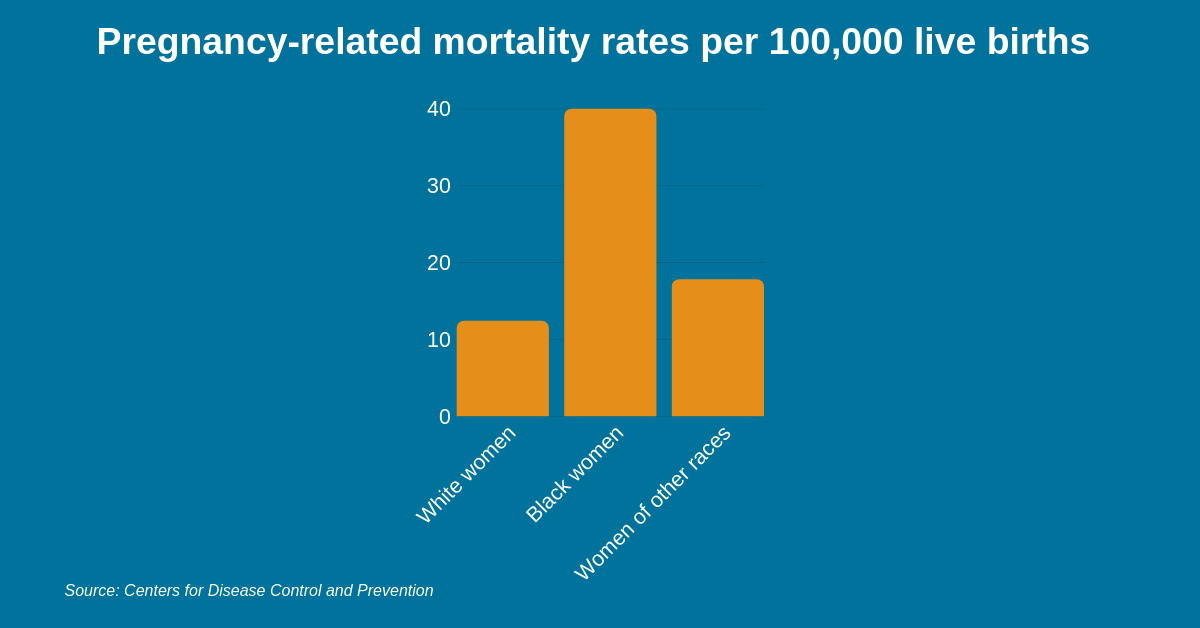
According to the Centers for Disease Control’s latest data, maternal mortality steadily increased between 2011 and 2014 with significant racial disparities: 40 deaths per 100,000 births for Black women compared to 12 per 100,000 births for white women.

A bar graph showing that pregnancy related mortality rates per 100,000 live births are 12.4 deaths for white women, 40 deaths for black women and 17.8 deaths for women of other races.

In the same period, maternal health funding decreased nearly 32% from $87 million to $58 million.

The rate of maternal mortality and racial disparities point to complex intersections of social determinants and structural inequities that undermine Black maternal health.

However, in 2011 funders designated only $2.5 million specifically to Black maternal health, and that was gutted by more than 50% in 2014.

The maternal mortality crisis is rooted in the marginalization of Black women.

Decreased funding for Black maternal health indicates a gap in grantmaking strategies and the root causes of pregnancy related deaths in the U.S.

Health outcomes are largely tied to social determinants including health and systems services, location, employment, education, race and income.

Maternal health care operates within systems that inherently undervalue Black lives. For most Black women, that means being exposed to multiple forms of discrimination and institutional barriers to quality care, which leads to wide racial disparities.

Black women are more likely to:

  • Be uninsured before becoming pregnant.
  • Die of conditions related to pregnancy than white women with the same condition.
  • Be exposed to environmental risks.
  • Receive subpar medical care based on their location.
  • Experience racial bias from health care providers.

Curbing maternal mortality requires investment specifically in Black maternal health care and solutions that engage inequities undermining health outcomes for Black mothers and their babies.

Dr. Joia Crear-Perry, founder and president of the National Birth Equity Collaborative, an NCRP nonprofit member said: “What happens when you mention the medical issues and you don’t talk about the social structure, you pick strategies that are not going to allow for ending any kind of inequity.”

Funders can break the mold and save lives.

Black women need systemic change that begins at the community level: access to vital community health centers, paid family leave, patient-centered care and access to health coverage.

Funders can help by:

  • Amplifying Black women-led solutions. The maternal health crisis is propelled by anti-Black racism. Philanthropy committed to maternal health equity should engage Black women and their communities as experts by giving them leadership roles in grantmaking strategies that impact their bodies and communities.
  • Promoting and investing in community-led organizing, nonprofit advocacy and civic engagement on behalf of Black women. They are the voices of the communities they serve, having intimate and expert knowledge on local resources and how social determinants effect health outcomes. Funding this work builds critical social capital and promotes long-term systemic change that benefits everyone.
  • Promoting Black women leadership within health institutions. Diversity in leadership will hold health care providers and institutions accountable to all patients. They can provide the necessary cultural competence to eliminate racial and cultural bias and discrimination in their organizations.
  • Defending the Affordable Care Act (ACA). The repeal of the ACA would have devastating implications for millions of people who rely on Medicaid for maternal care and undo the progress it has made towards health equity. Reach out to your nonprofit partners and ask how you can support them in defending the ACA and expanding access to low-income communities.

Maternal mortality in the U.S. reflects a grave injustice to Black women and a deeply flawed health care system. Their voices must be amplified in the fight for health equity.

Nichia McFarlane is NCRP’s events intern. Follow @NCRP on Twitter.

Lent is one of my favorite times of the year. For many people, it’s about giving up something they like, but the purpose of going without is to give more to those in need. It is an opportunity to practice better philanthropy, or “love of humanity.”

As a Roman Catholic who has visited Paris many times, I was sad to learn that Notre Dame Cathedral was burning. But I became angry when I saw how quickly “lovers of humanity” mobilized money for rebuilding a building in contrast to the sluggish pace at which institutional philanthropy moves money to human beings.

While Notre Dame was on fire, Al-Aqsa Mosque in Jerusalem also experienced a fire. Last week, 3 Black Louisiana churches were set on fire in an alleged hate crime.

The fires in these holy spaces echo a Lenten refrain, when Jesus said, “Destroy this temple and in three days I will raise it up.”

Jesus’s comment was a scandal to his contemporaries. He was promising the rebuilding of people, community and relationship, not the rebuilding of a building. But his critics missed his point, like we are missing the call to action from these fires now.

The speed of the philanthropic response to support Notre Dame’s repair exposed the hypocrisy of a sector that too often claims an inability to move quickly. This incident shows that philanthropy has the resources and the ability to support urgent social justice and movement-building work, but chooses not to.

The destruction of Notre Dame, and any sacred site, is painful, because such places help us to remember people and events that inspire and motivate us to be our best selves. Notre Dame, which means “Our Lady,” invites us to reflect on the life of Mary, mother of Jesus.

I remember that Our Lady was a poor, young mother who was forced to immigrate to another country because of threat of state violence against her son.

I believe that she would be appalled at the number of poor, young mothers who flee violence with their children today and are met with hostility or apathy.  

I remember that Our Lady watched her innocent son die at the hands of a mob and a corrupt government. She would weep at the numbers of people who are incarcerated and who die in our systems for crimes they didn’t commit.

Our Lady would be shocked that in 2016 more grant dollars were given to support leisure sports than to support the urgent work of the pro-immigrant and refugee movement.

And Our Lady would be ashamed that a combination of wealthy individuals, companies and foundations pledged more than $300 million within 24 hours to rebuild a symbol of her love, but foundations in the U.S. gave less than half of that in 2016 to support fighting for the people who most closely share her experiences.

Our Lady would be underwhelmed at the outcry of support for the idea of her and the lack of support for the reflection of her in other human beings.

So let’s stop missing the point, philanthropy. If donors and foundations can move this quickly to rebuild a damaged temple, then the broader philanthropic sector can certainly act more swiftly to support people in rebuilding the systems that have damaged their lives.

Start by learning what today’s immigrants and refugees need and how funders can take up the urgent opportunity to support them.

Jeanné L. Lewis Isler is the vice president and chief engagement office at NCRP. She is a lifelong practicing Catholic, loves grand old buildings, and knows that empowered people are the key to a better society.

Since the 1980s, an escalating combination of resource extraction, economic globalization and automation, retail consolidation, industrial agriculture, fossil fuel development, and regressive tax and budget policies has hurt many rural and small city communities and economies across the country.

In turn, this tangle of obstacles has produced social and political fragmentation across urban/rural, religious and racial lines that make public discussion and consensus around core values, public policy and a vision for a shared future increasingly difficult.     

At the same time, there has been a decades-long downward trend in philanthropic investment in people and places outside major metropolitan regions, and that disinvestment is now almost total. 

Even exceptional community leaders, organizations and projects across rural and small city America are almost entirely unsupported by, invisible to and disconnected from broader social justice and issue advocacy efforts.

It’s no wonder progressives felt blindsided by the 2016 election. They’ve largely separated themselves from rural voices, perspectives and experiences for 30 years.

Non-metro areas provide a great opportunity for philanthropy

Truth is, there is enormous energy, innovation and commitment among people in these places to steward their communities toward a promising future. 

In addition, the demographic landscape in suburbs, small cities and small towns is far more multi-racial and multi-ethnic than many urban progressives think. 

Indeed, rural and small city America is only about 14% less diverse than the rest of the country, a gap that continues to shrink.

What’s more, when presented with compelling narratives and policy proposals of concern to them – on issues ranging from health care to environmental protection to inequality and economic opportunity – a large number of rural and small city residents support progressive and populist positions. The divides are narrower than we think.

(For further information and analysis on rural demographic, cultural and political trends, see Wallace Global Fund’s recent report, All the People, All the Places.)

The 2018 midterms demonstrate this. Rural voters shifted their vote by 7% compared to 2016, while suburban voters shifted their vote by 5%. 

These shifts occurred because candidates and civic engagement groups supported bold – and often progressive – policy platforms that spoke to the expressed needs and issues of a cross-section of suburban/small city/rural voters.  

Especially in the Midwest, this political volatility resulted in significant progressive wins, many driven by rural and small city voters. These included:

  • Progressive governors elected in Michigan, Wisconsin, Illinois, Minnesota and Kansas.
  • Progressive gains in state legislative elections (despite gerrymandered maps) in Iowa, Minnesota and Michigan.
  • Major shifts in U.S. House district elections.
  • Major pro-democracy reforms passing on the ballot in Ohio, Michigan and Missouri.

We now see new governors and legislators committed to, for example, 100% renewable energy, raising the minimum wage, increased access to healthcare, criminal justice reform and other progressive policies.

To some degree, this turnaround is the result of concerted efforts by state and local organizing, issue advocacy and community-building groups to reach beyond major metro regions and into suburbs, small cities and small towns.

Despite their productivity and potential, these efforts remain significantly underfunded by national and most state-based donors. With more support, these groups’ scale and impact could soar.

While the Midwest offers the most politically volatile, and therefore opportune, region in the country, the same investment is needed everywhere.  

In short, it is simply not possible to arrive at a representative governing majority – in states or nationally – while writing off non-metro areas and accepting massive and uncontested ideological, cultural and political losses in those places.

Without small cities, towns and rural areas, we won’t be able to build support for, enact and enforce public interest ideas and policies.

To be clear, this is not a case against deeper work in urban areas, but rather a case for investments in rural and urban/suburban/small city engagement to be a meaningful part of an integrated statewide strategy.

To jumpstart and better coordinate this work in the Midwest, a group of national and state funders created The Heartland Fund.

The Heartland Fund

The Heartland Fund, a 501c3 donor collaborative housed at the Windward Fund, was launched in 2018 by the Franciscan Sisters of Mercy and the Wallace Global Fund, and since joined by other donors, to begin redressing the philanthropic neglect of rural, small city and suburban communities in the region.

Heartland’s mission is to promote increased multi-issue and multi-racial organizing, issue advocacy, movement building and civic engagement in the Midwest, and to support an infrastructure working to bridge social and ideological divides.  

Initial grants supported superb efforts already underway towards building the capacities of groups and leaders.

The Heartland Fund’s grantmaking – deeply informed by a diverse, multi-issue advisory board of field leaders from across the region – is designed to connect with and amplify the funding priorities and strategies of other donors and donor collaboratives who support work in the Midwest. 

The Heartland Fund is one example of the kind of generative engagement needed to ensure that the Midwest region can continue to be an anchor and engine for ideas, alliances, movements and policies that promote a more equal, just and prosperous country.

Scott Nielsen is managing director of advocacy at Arabella Advisors and a founding partner of The Heartland Fund. Follow @arabellaadvisor on Twitter. 

Photo by David Wilson, used under Creative Commons license.

Jolted by a stream of recent events, I have been reminded of the value and myriad benefits of Black-led giving circles and why I am a member of 1.

Hardly alone in this consciousness, I recently joined 2 chroniclers and members of giving circles to write “The Sweetness of Circles.”

In that opinion piece, we share our collective views on why giving circles have growing appeal among Black Americans in these trying times. This parallel piece, a twist on the other, delves into my own giving circle story and revelation.

Thirteen years ago, I was part of a group that formed New Generation of African American Philanthropists (NGAAP-Charlotte), a giving circle based in Charlotte, North Carolina.

My peers and I, after months of deliberation, crafted a mission centered on promoting philanthropy the giving of time, talent and treasure among African Americans with the goal of enhancing the quality of life within our communities.

Pooling our resources with the intent of leading social change was no small feat. During the initial 18 months of forming the group, we consciously waded through 400 years of ancestral anxieties and societal realities to arrive at establishing a collective fund.

We navigated such issues as structural racism, the denial and extraction of Black wealth, fractured trust within and across race and class, and the effects of economic insecurity.

Thankfully, shared cultural roots and hunger to do more in the community propelled us through. Self-determination was a powerful motivator.

Freedom to live out our values, practice grantmaking on our terms, dream up a bold name and more was at times even exhilarating.

Attention and investment in cultivating Black-led giving circles got a boost in 2003 when community organizers Darryl Lester and Athan Lindsay gained support from Ford Foundation and W.K. Kellogg Foundation to promote Black giving circles across the South.

The rationale for their initiative was based on fast-changing demographics in Southern cities and slow-to-progress dynamics prevalent in philanthropic institutions.

They knew of the leadership qualities, financial assets and social capital present, yet undervalued, among the growing number of young Black adults in these communities and the great many Black retirees returning to their Southern roots.

Found in these same cities were community foundations, which were often viewed as bastions of White wealth and privilege, and deemed disconnected from local Black communities.

Black-led giving circles with funds held at community foundations were envisioned as a strategy to disrupt old patterns, clear away barriers to engagement and perhaps shift racial inequities in philanthropy at a local level.

The strategy launched with a belief that stronger ties between Black donors and community foundations could produce mutual benefits as well as gains for the larger community. Hearing the premise, I was intrigued.

Today, after more than a dozen years and nearly 40 members, NGAAP-Charlotte has leveraged resources totaling more than $1.6 million through grantmaking, voluntarism, civic engagement and collaboration.

We have supported a variety of grantee partners, ranging from start-up nonprofits to long-established institutions.

Our support is aimed, strategically, at projects and organizations routinely neglected by other forms of philanthropy.

True to our mission, we have elevated philanthropy in Black communities, near and far, through innovative multimedia storytelling, celebrations of culture and guidance to new giving circles.

Our small-dollar investments and in-kind contributions are fortified by members’ insights and will, gained through lived experiences, cultural connections and proximity to underserved communities.

Years before Charlotte’s 2016 uprising, NGAAP Charlotte articulated social justice as a funding priority, the first local grantmaker to do so.

Often catalysts under the radar, we are sharpening our focus on Black-led social change and intensifying our collective influence to accelerate progress toward a fairer and thus truer New South.

Excruciating in its wrongness, one recent experience stands out in re-affirming our circle’s creation and mission.

After accepting an invitation to an event on the local philanthropy scene, I found myself an accidental token.

In a sea of one hundred or so white faces, who were mingling and chatting, and also serving the drinks and food, I realized I was the sole Black guest and, too, the only guest of color – telling in a city where Whites are the minority.

The evening’s most unsettling point came when the featured speaker, a white man, began probing Black lives, with economic mobility data and project plans, as he stood before a nearly all-white audience.

The incongruity likely went unnoticed by presumably well-intentioned donors, who sipped wine and nibbled from pretty plates as the speaker delivered sobering facts.

Transfixed, I pondered what impact the group might expect with the most marginalized and isolated Black people when it had failed to draw more than one Black donor that night.

Moments like that one enliven my dedication to New Generation of African American Philanthropists. I think back to our origin and that 16-year-old theory of change. As is often the case with Blackness, to exist is to resist.

Until greater evidence of racial equality and equitable ways in philanthropy, I remain strident about the necessity of “for us, by us” philanthropy and Black-led giving circles. To bend a phrase: the Blacker the circle, the sweeter the justice.

Valaida Fullwood is author of Giving Back: A Tribute to Generations of African American Philanthropists, creator of The Soul of Philanthropy exhibit and co-founder of New Generation of African American Philanthropists, a giving circle in Charlotte, North Carolina. Read “The Sweetness of Circles” for more on the country’s Black-led giving circles.

The beginning of the year is a chance for many funders to examine what they can do better – and differently – to move justice and equity forward in communities and issues they care about.

“There are many in philanthropy who are absolutely committed to ensuring that foundations and wealthy donors do everything in their power to defend democracy and build a more just society,” wrote Aaron Dorfman, chief executive of the National Committee for Responsive Philanthropy (NCRP).

The newly released February edition of “Responsive Philanthropy” offers grantmakers and philanthropists examples of ways they can be more effective and strategic in their giving.

Philanthropy: Perilous times call for bold measures

Tory Gavito, president and CEO of Way to Win, invites fellow philanthropists to take more risks by giving more, breaking silos and funding local efforts. According to Gavito, doing all these will “create the groundswell of organized people, ideas and resources required to change the trajectory of history.”

How to think about power (especially if you have some)

Farhad Ebrahimi, president of Chorus Foundation, shares how understanding the “ecosystem” of power transformed his foundation’s approach to climate philanthropy. “What are the unspoken assumptions in our sector,” Ebrahimi asks. “What could it look like to challenge those assumptions?”

Lessons for foundations on rapid-response support at the front lines of democracy

Many funders have responded to these challenging times through rapid-response support. But what does it take to provide resources quickly and effectively? Shireen Zaman and Melissa Spatz, program directors at Proteus Fund, share 5 tips for funders.

What does Amazon’s HQ2 tax-grab mean for U.S. Cities?

Greg LeRoy, executive director of Good Jobs First, and Ryan Schlegel, research director at NCRP, highlights 4 ways that funders can help community-led efforts to ensure that HQ2 benefits “the 99% as much as it benefits Bezos.”