This year’s drought, hurricanes and other extreme climate and weather events have been devastating, and many experts predict that they will become the new normal as a result of climate change.

Unfortunately, foundations and other donors have not stepped up to support communities working to alleviate the impacts of climate change. This is particularly important in the South, which has emerged as ground zero for the effects of climate change.

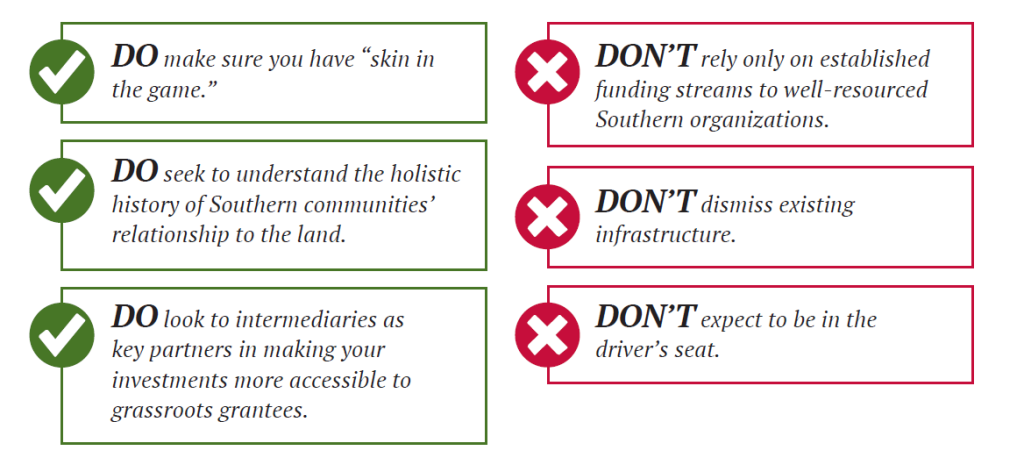
Our newest As the South Grows report, “As the South Grows: Weathering the Storm,” includes three Do’s and three Don’ts to help foundations and wealthy donors invest in climate resilience effectively and sustainably.

Do's and Don'ts

Weathering the Storm” is the third report in the five-part As the South Grows series. The fourth report will be released in February.

https://twitter.com/kendedafund/status/940679158375636992

We hope “As the South Grows” inspires you to look at the South as an important opportunity for deeper engagement, investment and partnerships.

https://twitter.com/LoraEliSmith/status/938526712429719553

Read the first two reports in the As the South Grows series:

As the historic 2017 Atlantic hurricane season has demonstrated, extreme weather events can have devastating impacts. And such events are becoming more and more common as the effects of climate change take hold. But those impacts are heightened in the American South, which sits on the front lines of the global climate crisis.

Our newest report, “As the South Grows: Weathering the Storm,” explores opportunities for philanthropy to invest in environmental, racial and climate justice in the South. Using examples in Eastern North Carolina and Southern Louisiana, the report details how the organizing and mobilizing of Southerners around these issues is not matched by foundation investment in their communities.


Learn about:

As the South Grows: Weathering the Storm” is the third report in the five-part As the South Grows series. The fourth report will be released in February.

We hope “As the South Grows” inspires you to look at the South as an important opportunity for deeper engagement, investment and partnerships.

Yna C. Moore is senior director of communications at NCRP. Follow @ynamoore and @NCRP on Twitter.

In our recently released summer edition of “Responsive Philanthropy,” I wrote about why W.K. Kellogg Foundation (WKKF) believes racial healing can transform the nation and how WKKF is attempting “…to acknowledge the wrongs of the past, while addressing the consequences of those wrongs” through its Truth, Racial Healing and Transformation (TRHT) effort.

The story focused on how leaders in Buffalo, Dallas and Louisiana are implementing TRHT. Chicago is another of TRHT’s 14 sites that sees unique opportunities in this model.

Grace Hou, president of Woods Fund Chicago, believes that TRHT will lead to a change in the outcomes for people of color in the region. Woods Fund has long been committed to prioritizing racial equity, as have their TRHT partners. Terry Mazany of Chicago Community Trust, Angelique Power of Field Foundation and Grace leveraged their relationships to quickly build a 16-person coalition to implement TRHT, and everyone they asked said yes. Grace observed that there is so much despair related to the impact of race on policies and people, and the audacity of this goal represents hope.

I was struck by the powerful cohesion among the coalition that attended the WKKF’s TRHT summit in December 2016, but Grace noted that some of the members who attended had never met before. The convening provided an opportunity to practice and bond using the head and heart model that reflects the pillars of narrative change and healing. The experience changed the way that Grace looked at racial equity work; as a former public policy servant she focused on the data, but didn’t always bring enough of her own vulnerability to the work. She said, “Digesting our own roles and figuring out how others can be brought to the table is important.” Now she believes that engaging the head and the heart can capture people who understand the data, and compel them to commit to the marathon of addressing structural racism.

The “Travelers,” as the coalition calls itself, met in January with other Chicagoans in the WKKF network. They did a healing circle to establish a strong relationship among themselves, and then worked together to host a city wide day of healing on April 4th with about 150 people. Now, with the TRHT grant they are hiring staff to coordinate design teams for narrative change, racial healing, and law and policy. Grace noted that it can be risky for a private foundation to lead a process that requires such vulnerability, but it is worth the risk.

Despite the optimism surrounding THRT from grant recipients in the 14 sites, each person acknowledged serious obstacles. One criticism is that TRHT, and specifically “racial healing,” is not systemic. Grace noted that she and others from Chicago were skeptical at the beginning of the summit with the framing of healing. But she believes that everyone who experiences healing circles can immediately understand their value. Now she, her colleagues in Chicago and leaders in the other sites are committed to supporting and modelling the healing practices that have the potential for lasting transformation in our communities.

How does your institution explore the risks of vulnerability and collaboration in your practices and grantmaking? How have you incorporated an honest acknowledgement of historical wrongs in your work? Share with us and your peers on Twitter and Facebook.

Jeanné Isler is NCRP’s vice president and chief engagement officer. Follow @j_lachapel and @NCRP on Twitter.

Aaron DorfmanNow is not the time for the philanthropic sector to hide behind a false perception of neutrality.

Some foundation staff and leaders may decide this weekend’s events and others like them are irrelevant to their grantmaking, or that to engage their foundation on issues of political extremism is to jeopardize their institution’s role as mediator, convener or dispassionate investor in the public good. This decision would be irresponsible and wrong on the facts.

There can be no neutrality in a nation where well-organized violent demonstrations and the federal government itself actively retrench centuries of structural racism and inequality.

The lesson in Charlottesville is clear: The nation’s philanthropic sector must deploy all the resources at its disposal to counter the rising tide of neo-Nazism and white nationalist violence. That means deploying a foundation’s public leadership role, its convening power, its invested assets and its grantmaking dollars to protect threatened communities – and to do so on those communities’ terms.

Here are just a few ways the philanthropic sector can meet the challenge of this moment and ensure they are among the forces for good at a time when the forces of violent oppression are gathering strength:

1. White foundation staff and leaders must speak out.

It is crucial for white foundation leaders to be vocal about their personal and institutional opposition to white nationalist politics and polices. This means not just condemning violence, but confronting the myriad ways white supremacy impacts our communities, our institutions and our grantmaking itself.

People of color are putting their careers and often their bodies on the line – white allies in leadership positions must join them.

2. Philanthropists must invest in ways to attract new people to the resistance.

Foundations and major donors can help create avenues for participation for people and communities who have to date not been involved in the movement to oppose white supremacy. The violent far right presents a threat to our democracy and to our safety. All of us are at risk.

Philanthropic investments to invite broader, deeper participation in organizing, advocacy and the political process are sorely needed now, when the white nationalist threat is attracting wide national attention.

3. Philanthropists must invest in broad-based movement building.

The movement to resist white nationalist policies at the federal, state and local levels and to oppose the real and immediate threat white supremacists pose to the communities you serve must be broad and inclusive in order to succeed.

White nationalist ideology is not just about race and ethnicity; these groups define their objective as a society where white, heterosexual Christian men and women dominate every facet of our public life.

Foundations must invest in movement building that cuts across the many issues we care about such as race, poverty, civil rights and others. It must nurture transformational relationships between and among all communities threatened by the violent far right.

Now is the time for wealthy donors and leaders of foundations to step up and take a stand. America is counting on you.

As the South Grows: Strong Roots coverDo you work at or with a national foundation investing in systemic change? Does your program include wealth- and power-building in the South? If not, your efforts may not bring sustained change.

Our latest report, “As the South Grows: Strong Roots,” details how foundations can make lasting investments in wealth-building in the South. It profiles six community, foundation and nonprofit leaders in the South, specifically the Coal Country of Kentucky and the coastal Lowcountry of South Carolina, to highlight opportunities for foundations and philanthropists to build Southern wealth by investing in local assets and capacity.

As Karen Watson of the Positive Action Committee said in our recent webinar on philanthropy in the South, as long as the South is underfunded, regressive policies will take root in the South and then spread nationwide. 


Learn about:
  • Six community leadersSix Southern leaders working to increase local assets and capacity, and protect existing ones.
  • Three Do’s and Three Don’ts for grantmakers interested in investing in wealth- and capacity-building in the South.
  • Four tips funders can take to get started with engaging with and investing in equitable economic development in Southern communities.

As the South Grows: Strong Roots” is the second report in the five-part As the South Grows series. The third report will be released in the fall.

We hope “As the South Grows” inspires you to look at the South as an important opportunity for deeper engagement, investment and partnerships.


Jennifer Choi is vice president and chief content officer at National Committee for Responsive Philanthropy (NCRP). Follow @jennychoinews and @NCRP on Twitter. 

Will history look favorably at philanthropy’s efforts to protect and promote equity during the Trump Administration?

Attendees of the Northern California Grantmakers Association’s annual conference were treated to a rousing debate over this very question. The panelists were a group of inspiring and passionate leaders from the sector: Cathy Cha of the Evelyn and Walter Haas Jr. Fund, Jacqueline Martinez Garcel of Latino Community Foundation, Lateefah Simon of Akonadi Foundation and NCRP’s Aaron Dorfman.

The verdict from the nearly 400-person audience was a resounding “No.”

If you missed it or would like to relive the experience, NCG recently posted a video of The Great Debate on its website.

Many commentators, including NCRP and various authors we’ve featured on this blog and our journal, have penned articles about what the foundations and the whole sector should do in this current moment.

And indeed, Aaron and Cathy shared during the debate how a number of foundations have stepped up in their leadership and commitment to vulnerable communities. But, as Jacqueline and Lateefah highlighted, there are many ways that the sector is still falling short of its potential for impact.

A time for soul-searching

In The Chronicle of Philanthropy, Cathy, Jacqueline, Lateefah and Aaron invited foundation leaders to look inward and ask themselves: Is my foundation responding appropriately? Is it doing enough? How can we challenge ourselves to do more?

They offer five guiding questions, among them:

  • Are we dedicating serious money so grantees have the resources they truly need?
  • Are we investing in building the power of people of color and women?
  • Are we moving money quickly?

And NCRP’s Jenny Choi encouraged grantmakers to be “bold, thoughtful and inclusive” in a Center for Effective Philanthropy blog post.

What do you think?

I hope you’ll check out these thoughtful resources and share with us your own ideas for what effective, high-impact philanthropy looks like in these times.

Yna C. Moore is senior director of communications at NCRP. Follow @ynamoore and @NCRP on Twitter.

Is your foundation prioritizing leaders and organizations that have the trust of the communities you serve? Or perhaps your nonprofit feels that donors simply “don’t get it” and are hindering instead of helping positive change from taking place?

NCRP and Grantmakers for Southern Progress have put together a list of five key Do’s and five key Don’ts for foundations and donors to have the greatest impact in the communities they serve.

You can find these Do’s and Don’ts and other important recommendations in our latest report, “As the South Grows: On Fertile Soil.”

We hope “As the South Grows” inspires you to look at the South as a ripe opportunity for impact and a source for ideas on how to deepen donor investments, collaboration and partnerships wherever you are.