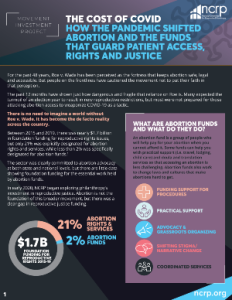
Image of the first page of NCRP abortion access fact sheet, The Cost of COVID.In early 2020, NCRP began exploring philanthropy’s investment in the reproductive justice movement and those providing services on the frontlines.

The reason was simple: Increasingly restrictive state legislation, a more conservative U.S. Supreme Court and an emboldened Trump administration that prioritized attacks on autonomy and access seemed to predict an end to the legal protections that are supposed to keep abortion safe, legal and accessible for all those seeking services.

A new year and a new presidential administration might signal greater cooperation with federal agencies, but it doesn’t eliminate the intense anti-abortion challenges that are still coming from state legislators or in the courts.

Reproductive rights are also inexorably intertwined with economic justice, racial justice, immigrant rights and health equity. As such, it’s a natural extension of our Movement Investment Project focus on how philanthropy can serve as a better ally to frontline social justice movement activists and organizations.

While over the coming year we plan to delve more deeply into the full array of issues encompassed in reproductive justice, the use of the pandemic as a pretense for anti-abortion policies, the funding patterns for this aspect of the movement and the increased pressure on state and local abortion funds made us decide to start our work here.

The reality of the reproductive access funding space

It’s hard to imagine a just and equitable world that doesn’t allow for people to have full control over decisions related to their body. While the sector is clearly committed to abortion advocacy at both state and national levels, there is little data showing foundation funding for the essential work held by abortion funds.

Why is that important? Unlike some other movements, a significant majority of the financial support for abortion access and services comes not through institutional foundations, but through smaller abortion funds that often struggle to keep up with the financial needs of patients.

In fact, less than 3% of the $1.7 billion of philanthropic dollars for reproductive rights issues between 2015 and 2019 was specifically designated to these abortion funds.  Overall, only 21% was explicitly designated for abortion rights and services.[1]

We reached out to abortion funds around the country to better understand how they are providing the practical support callers needed and how a shift in funding would benefit their sustainability and capacity. (We summarized the data and these conversations, with a focus on 5 abortion funds in Southeast, Northeast, Southwest, Midwest and Northwest, in this fact sheet.)

What we heard won’t come to a surprise to many who have sought to access the reproductive rights that the Supreme Court first upheld 48 years ago in Roe v. Wade.

The need to make access real and affordable

There is no need to imagine a world without Roe v. Wade. It has become the de facto reality across the country.

It has come into existence by those who have seized on the restrictions imposed to curb the spread of COVID-19 to further limit access abortion-related services and procedures. Consider that across the nation:

  • 12 states have attempted to shut down abortion clinics by labeling them as “nonessential businesses,” with Texas, Ohio, Arkansas and Iowa restricting or banning abortion altogether during the pandemic.
  • 19 states have banned telemedicine, limiting both the overall number of clinics and states with clinics accessible to out-of-state patients.
  • 33 states require counseling before an abortion procedure, and 25 of these states have waiting periods of at least 24-hours, forcing potential patients to make multiple trips or arrange travel for multiple days at a time.

The restrictions have also limited the work of volunteers and increased overall costs, straining regional networks of volunteers and providers that patients rely on for logistical, economic and social support.

“In the past we have relied on a network of volunteers who could house callers in their home while they were traveling for abortion care as well as provide rides to folks who needed to get to and from their appointments,” says Iris Alatorre of the Northwest Abortion Access Fund. “After COVID-19, relying on our volunteer network for these necessary services was no longer a safe option.”

What should philanthropy do?
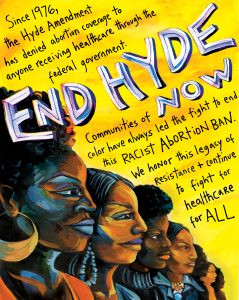
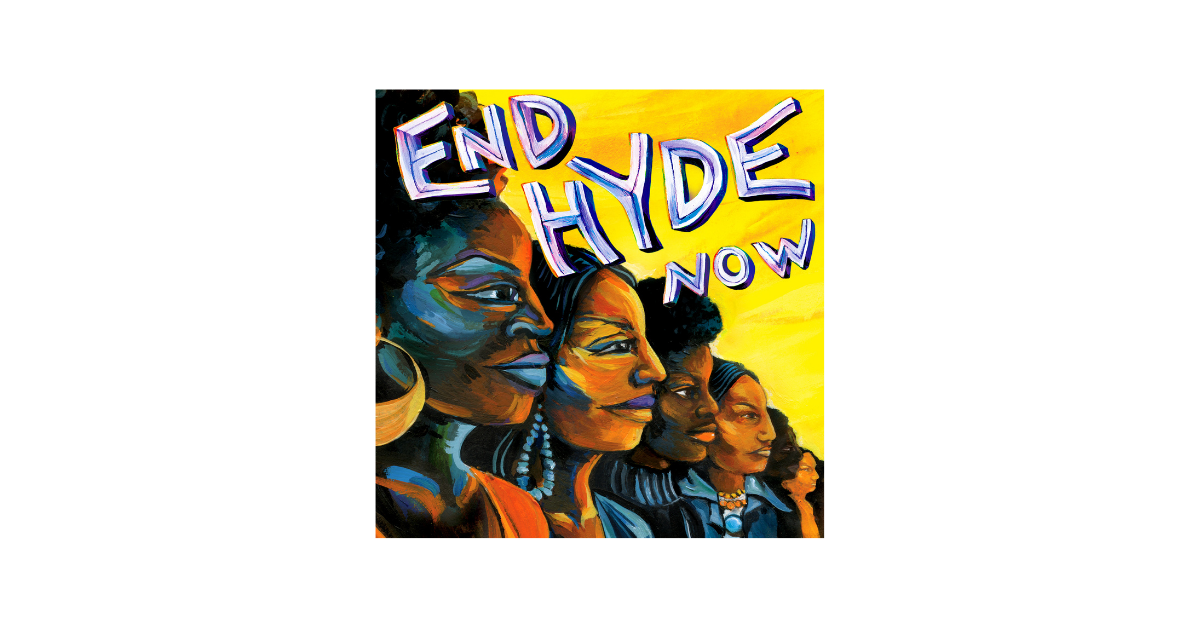
Art created by Forward Together staff, Diana Lugo-Martinez, Kara Carmosino and Micah Bazant, to mark the 43rd anniversary of the Hyde Amendment.

Art created by Forward Together staff, Diana Lugo-Martinez, Kara Carmosino and Micah Bazant, to mark the 43rd anniversary of the Hyde Amendment. Used under Creative Commons license.

Money certainly helps, as increased investment in abortion funds would help frontline groups and networks address the continuing uncertainty as the pandemic and anti-abortion legislation leaves abortion advocates under protected and overwhelmed.

It would also allow funds to further accommodate patients through increased partnerships with other organizations to better coordinate both logistical needs like housing and travel as well as mental health needs and services across states to better support those who live in restrictive regions.

The math is not complicated. We know that if abortion funds saw an increase equal to even 1% of all reproductive rights funding, this would mean an additional $9 million in foundation support for the frontlines. However, maximizing the impact of additional dollars would also require a shift in funding practices in the following ways:

Wielding power: Philanthropy must leverage its reputation, financial assets and capacity to destigmatize abortion, empower abortion funds and secure access for those seeking services.  

Unrestricted and multi-year grants: Abortion funds rely on 5 primary funders that make up 74% of their philanthropic support. If they were to lose their top institutional funder, it would compromise half of their philanthropic support, a risk that multi-year, unrestricted grants have the potential to reduce. 

Funding at the state and local level:  At the moment, the top 20 recipients of reproductive rights funding are all national organizations, while a majority of abortion services and practical support are happening at the state and local level. 

Transparency from the sector: Philanthropic transparency is vital in not only building trust with a movement that is rightfully cautious, but to disrupt the harmful practice of anonymously funding such a visible issue.  

Divestment from fad-funding: Short-lived funding inspired by a historic moment or the fear of abortion restrictions is a harmful practice and doesn’t allow abortion funds to build their capacity.  

In many ways, the situation at hand is a vivid reminder that grantmaking reflects an erroneous assumption of reproductive rights as an exclusively white, cis-woman issue centered on the national legal debate is not a framework sufficient to meet the current challenge, much less those that lie ahead.

To equitably serve communities, philanthropy must move beyond the mainstream feminist funding approach that, among other things, privileges legal advocacy over direct support on the ground, negates the links between economic justice and reproductive rights, and often renders invisible the existence of trans and non-binary people as patients needing abortion services and care.

Only a truly inclusive and intersectional reproductive justice funding framework allow us to move us closer to the social change we all wish to see.

Brandi Collins-Calhoun is NCRP’s senior movement engagement associate and leads the organization’s Reproductive Access and Gendered Violence portfolio of work.

Stephanie Peng is NCRP’s senior associate for movement research and was the lead researcher on the organization’s most recent factsheet, The Cost of Covid: How the Pandemic Shifted Abortion and the Funds that Guard Patient Access, Rights and Justice.


1Editor’s Note: Analysis of original figures initially published in January of 2021 concluded a total of 912 million in funding for reproductive rights issues, with 20% going to abortion services and 2% going to abortion funds specifically. However, new data added into the Candid database in late 2021 updated those figures.

I invite donors to act as boldly as the Black and brown women whose bodies are the front lines of change.   

In Georgia, long before the 2020 elections were part of the national news cycle, Nse Ufot, Stacey Abrams, LaTosha Brown, Phyllis Hill and many other Black women saw the threat that was coming for their families.   

They activated their vast networks, at first with very few resources to support the work, and they did the slow, tedious work of building a base of everyday people.   

Their successful efforts will reverberate to benefit millions of families. In Arizona and Nevada, Latinas including Alejandra Gomez, Alicia Contreras and Denise Lopez changed the course of history, generating record election turnout numbers.  

Yet still too few foundation dollars are being devoted to centering the leadership of Black and brown women.     

My colleague Aaron Dorfman, president and CEO of the National Committee for Responsive Philanthropy, and I met in 2003 when we were both organizers in Florida.   

In an early conversation about my upcoming book Thriving in the Fight: A Survival Manual for Latinas on the Front Lines of Change, he encouraged me to include a list of tips for donors who want to support the leadership of Latino women. Most of these tips also apply to investing in leaders of color more broadly. 

Here are 7 tips to help you be wildly successful at supporting the leadership of Latinas.   

1. Trust Black and brown women. Nikole Hannah-Jones reminded us in The New York Times 1619 Project that “Our democracy’s founding ideals were false when they were written. Black Americans have fought to make them true.” Black women have been calling our country to live into its fullest self since before we were a country. When in doubt, lean on the wisdom of women who self-identify as Afro-Latina, Black, Indigenous, Hispanic – all women of color who are closest to the community.  These are the people who will continue the fight when no one is looking.   

2. Don’t wait for us to call you. We’re usually overworked and very busy. Reach out to us by phone or text and be willing to talk to us while we’re on the move (or with kid noise in the background). I believe that Black and brown women bear outsized responsibility both at work and at home. We often don’t have the commensurate resources, recognition or room for reflection to get the job done. Yet, we usually get the job done anyway. Sometimes this happens at the cost of our health, psyche, careers and families. That is why it’s critical to deeply invest in our leadership.   

3. Invite us many times. If you reach out to us and you don’t hear back, it’s because we’re usually overworked and very busy. If you invite us to present at a conference and we say no, persist. I know many Latinas who have declined invitations to speak or be honored for their work because of the lessons we’ve been taught about humility and leading from behind without expecting any recognition or reward. It’s also a huge sacrifice every time we leave our chosen families and families of origin to attend ‘extra’ events even if they’re virtual.   

4. When we do call you, we’ve needed your help for a long time. Listen intently to what we need, and do your best to help us out. Sometimes when you are used to doing your work with limited financial resources, it becomes hard to imagine what it would be like to have lots more money. I have watched white women leaders advocate for 3 times the resources as their Latina sisters for the exact same work.   

5. Make it easy for us to access funds. Remember, many of us have complicated relationships with money. When you come from poverty, asking for money is terribly  As an example, instead of asking a close family member for a loan to support my exorbitant Harvard tuition, my parents chose to rent out their house and go live with family, work overtime, deliver Domino’s pizza and damaged their credit. Do your best as a donor to make it simple for us to access resources.   

6. Give us other ways to communicate with you.If you find that we are delaying at the point of the process where we need to submit something to you in writing, it’s likely we worry that our writing isn’t good enough. So instead of sending it over, many of us will wring our hands and avoid. To combat this, consider accepting information in many modalities: PowerPoints, YouTube videos, listening into a meeting via phone, events, phone conversations, newspaper articles, etc. Or, you could even offer to pay for a writing consultant or firm. Remember, worship of the written word is one of the symptoms of white supremacy, so do your best to break down that norm in your role as a donor.   

7. Ask us how we are investing in our own development and consider paying for it in some way. Always take a moment to ask Latinas and women of color more broadly how they’re investing in their own development. So often, women stay so busy doing the work that we put our own needs last. Ask what they’d love to learn but haven’t had time for. Seek additional ways to support the leadership of women. A prestigious K. Kellogg Foundation fellowship includes funds for self-care that can be used for things like acupuncture and massage. Before COVID-19 hit, the Ford Foundation began investing in convenings that can be built around radical self-care. These are the kinds of supports that can rejuvenate Latinas and all women of color. Ask about the organization’s leave and parental benefits policies, and ask how they’re preparing themselves and their employees for retirement. There are many ways to support the development of Latinas. Sometimes we’re too busy to imagine what could be. 

This country is in a moment that requires accountability. I am grateful for groups like NCRP who are calling for greater accountability for donors who are seeking to do the most good. By following these 7 steps, funding partners can help create environments in which women of color thrive. When Black and brown women thrive, we all thrive.  

Denise Collazo is a social justice leader, mentor to fellow women of color and family work integration innovator. She is senior advisor for external affairs and director of institutional advancement at Faith in Action, the nation’s largest faith-based community organizing network. Pre-order copies of her book before February 23, 2021 here. Net proceeds from the sale of the book will go to a fund for Latina community organizers that is administered by Latina community organizers.   

This post was originally published on NCRP’s Medium page.

On Jan. 5, my home state of Georgia made history. Georgians chose to send Rev. Raphael Warnock to Washington, making him Georgia’s first Black U.S. senator, the country’s 11th Black senator ever, and the second Black senator from a former Confederate state since Reconstruction. They also chose to elect Jon Ossoff, Georgia’s first Jewish U.S. senator and the body’s youngest sitting member. 

Georgians did what many thought was impossible because grassroots organizers – especially Georgians of color, and most especially Black women – fought tirelessly. They responded to absurd levels of documented voter suppression in 2018 by helping register over 800,000 new voters. And when many of November’s white voters stayed home in January, voters of color showed up

On Jan. 6, Georgians’ choice became even more important. Months after the U.S. Department of Homeland Security labeled white supremacist groups as the most persistent and lethal threat” to the country, far-right terrorists stormed the U.S. Capitol in a blatant attempt to stop the legal certification of votes for the presidency. In the chaos, 5 people lost their lives. 

The president, the majority of House Republicans and several Republican members of the Senate incited and emboldened the insurrectionists. Congress and their staff were forced to flee.  

And in the wake of a poorly coordinated and at times sympathetic Capitol Police response, we saw once again how law enforcement so often props up white supremacy and far-right extremism.   

Like Georgia, D.C. has long been my home. As I sat awake in my bed barely 2 miles from the attack, hearing sirens late into the night, I felt in my bones what so many Southerners know: This week wasn’t a surprise. This is America. A country of progress and backlash, Reconstruction and Redemption. It’s a history that rhymes, with many more chapters ahead.  

Our NCRP team has family who have lived through armed civil conflict around the globe, and we know that we embrace American exceptionalism at our own peril. After all, America has suffered a far-right coup before.  

White supremacists in Wilmington, N.C., responded to the 1898 election of a progressive inter-racial coalition by overthrowing the local government and massacring at least 60 people. That coup was successful. It became one of many brutal, anti-democratic acts of terror that laid the groundwork for Jim Crow to flourish long past the end of slavery and into the current day. 

That’s why in moments like these – and there will be more in the days and years ahead – I look home for guidance. Whether our history books acknowledge it or not, the beautiful organizing for justice and liberation in Georgia and across the South has always been there, waiting for the rest of us to wake up, to listen and to join the call with our voices, our bodies and our dollars.  

This is all the truer for liberal white men like me, who are tempted to distance ourselves from whiteness as if we’re one of the special ones, rather than recognizing our complicity in the violence. 

The oppression so often pioneered and refined in the South, like the resistance to it, always shapes the nation. In NCRP’s joint As the South Grows initiative with Grantmakers for Southern Progress, we pointed out that Southern activists have long known how to overcome regressive policies and unjust rules of the game, despite receiving just 56 cents per person in foundation funding for every $1 invested elsewhere.  

So, as we prepare for what comes next, this is a good time to honor the people who have worked for generations to make Georgians’ January choice possible and who will be hard at work long after 2021 ends. Stacey Abrams has a great list to follow 

Here at NCRP, we want to shout out our own nonprofit members based in Georgia fighting daily for a better future:  

  • Black Voters Matter Capacity Building Institute  Led by long-time NCRP friends LaTosha Brown and Cliff Albright, and headquartered in Atlanta, Black Voters Matter needs little introduction. Black Voters Matter increases the power of marginalized, predominantly Black communities through year-round relational organizing, voter registration, policy advocacy, organizational development, authentic messaging and a deep respect of local infrastructure. Black Voters Matter recognizes that Black women are the MVP’s of systemic change and invests accordingly.  
  • Blue Institute – For too long, the staff on electoral campaigns have failed to represent the demographics of our communities. The Blue Institute provides trainings, education and advocacy so youth of color across the South can lead and thrive in progressive politics. When campaign staff of color are compensated and trained at the levels they deserve, fights for public office are stronger, wiser and more effective. 
  • Georgia ACT Georgia Advancing Communities Together works to ensure that all Georgia families have safe, decent housing in strong, vibrant neighborhoods. As a statewide coalition of nonprofit housing and community development organizations, Georgia ACT combines policy, coalition work and civic engagement to fight for fair, affordable housing for all. 
  • Georgia Appleseed The Georgia Appleseed Center for Law & Justice is deeply dedicated to justice for all of Georgia’s children, especially children of color, children with disabilities and children experiencing poverty. They combine pro bono legal expertise and top-notch research with grassroots engagement, policy advocacy and nonpartisan civic engagement. This Swiss Army knife approach enables progress on everything from equitably funded schools and healthier homes to juvenile justice reform and access to the polls.  
  • Inner-City Muslim Action Network – IMAN Atlanta has its roots in Atlanta’s West End neighborhood, where they’ve organized for years around criminal justice reform, refugee rights, children’s rights, community arts, mental health and holistic wellness, and so much more. IMAN’s relational organizing and advocacy enables them to work alongside marginalized communities in Georgia to upend structural and systemic barriers at the root of injustice. 
  • Southeast Immigrant Rights Network With roots in Georgia and North Carolina, SEIRN is an incredible network of grassroots, immigrant-led groups across the rural and urban Southeast. SEIRN promotes collaboration, connection, leadership development, political education and collective action throughout the network. They’re a trusted voice and a much-needed resource to build just and inclusive communities in Georgia and across the South.  
  • Welcoming America – Headquartered in Decatur, Welcoming America fosters inclusive, welcoming communities for immigrants and refugees in Georgia and across the country. They’re well known for their trainings and regional plans with city and county governments. They also have a savvy understanding of narrative and communication and work closely with other organizing partners in the pro-immigrant movement. 

We also want to thank a few local and regional funding efforts that have been in it in Georgia for the long haul: 

  • Grantmakers for Southern Progress Based in Atlanta under the leadership of Tamieka Mosley, GSP is a crucial resource for any Southern or national funder who wants to invest accountably and effectively in Southern-led social justice. NCRP has worked closely with GSP since our joint initiative As the South Grows, and they provide an incomparable wealth of connection and expertise.  
  • Latino Community Fund of Georgia – LCF Georgia is an all-star when it comes to funding, supporting, and advocating for Georgia’s Latino-led and -serving organizations across the state. They raise and move money, build capacity, amplify the collective voice of this powerful network and ensure that the narrative of Georgia’s Latino, Latina and Latinx communities is rich with beauty and complexity. They also co-host , a local funding collaborative for immigrant justice.
  • Mary Reynolds Babcock Foundation – For decades, the Mary Reynolds Babcock Foundation has invested in Southern social justice groups in Georgia and across the South, often providing stable, long-term funding before another funder would. Their shrewd investments are combined with a commitment to bring more foundations to the cause and work alongside marginalized communities to determine their strategies. 
  • Sapelo Foundation With an abiding belief in a “just Georgia,” the Sapelo Foundation makes grants across the state to protect the environment, build civic power, and create healthy communities. The foundation is also embarking on a mission investing plan to align 100% of its capital with these values. 
  • Southern Partners Fund – Headquartered in Atlanta, SPF provides grants to social justice organizations in Georgia and across the rural South. Their model is all about building power by sharing power: Grant decisions are made with dynamic input from the grantees themselves. They organize year-round, think long-term and respond quickly to crisis.  
  • Southern Power Fund Created in 2020 by 4 Southern pillar organizations, Project South, Alternate Roots, The Highlander Center and Southerners on New Ground, this fund is moving millions to Black, brown, Indigenous and queer leaders and organizers across the South with brilliant plans for change. The fund is also supported by Grantmakers for Southern Progress and Funders for LGBTQ Issues’ fantastic Out in the South initiative. 

Last but not least, the rest of the South deserves love too. We owe a debt of gratitude to our amazing nonprofit members throughout the South:  

This year will offer us many more choices. Will we honor what’s been sacrificed with words, but move slowly in our actions? Or will we choose that just, more beautiful future faster? For America’s sake, this displaced Southerner prays for the latter.  

Ben Barge is NCRP’s field director. He, alongside Research Director Ryan Schlegel, Senior Associate for Movement Research Stephanie Peng, voting rights activist LaTosha Brown and staff of Grantmakers for Southern Progress and the Institute for Southern Studies were instrumental the creation of As the South Grows. The 5-part series exploring the fundraising challenges and other obstacles faced by those organizing in the South, can be found here. 

Image by John Ramspott. Used under Creative Commons license.

There is no doubt that this has been a uniquely challenging year for everyone across all sectors and professions, in ways we couldn’t even have fathomed as the year began. 

At NCRP, our work to achieve long-term change and support for under-resourced Black, Indigenous and people of color communities took on new significance this past year, as poverty, health disparities and institutional racism were just some of the long-standing fissures that deeply impacted lives in deadly and unavoidable ways.

Certainly, none of this work would have been remotely possible without the incredible work of our NCRP staff. Like so many people around the nation, they managed to do amazing things amid a pandemic and, in some cases, significant disruptions to their personal lives.  

It is because of their tireless work with our allies and partners that we are privileged enough to be able to enter 2021 with some ambitious plans for holding ourselves and the sector accountable to equitable systemic change.  

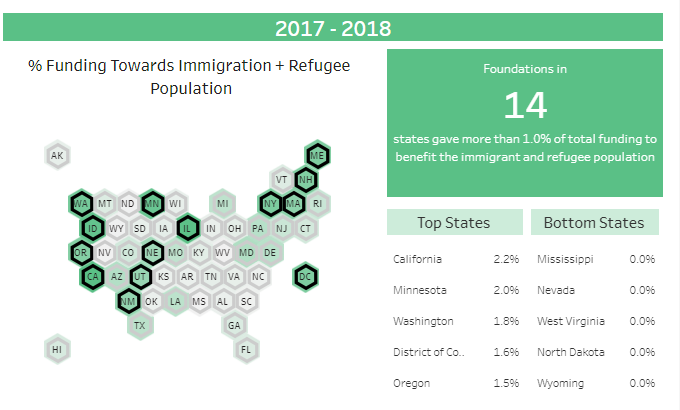
From the 2020 Interactive Dashoard: Number of States that Meet or Exeed 1% Demographic Standard of the Report

In 2020, NCRP released an online dashboard of grantmakers that provide the most and least funding for groups serving or led by immigrants and refugees in each state.

What we accomplished in 2020 

Before stepping into the new year, it’s important to take a step back and acknowledge some of the important successes that our collaborations achieved over the past twelve months. Some of those highlights include: 

  • Rapidly Pushing for an Equitable Response to COVID-19: We, along with many of our partner philanthropy serving organizations (PSOs), encouraged increased giving with a focus on equity in response to the pandemic and the lack of racial justice in America. Many foundations responded incredibly well. (See here and here.) 
  • Galvanizing Better Support to Movements: We helped foundations and high-net-worth donors improve how they support movements. Our Movement Investment Project seeks to inform, influence and expand the number of movement funders. In 2020, we focused on the Pro-Immigrant and Refugee Movement, conducting intensive engagement with national and regional PSOs and funders. We also engaged deeply with the movement groups, bringing their voices and experiences into the campaign. In May, we released a new online dashboard that allows users to see which grantmakers in their states provide the most (or the least) funding for groups serving and/or led by immigrants and refugees. 
  • Deeping the Conversation Around Power: We helped hundreds of foundations and donors think critically about how they build, share and wield power. Power Moves (NCRP’s foundation assessment toolkit) continues to be popular, with several foundations publicly releasing the results of their assessments. We also made numerous presentations on the toolkit, which can be found on our events calendar

All of this important work was made possible because of the leadership, vision and trust of our board, the collaboration of our many partners and allies, and with the support of our funders.  

Big plans for 2021 

As we enter our 45th year of existence, NCRP is more committed than ever to playing our role as the sector’s only independent watchdog and its longest serving critical friend. As a result, expect us to:  

  • Expand the Movement Investment Project. We are adding a focus on reproductive access and gendered violence,which will culminate in projects and reports that aim to help movements galvanize funding and intersectionally reframe the public discourse about these issues. Work on the pro-immigrant and refugee movement will continue, as will our work to be responsive to movements in the moment, including the Movement for Black Lives.  
  • Continue to engage the sector with our Power Moves toolkit. We have several presentations planned, and we’ll continue to facilitate peer learning and one-on-one interactions among select foundations to advance their use of the toolkit to change practice. 
  • Honor the sector’s best with the NCRP Impact Awards. Next fall, we’re looking forward to celebrating bold, cutting-edge philanthropy that makes our nation more fair and just. Stay tuned to find out more about this initiative, which will be held at the CHANGE Philanthropy Unity Summit in Minneapolis. 

For 4 decades, we have prided ourselves at producing and presenting credible, evidence-based research that holds a mirror to what philanthropy is doing right and what it needs to correct to do better. However, if there is anything that 2020 has reminded us, it’s that the world depends on us to do more than just present data, stories and solutions. It demands that we move past applauding our intentions and actively using all these tools, without hesitation, to act. 

Philanthropy is filled with a lot of people who want to do good, even if they don’t quite know how to do it. We look forward in 2021 to building on the current spotlight to do good and pushing each other to double down on the investments that need to be made in social, economic and environmental justice.

To continue redefining public safety beyond law enforcement so that we can abolish the various forms of fear and violence that limit not just dreams and potential — but also lives.   

To creating and continuing partnerships that boldly seize on the urgency of now to actively bend the moral arc of our sector toward equitable justice — and love. 

Aaron Dorfman is president and CEO of the National Committee for Responsive Philanthropy. 

Leadership matters, especially in challenging times. 

I am feeling deep gratitude for the nonprofits (501c3 and 501c4) that played such an incredibly important role this year protecting democracy. Their work was absolutely pivotal. 

Joe Biden and Kamala Harris have been elected president and vice president of the U.S. Control of the Senate won’t be decided until the January runoff elections in Georgia. While the full implications of the election remain uncertain, one thing is crystal clear: Philanthropic funding for movements will be needed more than ever in 2021. Sustained grassroots organizing is essential if we hope to make progress on the pressing issues facing our nation and the world. 

In this issue of Responsive Philanthropy, we explore courageous leadership and damaging failures of leadership at some of the nation’s largest philanthropies. 

Performative philanthropy and the cost of silence

Ray Holgado, a former Chan Zuckerberg Initiative employee who recently filed a discrimination claim against the philanthropy with the California Department of Fair Employment and Housing and the U.S. Equal Employment Opportunity Commission, offers a blistering critique of the philanthropy’s alleged racial discrimination toward Black staff and suggestions for how the field can move forward.

Filling in NoVo’s void

Brandi Collins-Calhoun, NCRP’s senior movement engagement associate, shares a deeply personal account of how NoVo Foundation’s decision earlier this year to eliminate its gendered violence program is impacting Black women in philanthropy and social justice movements. She also challenges other donors to step up and urges NoVo to execute a responsible exit – something the foundation has committed to in general terms without offering any specifics thus far. 

Donors and foundations are increasingly supporting movements

The above examples notwithstanding, it has not been all bad news for philanthropic leadership in 2020. In fact, many high-net-worth donors and foundations have been leading in phenomenal ways. I lay out some shining examples of philanthropy supporting movement work.

As we conclude the final week of Hispanic Heritage Month, I want to take a moment and some words to appreciate our Hispanic and Latinx comrades1.   

No matter my work, defunding the police, abortion access and everything in-between, they met me on the frontlines and had my back.  

We found ourselves intentionally sharing space and being in community with each other. And we often stand in solidarity with one another also because our movements and lived experiences tend to intersect.  

As people of color, we constantly find our communities with the same foot, just a different shoe, on our necks, and showing up for each other has become an act of survival.    

I choose this space and moment to honor the history and many contributions of Hispanic greatness across movement areas and sectors.  

Shared battles confronting America living history of violence 

This year I began my work with NCRP as the new senior movement engagement associate, curating space within the Movement Investment Project to focus on reproductive access and gendered violence. These frameworks wouldn’t exist without the contributions of activists like Luz Rodriguez and the late Lorena Borjas 

Over the past few weeks, I’ve watched movement leaders and organizations holding the work at the intersection of Latinx communities, reproductive access and gendered violence. Not because it’s my job, but to make sure I plug into their work celebrating Hispanic Heritage Month and provide support as needed as they’ve done for me time and again.  

But what they’ve reminded me of is that, as people of color, we do not have the privilege of living single issue lives. So, in the moments we reserve to celebrate and honor our history and accomplishments, there are often moments that call for a pause.  

Since the first week of Hispanic Heritage Month, folks have had to shift their capacity and focus to the violence that Latinx folks experience, all at the hands of the state.  

In mid-September, we learned that a doctor in Georgia was performing hysterectomies on immigrants detained at the Irwin County Detention Center without their consent.  

Multiple people explained that they were taken to an outside medical space where they were coerced into the procedure through the lack of translation services and extreme tactics like malpractice. 

A woman reported that the doctor removed the wrong ovary during a surgery that was scheduled to relieve her of an ovarian cyst, and another explained that she was simply getting a cyst drained. Both received hysterectomies and were left sterilized.  

But the current presidential administration using immigration as an entry point to revoke bodily autonomy and inflict reproductive harm isn’t a new strategy.   

In September 2017, the world learned that a shelter under the watch of the Office of Refugee Resettlement was holding a pregnant 17-year-old, Jane Doe, hostage to prevent her from getting abortion care.

For a month, the shelter refused to let Jane attend appointments for her abortion. They forced her to receive coercive religious counseling from anti-abortion crisis pregnancy centers and medically unnecessary ultrasounds to guilt her into carrying the pregnancy to term.  

The staff also took it upon themselves to inform Jane Doe’s parents of the pregnancy despite Jane already securing a court order to avoid bypass their involvement.  

At the end of September, the 3-year long battle between the ACLU and the administration came to an end when the absurd policy that banned abortion access to unaccompanied immigrant minors was overturned.  

The news of the win for Jane Doe and other minors who have since received counsel from the ACLU was a major win, but was also a reminder that the prison industrial complex has a variety of ways it exists and harms Latinx folks. 

As October came, I continued to watch for ways to support frontline efforts. 

On Oct. 4, organizers and their communities in New York City and across the nation made sure we said Layleen Polanco’s name, a loved transgender woman in their Yonkers community who lost her life a year prior.

That Sunday would’ve been her 29th birthday, but a $500 bond and her killers at the Rikers Island Prison Complex stole that from her.  

She was left in solitary confinement with known physical and mental health needs, as prison guards left her unresponsive for hours before calling for medical attention. Solitary confinement is a weapon the carcel systems uses to inflict gendered violence especially against transgender kindred.  

And while the state has offered her family $5.9 million in settlement money and “disciplined” 17 guards and captains employed by Rikers, we know that justice has not been served and actions haven’t been taken to prevent this from happening again.  

How can philanthropy step up? 

I’ve tried to think of ways to support my comrades holding this work, sharing their content and sending what coins I have the capacity to give, but let’s remember there is a sector with greater means and capacity we can call in.  

NCRP will continue to hold space beyond October to discuss the ways funders can invest in the safety of Latinx folks. Some ways philanthropy can immediately be helpful include: : 

  • Supporting the leaders on the ground holding this work and holding their communities close.
  • Following movement leaders such as those at Project South, who have made it their personal missions to shut down the Irwin County Detention Center and fight for those that have been sterilized.
  • Funding abortion access work through the Janes Due Process whose team alerted the ACLU about Jane Doe’s case and is at the forefront of the fight for abortion access in Texas in these uncertain times.   
  • Give coins to the COVID Bailout, an organization committed to freeing incarcerated folks being held hostage by New York City’s bail system.  

There are movement leaders like NCRP member National Latina Institute for Reproductive Justice that commit to working at this intersection and require ongoing support to hold the cross-movement work that their mission reaches.  

Considering all that is going on in the world as we speak, the best way for philanthropy o celebrate Hispanic Heritage Month by is by investing in the safety of our Latinx neighbors and colleagues on the frontlines and in their communities.      

Brandi Collins-Calhoun is NCRP’s senior movement engagement associate. 

1. Editor’s Note: How to classify U.S. residents with heritage from Latin America is an ongoing debate. For clarity’s sake, we are choosing to refer to the time from Sept. 15 to the end of October as Hispanic Heritage Month, using the most generally used governmental term. We are choosing to refer to the current community that shares that heritage as Latinx. While we see using the suffix “x” as the most inclusive, non-gendered based term, we understand that desire to use the more traditional Latino/Latina term. This is by no means a settled debate.  

Image by The COM Library. Used under Creative Commons license.

recently spoke to Zakiya Mabery, founder of B. Global Diversity & Inclusion Strategic Planning, to spark an action-oriented conversation in philanthropy about including the needs and voices of the disability community in efforts to combat systemic racism. 

Vilissa Thompson

Vilissa Thompson

As I sought out the voices of people of color doing this work, a trend started to emerge: A vast majority of the people most visibly working on disability justice are contracted consultants.  

One such consultant is Vilissa Thompson, LMSW. A macro social worker, disability rights consultant and founder of Ramp Your Voice, Thompson has worked on disability rights issues for about 7 years without grant support.  

Thompson said this was an intentional decision because there are many regulations and rules governing nonprofits, as well as burdensome processes to acquire philanthropic resources.  

She believes the nonprofit path isn’t as appropriate for her work; incorporating as an LLC gives her more independence and does not come with the constant struggle to fundraise from grantmakers and other donors as a Black disabled woman.

NCRP and Grantmakers for Southern Progress’s As the South Grows (ATSG) project documented similar challenges for local civil rights groups across the South that did not fit into traditional structures of what funders think indicates capability for success.  

Much like society’s historical view of disability is that those with them are prevented from succeeding, funders relied on outdated assumptions when determining which groups to fund. 

“Foundations and donors disregard … leaders because these individuals seem to lack the educational credentials or formal capacity that grantmakers expect from experienced nonprofit executives,” our ATSG research found.  
 
However, “the capacity to effectively relate to, persuade and represent communities is more important than the capacity to write a grant proposal or speak a funder’s language.”  

The structure of how Thompson gets paid doesn’t impact the professional joy that she gets from the work. For her, working with the Movement for Black Lives — a nonprofit-based movement — as an accessibility consultant for virtual events has been a positive experience.  

“It’s been really good to encounter an entity that is intentional about centering disability justice and the experiences of Black disabled folks,” Thompson said. “That’s been a surprisingly good experience.”  

Over the years, Vilissa has witnessed an increase in interest from organizations and activists to center the disability experience, particularly those of multiply marginalized disabled people.  

Of course, while the people with lived experiences will always be doing the work, it will be telling who continues to focus on disability justice after the current racial justice reckoning dies down.  

Unfortunately, our country tends to have a short attention span when it comes to marginalized communities.  

When the COVID-19 pandemic first hit, how states would meet special education requirements under the Individuals with Disabilities Education Act (IDEA) was a hot topic even outside of the disability community.  

There was a flurry of national mainstream media attention in March and April when U.S. Department of Education Secretary Betsy DeVos was expected to make recommendations on IDEA waivers to Congress.  

However, after she released the recommendations, the issue, which affects children of all ages, was relegated to the local news and specialized publications about disability rights. 

“It’s time to put your money where your mouth is,” Thompson declared. “Philanthropy needs to listen to the folks with lived experiences to see how they can support the work and not just maintain the status quo.” 

Adam Fishbein is NCRP’s membership intern.

Have you considered how your foundation is centering Black disabled lives in your grantmaking? Have you asked your grantees how they’re including people of color with disabilities in their work and provided resources for them to do so? Look out for the third and final installment of NCRP’s blog series on disability justice, which will include recommended actions philanthropy can take to better fund the disability rights movement. 

Fundraising, especially for small grassroots nonprofits, is often a necessary, but daunting task. For those who are working hard toward ending the exploitative nature of much of our economic system, it can be especially frustrating to have to engage in that very same system in order to continue their fight and support local residents.

However, a different, more transformative story is emerging from the organizing efforts of groups like Siembra NC. The organization’s members in North Carolina are stepping into leadership and providing direct assistance to neighbors impacted by the immigration system and COVID-19.

What it shows is that if centered on the direct needs of impacted vulnerable communities, fundraising efforts led by the most impacted can not only raise money but can also enhance other power building activities.

Siembra’s Immigrant Solidarity Fund

Virtual fundraisers spread through social media has helped empower Siembra's grassroots fundraising efforts. Photo credit: Siembra. NC

Virtual, social media-driven fundraisers have helped empower Siembra’ s members to raise money for community residents.  Photo credit: Siembra NC

Siembra NC was founded in 2017 as an explicitly pro-Black, pro-undocumented, pro-working class, pro-woman, pro-LGBTQ, pro-transgender, and pro-Indigenous organization of Latinx people building power “with papers and without papers.”

A fiscally sponsored project of the national Mijente Support Committee, its members across 6 North Carolina counties have won new policies to limit U.S. Immigration and Customs Enforcement-local law enforcement collaboration, helped defeat anti-immigrant state legislation and supported immigrant worker wage theft campaigns that won over $60,000 in back pay and damages for their members.

Last year, they knocked on hundreds of Latinx voters’ doors in Durham to help win a $95 million affordable housing bond, the largest housing bond referendum in North Carolina history.

One of the most significant efforts has been their ability to directly provide cash assistance to community residents caught up in the nation’s detention machine. Much of $80,000 raised before this year was initially raised by undocumented immigrants at “pop-up” fundraisers and with help of groups like Church World Service, who helped expand the fund permanently to cover some of the most populous counties with more of the state’s ICE detentions, including Raleigh and Durham.

The effort came about as a response to a direct need, as families who had lost their primary breadwinner to ICE detentions needed direct support. (Of people detained by ICE in North Carolina who came in contact with Siembra, 95% were men and the vast majority were a family’s primary earner).

It was that attention to the practical service needs of their members that also forced them to adjust the focus of their work in the aftermath of COVID-19.

Responding to the moment

People of Latin American descent make up 34% of North Carolina’s confirmed COVID-19 cases, despite making up just over 12% of the state’s population. The majority of Siembra’s members and Latinx people in the state also work in industries considered “essential” and were never forced to close.

Siembra members distributed their own masks to community residents to help combat the coronavirus pandemic. Photo credit: Siembra, NC

Siembra members distributed their own masks to community residents to help combat the coronavirus pandemic. Photo credit: Siembra NC

Siembra’s inaugural survey of impacted Latinx North Carolinians revealed the problem early on.

While nearly 70% of those interviewed lived in a household where at least one person had lost work, only 13% lived in a household where someone was receiving federal aid, with as many as 45% reporting at being unable to pay rent.

Their 24-hour detention hotline organically became a COVID relief hotline, with hundreds of people across the state calling to find out everything from the proper social distancing measures to how to electronically pay a utility bill to navigating job terminations after revealing that they tested positive.

“As has been true during regional tornados and hurricanes, Siembra instantly became a critical source of Spanish-language information for our 30,000 Facebook followers and thousands more who receive our text message alerts,” says Siembra’s Interim Director, Andrew Willis Garcés. “We started hosting livestreams in Spanish with public health experts, tenant organizers and local city attorneys and others who could explain not just the shutdown orders, but how they could virtually organize to advocate for themselves and family members.”

Some of those virtual conversations pulled in as many as 10,000 views within a few hours, as Spanish-speaking North Carolinians listened to advice on how to navigate situations like what to do about a rural school district not making accommodations for students who did not have Wi-Fi at home or how to handle outbreaks at work where they were not being offered preferred provider organization coverage — in violation of the CARES Act.

When getting PPO equipment became an issue, Siembra members relied on their sewing skills to create a mask making business that not only provided basic protection, but also raised funds for families who could access traditional government assistance.

Donors to the detention fund reached out to ask Siembra if they’d be willing to expand the fund’s mission to support immigrants impacted by COVID-19.

“Initially we said ‘no,’ because up until this point we had been able to support 100% of the people who had asked us for support with detention navigation after an ICE arrest, and we did not want to be in a position to serve as gatekeepers for scarce resources,” said Garcés. “However, rather than make the decision ourselves, our staff team convened our member leaders over Zoom and put the question to them: “Would you all want to design an eligibility process and distribute the funds to people impacted in each county?” They said ‘Yes’, and elected three undocumented delegates from each leadership team to form community driven decision-making body, our “Comité de Fondo”.

Siembra members put their sewing skills to the test to make their own masks for community residents. Photo Credit: Siembra, NC

Siembra members put their sewing skills to the test to make their own masks for community residents. Photo Credit: Siembra, NC

Members of the new Comité created a bottom-up eligibility process, holding Zoom meetings to establish criteria for their “People’s Stimulus” relief funding.

They decided to award funds to other undocumented people ineligible for federal stimulus funds or unemployment, with additional priority given to families with active COVID-19 cases, households with fewer earning adults (often headed by single mothers), and who had experienced significant income loss.

As they continued to see people detained by ICE in county jails, those families received priority as well.

It was not easy. A lot of unpaid time was spent talking for hours about how much aid to provide to each family. The overwhelming sense among the leaders was to try to “get this out to as many people as possible,” leading to them to settle on a donation range of $300-$750 per family.

Recipients were identified both after calling Siembra’s hotline looking for a referral for financial support and by members themselves canvassing their neighborhoods and workplaces.

However, according to Garcés, making hard choices about aid eligibility made many of those members feel more ownership of the organization and of their leadership teams. Seeing families getting checks in their hands motivated them to do more, empowering them to take the lead on other service activities like “drive-thru” mask distribution and voter registration events.

They also recruited many other Latinxs new to Siembra who learned about the Relief for All work on social media or in local businesses to become volunteers and, later, dues-paying members.

The result is a people-powered campaign that has raised more than more than $200,000, with over $100,000 from individuals as part of their #ShareYourCheck campaign. Additional support has also come through grants from various foundations and through the cities of Winston-Salem and Greensboro.

For these leaders, being charged with giving away hundreds of thousands of dollars has given them both a greater sense of purpose and a deeper sense of larger community issues and problems. When Latinx immigrant members this summer showed up at over a dozen demonstrations led by Black partner organizations in multiple cities, it led to 2 different member study groups to learn about the history of anti-Black racism and the ways their struggles are connected.

Philanthropy’s key role is evident and imminent

Giving Siembra members the opportunity to learn how to wield financial power for others has helped positively define their local leadership journey. Yet, for all of their fundraising success, the vast majority of financial support that the organization has received has been for direct cash assistance, not to pay staff to oversee funds distribution or the other program work. Even worse, there is a real fear that foundations won’t see the need to help a group that seems to have learned how to survive – though maybe not thrive.

So what is the opportunity for local, regional and national funding networks with groups like Siembra? A generation-defining chance to not just economically stabilize families, but also produce Black, Indigenous and People of Color leaders that will care about issues across racial, economic and gender lines.

Imagine how many people Siembra members could help if this kind of experiential fundraising training were directly funded? By directly supporting this kind of resource building, philanthropy has the opportunity to develop the individual and collective economic power of local communities beyond the structural obstacles that threaten to keep us all back.

Continued racial injustice, increased ICE enforcement and a looming housing crisis already has many across the state reaching out to all sectors for guidance and direct financial support. At Siembra, members know that they are the seeds of change that communities need to grow. They are more than willing to collectively tend and till the soil. However, to successfully nurture the environment that people need to reach their potential, they need more people to pay for the water, not just deliver it.

Elbert Garcia is NCRP’s director of strategic communicationsFollow @ElbertGarciaFl and @NCRP on Twitter.

Top Photo: Siembra members celebrate delivering “Relief for All” checks to families. Photo credit: Siembra NC

Part 2 of our discussion with Comunidad Colectiva’s Stefania Arteaga. Read part 1 here.

When it premiered in August, Time Magazine called Netflix’s “Immigrant Nation” one of the year’s most important documentaries.

NCRP Field Director Ben Barge continues his conversation with Stefania Arteaga about what philanthropy can learn from the film, especially in this crucial moment in our history.


BB:
I think a lot of people in philanthropy may watch this show and say, “This is horrible, but I don’t fund immigrant justice.” What would you say to that?

SA It’s extremely important to see immigration as a fundamental justice issue because it is. We have large, privately run detention centers and a federal mandate that requires a body minimum in a detention center per night.

And our taxpayers pay for that! This is a subset of our mass incarceration system, and a key part of the criminalization of Black and brown bodies. Black immigrants are deported at much quicker rates.

This whole system has no accountability or due process for those detained. So I really encourage funders to see that we can’t live in a world where we have separate systems of punishment for people and a total absence of justice.

We also need to do away with the bad immigrant, good immigrant narrative, because then you just don’t talk about the over-criminalization of folks.

Pict. of Stephania Arteaga is co-director/strategist of Comunidad Colectiva and the Carolina Migrant Network

BB: That parallel system exists in philanthropy, too. Senior foundation leadership is notoriously whiter than the rest of the country, and white-led groups typically get more money, with less vetting, because they feel more familiar and comprehensible to these decision-makers.

As part of our Movement Investment Project, we’ve found that less than 1% of foundation funding in the U.S. goes to benefit immigrants and refugees, and far less than that goes to the pro-immigrant, pro-refugee movement.

Our interactive dashboard about local foundation funding for the movement shows a similar disparity. So if philanthropy is serious about tackling anti-racism and inclusion, then these unjust standards have to be dismantled too, right?

SA Absolutely. As someone new to this process of foundations and fundraising, it’s been a learning curve for me.

The treatment has been eye-opening, realizing who embodies the ideals of a funder versus who doesn’t. As I defend my community, I’m also working my full-time job, which makes all of this 10 times harder.

This is primarily volunteer work. We’ve organized 9,000 people here in Charlotte. We have over 30,000 Facebook followers who simply follow us because we provide consistent information about immigration operations.

Unrestricted, consistent funding is important because we have to be flexible for our community, from the services we provide to the power we build every day.

BB: When they do invest, funders often look for a state law or ballot initiative to justify their money. But that can leave organizers in places like Charlotte, where a win may look different, at a disadvantage.

The South is crucial for national progress, which NCRP has argued frequently through our As the South Grows reports and with partners like Grantmakers for Southern Progress. How would you encourage funders to understand success?

SA: Often when I go to conferences there’s an automatic comparison to places like New York or Boston or L.A. A Southern win may seem like what L.A. was in the 1980s, but it’s extremely relevant and important to people in the South.

For example, when we recently elected historically progressive sheriffs North Carolina, only 1,000 Latinos went out to vote, but that was a 110% increase from the previous primary.

We can have a big impact with small numbers, and, more importantly, it allows people to feel hope, to keep going.

Ben Barge is NCRP’s field director. Stephania Arteaga is co-director/strategist of Comunidad Colectiva and the Carolina Migrant Network. Read Part I of their interview here. Q&A: Leadership, lights, camera y Comunidad! (Part I)


Or what does it mean to be bold and Black in Charlotte, North Carolina, right now? 

Three years ago, I read a report stating that, out of the tens of billions of dollars in annual philanthropic giving by U.S. foundations, an estimated  2% of funding  from the nation’s largest foundations is specifically directed to Black communities. While I knew funding to Black-led organizations was inequitable, I had no concept of the scale of neglect.

The reports keep coming, and nothing appears to have changed except for the worse. Studies also point to the dearth of national foundations that even fund nonprofit organizations based in the South.

These data sharpened my once-vague understanding of the funding landscape to an acute awakening to the insidious practices of funders that unfairly advantage white-led nonprofits over Black ones, a matter further compounded in the South.

Then last week, I read the new report by the National Committee for Responsive Philanthropy (NCRP), “Black Funding Denied: Community Foundation Support for Black Communities.”

It disclosed data on philanthropic giving to Black communities by Charlotte’s community foundation, which hosts my collective giving circle’s fund. Of Foundation for the Carolinas’ giving, an estimated average of only 0.5% is allocated to Black communities, in a region where 22% of the population is Black.

For decades, I have witnessed the bias and heard accounts from Black nonprofit founders and leaders about chronic underfunding by philanthropic institutions. It is part of a pattern referred to as “foundation redlining,” borrowing the term about policy and tactics that resulted in segregated housing patterns and a wealth gap that still plague cities, including Charlotte, today.

Probing this issue compelled me and fellow members of New Generation of African American Philanthropists (NGAAP Charlotte) giving circle to organize The Bold Project.

The Bold Project: An NGAAP Charlotte Initiative for Black Organizations Leading Differently provides a framework for our grantmaking, thought leadership and civic engagement with local Black-led nonprofits.

The Bold Project also serves as a communitywide call to action for funders to attend to and repair the funding gap that results from giving preference to white-led nonprofits and effectively abandoning Black communities and sabotaging Black-led nonprofits.

Urgency exists in dismantling old structures and reimagining how to allocate philanthropic dollars in fair and just ways.

Equity audits and new funding measures are required to blunt the negative impact of bias and anti-Black racism, reduce barriers to accessing capital for operations, and address the damage caused by long-running patterns of funding inequity. The data and the times demand boldness.

But, in a region fond of subtlety, confounding euphemisms, and centuries-old face-saving lies over hard truths and candor, what does bold look like?

Illuminated Charlotte skyline. Photo credit: Alvin C Jacobs Jr.

Illuminated Charlotte skyline. Photo credit: Alvin C Jacobs Jr.

Being boldly Black and free

If you are from the South, you already know that behind the smiles and pleasantries — and that famous hospitality — linger deep-seated hostilities. I perceive it as a simmering brew of concentrated privilege and power with heaps of confusion and contradiction, spiked with aged worries and wounds.

Born, bred and schooled in North Carolina, I know the culture well. My family roots, on both sides, are easily traced for 8 or more generations in this state. I probably rank as expert in our quirky pronunciations, idioms, delicacies, pastimes and, too, our civic pathologies.

For years lyrics sung by another native daughter, Nina Simone, about the value of being “young, gifted and Black” resonated deeply. Now a much less young Southern woman, I am pondering: What is it to be bold and Black?

I pose these questions publicly in the hope that as I grapple with this, you also will reflect deeply on these tough questions. Perhaps we can find our respective answers and respond together.

Constant questioning seems fitting since friends can attest my resolution at the top of the year was to be an interrogator — a kind one, yet an interrogator nonetheless. I have found, in Southern culture, asking questions is a form of boldness.

This moment requires sharper understanding of bold, that speaks to our urgency. Let’s go further than a dictionary, where nuanced definitions span from “fearless,” “unafraid” and “daring before danger” to “adventurous” and “free” to “standing out prominently.”

What does bold mean when life, liberty and limb are literally on the line for us and our communities?

Fearlessness rings true, because I have experienced that being Black and bold just might mean winding up black and blue, in every sense. In the fight for justice, boldness and Blackness can bring harsh repercussions: psychological, physical and fiscal.

When I question the high stakes of speaking out and challenging “the establishment,” I draw on examples set by seeming unafraid Black Southerners, like Dorothy Counts, Reginald Hawkins and John Lewis, and I know I must persist.

The connotation that intrigues me most is to be free. Which stirs the question: How can we emancipate ourselves from constraints of the past? That is, how can we be bold in ways that liberate us all right now?

Coronavirus, unconscionable police brutality, protests for racial equality and data on dire funding inequities provide compelling reasons to assert our collective liberties to accelerate justice.

While my perspective is that of a Black Southerner, these questions are perhaps even more pertinent to white Southerners and Charlotte residents with other regional and racial identities.

In his book “Why We Can’t Wait,” Dr. Martin Luther King Jr. observed, “the straitjackets of race prejudice and discrimination do not wear only southern labels.” Yes, the South has its own brand of racialized restraints that we must reckon with and reconcile at this pivotal moment.

Our region is not alone though, as headlines from Minneapolis to Portland to Kenosha confirm. As Malcolm X boldly suggested: We all are Southerners.

This is 21st century America, and I want to be free; however, I know none of us is truly free until all of us are free.

Data in the NCRP report provides new insight on structural blocks in philanthropy. We can clearly see how funders are culpable, as prime contributors to social and economic immobility for Black people as well as brown people — immobility as in locking out whole swaths of the community from vital resources and opportunity, in essence chaining us to undesirable conditions and outcomes.

I venture to call out philanthropy’s inequities for the shame that it is. I dare to question the concentration of wealth, accumulated at the expense of Black and brown people, that then rigs the system to deny us equity and mobility. To progress we must burst the charmed bubble of philanthropy with data and truth.

Drawing from another Southern-born woman, the intrepid Ida B. Wells: “The way to right wrongs is to turn the light of truth upon them.” I urge you to join me in turning on the lights and holding funders accountable, if we may be so bold.

Valaida Fullwood is the award-winning author of “Giving Back: A Tribute to Generations of African American Philanthropists,” creator of The Soul of Philanthropy exhibit, and a founding member of New Generation of African American Philanthropists, a collective giving circle in Charlotte, North Carolina. Her achievements in philanthropy were acknowledged this year by ABFE, which named her its 2020 Trailblazer. Valaida can be reached on LinkedIn and at valaida.com.