Until the current COVID19 pandemic and the havoc it is wreaking are history, grantmakers will see a significant part of their work dominated in some form or fashion by the disease.  

In fact, barely a month into the national spotlight, Candid maps show that close to $700 million have been allocated domestically for COVID19 grantmaking.   

As philanthropy’s response continues to unfold, what lens can we use to assess the impact of the sector and individual grantmakers? How can you know that you are acting decisively to exercise equity and justice in this trying time? 

You can start by taking stock of how well your institution is building, sharing and wielding power. 

Measuring your actions alongside these 3 interrelated practices can help funders redefine risk and harness the financial, reputational, intellectual and social capital of your institution to change the systems that perpetuate inequity both in the current moment and alongside the enduring drive for justice.   

Not surprisingly, funders we have spotlighted in the past for building, sharing or wielding power are exercising leadership during this crisis as well.  

Building power in the time of Rona  

Recently, a group of 40 social justice funders have pledged to ease the burden on their grant partners, demonstrating trust in those movement partners so they can continue fighting for justice.  

Why is this significant? Because one of the best ways to build power and support systemic change is by funding civic engagement, advocacy and community organizing among communities experiencing inequities. 

Towards that effort, the California Wellness Foundation announced $4 million in grants to support frontline health workers, economically disadvantaged people, immigrants, seniors and Asian Americans experiencing race-based harassment and assaults.  

They also offered core operating support to shore up existing grant partners — all with a power-building and equity lens. President and CEO Judy Belk was clearly doing all this within a power building and equity frame:  

“Where people live, their race and their immigration status has a direct influence on their health and wellness. This crisis will disproportionately affect folks who are already suffering as a result of deep inequities in our societyIn addition, we will continue to support community organizing and advocacy so that folks can speak up and hold government accountable for enhancing the health and wellness of their communities. 

Located in a new viral epicenter, the Brooklyn Community Foundation not only set up a rapid response fund, it has already disbursed $400,000 in grants in record time to upwards of 40 social change organizations “that work towards racial equity, are led by members of affected communities, and center the voices of those directly impacted by structural racism in decision-making.”  

One grant partner, VOCAL-NY, will use part of its grant to advocate for reducing prison and jail populations, where people cannot protect themselves from the spread of disease. 

If you want another example of this kind of leadership in real time, all you have to do is take a look at The Libra Foundation. The funder, which received the 2019 NCRP Impact Award for Changing Course based on grantee feedback, just announced on Twitter that they were “doubling its grantmaking from $25M in 2019 to $50M in 2020. Our latest docket includes $22M to grassroots orgs led by and for low income communities of color. All general support, no proposals, no reports.”  

Sharing power by nurturing transparent and trusting stakeholder relationships 

NCRP’s Aaron Dorfman highlighted several early examples of funders shifting their grants practices to help their partners through the crisis.  

Hundreds of funders have since pledged to ease grant requirements and to listen and act on feedback, echoing many of the best practices advocated by the Trust-based Philanthropy Project.  

Even grantmakers that haven’t signed the pledge have made similar commitments, such as the equity-driven Dan and Margaret Maddox Fund in Nashville. 

All these funders understand that the best way to share power is by nurturing transparent, trusting relationships and co-creating strategies with stakeholders. 

The Weissberg Foundation in Washington, D.C. (a social justice grantmaker that has used our Power Moves resources to improve its equity approach and practices) is easing requirements and taking the additional step of inviting dialogue with and among its grant partners.  

As they note on their website, “To the extent that it is helpful, we also want to provide you a forum for sharing with us and your peers what you are doing to respond to and weather this crisis, and what support you could use from us, each other, and the broader philanthropic community.”  

Wielding power by exercising public leadership beyond grantmaking 

What may be the biggest stretch for many funders is for them to exercise public leadership beyond their grantmaking.  

Practically speaking, it means leveraging and tapping into relationship that you might have with elected officials and other influential policymakers to create equitable, catalytic change, all the more important in today’s rapidly evolving policy environment. 

One foundation that has been centering power more intentionally is The Colorado Trust. They’re using their platform to draw attention to the impacts of the pandemic on vulnerable groups such as low-wage workers, homeless individuals and victims of domestic violence.   

They are also directing staff time to compile and broadcast articles that provide advice, requests for assistance and in some cases policy recommendations from ground-level service providers and advocates.  

The California Endowment is similarly using social media to draw attention to the plight of immigrants during this pandemic and to forcefully advocate for the closure of ICE detention centers. 

Like many community foundations across the country, the Coastal Community Foundation (CCF) of South Carolina has launched a COVID-19 Relief & Recovery Fund.  

However, they are also taking their efforts one step further by also advocating for federal changes to the tax code to motivate more giving, specifically calling on Congress to eliminate limits on charitable giving, at least through the crisis.   

What will you do? 

These are just some of the many grantmakers that we know that are taking important and valuable steps to ease their grantees’ burdens and even rally additional funding support.  

As those wielding power above have shown, philanthropy’s leaders can and must amplify the voice of historically marginalized communities to advocate for equitable policies and distribution of resources.  

We urge more funders and donors to use the additional tools that you have at your disposal to respond to the COVID19 pandemic, including your bully pulpit. 

In and beyond this immediate moment of crisis, NCRP will continue to examine philanthropic actions through our Power Moves analysis and solutions.  

Now more than ever, it is important to hold even our closest allies accountable for what they are doing to ensure that public, private and nonprofit resources and capacities are being directed towards those that have been left out of past recessions and recoveries.  

We do so standing in solidarity with groups led by and serving Black, Latinx, Asian, indigenous, LGBTQ, immigrant, refugee, low-income and disability communities. 

History will ask who stepped up to challenge the systemic inequities that are making the pandemic that much harsher for under-resourced communities.

It’s not too late for you and other grantmakers to deliver your answer.

How are you exercising public leadership in this critical time? Let us know on social media using #PowerMovesEquity #COVID19. 

Follow @lisa_rang and @NCRP on Twitter.

Photo by GotCredit. Used under Creative Commons license.
April 2nd – NCRP and a coalition of 8 organizations released a statement Thursday urging their philanthropic colleagues to increase their giving to nonprofits, even if means dipping into their endowments.

The statement echoes NCRP’s consistent message that foundations and donors should be stepping up and doing more to supporting nonprofits in the wake of the coronavirus pandemic.

“At this moment of need, it is vital that we not just help the public survive the current challenge, but also help those nonprofits on the frontlines of catalyzing social change come out stronger for the future,” said NCRP President & CEO Aaron Dorfman.

“Grassroots organizations, especially led by people of color and serving impacted communities, are likely to be especially hard hit during this crisis. Now is the time for foundations and donors to tap into all of their resources and invest equitably in these and all groups. If not now, then when?”

A full text of our April 2 statement is below:


As leaders of philanthropy-serving organizations in this unprecedented moment of challenge for our country and globally, we applaud the efforts by foundations to be responsive to the needs of nonprofits and the communities and causes they serve. We strongly endorse the pledge signed by more than 460 foundations to loosen restrictions on grantees during this time and generally to be as flexible as possible.

View this statement as a PDF

Yet what nonprofits need most right now is more money. Without rapid and meaningful infusions of additional resources, many organizations will have to dramatically pare back programs and services or fold their operations entirely – and the results for the economy, vulnerable populations, communities and progress on crucial issues will be devastating.

The CARES Act and other stimulus packages passed recently by Congress include wide-ranging supports for nonprofits and low-income people. And yet these funds may be difficult to access and still will not meet the needs.

Read coverage in The Chronicle of Philanthropy (paywall)

We’ve been heartened that some foundations and corporate giving programs are increasing their grants at this crucial time. We call on all funders to consider joining them by significantly increasing their grant spending during this crisis. Organizations helping and empowering the most vulnerable, those closest to the financial precipice with limited operating capital or reserves, and those with significant earned revenue streams or that rely on small gifts from individual donors are facing significant challenges. Organizations serving communities of color are also going to need extra resources as they deal with skyrocketing unemployment for all racial groups and particularly for Black, Indigenous and Latinx communities, and with Asians and Pacific Islanders facing xenophobia.

Additional COVID-19 resources for philanthropy and nonprofits

Deploying philanthropic assets to strengthen vital organizations doing crucial work in extremely challenging circumstances is more important right now than preserving endowment capital. The strength of a funder’s grantees at the end of this crisis will be a much better measure of the significance of a foundation than the size of its endowment. Unprecedented challenges require unprecedented responses – and a casting aside of traditional norms and approaches.

Originators:

Ana Marie Argilagos, President & CEO, Hispanics in Philanthropy

David Biemesderfer, President & CEO, United Philanthropy Forum

Phil Buchanan, President, The Center for Effective Philanthropy

Dan Cardinali, President & CEO, Independent Sector

Aaron Dorfman, President & CEO, National Committee for Responsive Philanthropy

Kathleen Enright, President & CEO, Council on Foundations

Nicholas A. Tedesco, President & CEO, National Center for Family Philanthropy

Anne Wallestad, President & CEO, BoardSource

Marcus Walton, President & CEO, Grantmakers for Effective Organizations

Many of us have been forced to work from home for the first time in response to the coronavirus. NCRP nonprofit member Define American has 11 best practices for organizations dealing with this new reality:

As organizations of all shapes and sizes move online, in an effort to unite around our collective health and safety, we must also remain mindful of the communities we serve and uplift. Many of our organizations balance on-the-ground and digital organizing every day. Moving rapidly to a remote world — hopefully for a short time — does not have to be as daunting as it seems. Define American is an intentionally remote organization and has been since 2013. We have discovered the challenges and benefits of building national movements with distributed teams. As much of the workforce moves to remote working, many have reached out for advice on staying connected and focused while continuing to impact the national conversation in this new era.

Read the entire post here.


Over the last several weeks, COVID-19 has further exposed the gaping holes in our social safety net that many NCRP nonprofits work tirelessly to address on a daily basis.

As communities begin to craft solutions to help keep Americans economically and socially afloat during the immediate weeks of this crisis, it’s important that decision makers listen to those closest to ground to ensure that the current crisis doesn’t amplify existing inequitable distribution of philanthropic resources in the nonprofit sector.

Meeting payroll and community needs

Nonprofit members who reached out to NCRP say they are foremost concerned with their ability to stay financially afloat and serve their communities.

Small organizations that are led by members of historically marginalized groups who are dependent on grassroots membership networks are especially worried about coping with the brunt of the increased demand for their work as their face-to-face capacity decreases.

Debra Watkins, founder and executive director of A Black Education Network, points out that unless it is directly addressed, those who have been historically left out by foundations and other grantmakers will bear the brunt of the immediate and long-term economic and social impact of the pandemic.

“There is an old adage that states: ‘When white folks get a cold, Black folks get the flu.’ This virus is wreaking havoc on the world, but it is poor people who are suffering the most,’ said Watkins. “While some non-white-led organizations have been around for decades, they’ve never had the full support to be able to build up their cash reserves. Sadly, that is primarily due to racism in philanthropy. The question for us now is whether we will continue that narrative or have the courage to deliberately create a new one.”

Amy Sausser, director of development at the Advancement Project of California, is grappling with the fact that, as each day passes, so does the chance that additional costs will eat into shrinking revenues. Practically speaking, that means having to worry about losing security deposits for revenue generating events that might be canceled or seriously impacted by the response.

“If, heaven forbid, the virus is still impacting gatherings, we will lose our security deposits,” said Sausser. “I suspect many orgs are struggling with this, especially for events happening this spring.”

Adrianne Johnson, vice president of development for Faith in Public Life, agrees that there is a need for more support to absorb the financial losses that might come from canceling events to non-refundable business expenses like travel or conference registrations.

She and others like Ohio Voice Executive Director Gavin DeVore Leonard are also concerned about meeting grant deadlines and deliverables particularly as it relates to programmatic work that is dependent on person-to-person meeting and organizing. Census outreach efforts face an especially daunting task as small under-resourced community efforts try to pivot quickly to digital or alternative solutions.

“Our core programmatic work – census, harm reduction, voter mobilization and all of our state-based work – is relational. We hold in-person gatherings, meetings, trainings and disseminate information and messages to other people in faith gatherings (church, mosque, etc.),” said Johnson.  “Nearly all of the tactics, not just ours but across the Census Get Out the Count stakeholders, are based on in-person contact either at community gatherings, events or going door-to-door. Even if coordinators and pastors are disseminating information and providing places for people to do the census online at churches, it won’t be impactful if people stop going to their places of worship.”

“We’ve heard concerns about whether funders will hold organizations accountable to goals on programs they don’t feel are safe at this moment, so we’re hoping that funders will come out clearly and ease those concerns to ensure health and safety are put first,” said Leonard. “Our hope is that funders will consider rapid response investments to help ensure field-necessary programs like voter registration, ballot signature gathering, and election protection can still reach goals, as well as resources to aid the transition to digital – hardware like tablets, phones and computers, as well as software, apps and more.”

Tech worries & costs

In additions to staying open, many organizations were struggling with the equipment and training costs of operating remotely and, in some cases, having to digitize their work.

Bambie Hayes-Brown, president and CEO of Georgia Advancing Communities Together, says that one of her biggest needs is around technology. Not only does she need funds to cover everything from laptops and tablets to microphones and web cams, but she also needs money to cover the infrastructure costs for hosting virtual staff and community events.

“We have had numerous meetings and events canceled in Georgia, primarily in Atlanta,” said Hayes-Brown. “We are researching virtual meeting platforms and this past week had to cancel an in-person annual membership meeting. Our budget is taking a hit because of the unexpected expense of having to find a virtual platform.”

For many organizations, some of this tech has been seen as needed, but just simply out of reach. Sausser empathizes with organizations who are now scrambling to pay for additional tech costs that they could never really afford.

“Unlike many organizations, we are well set up for this, “said Sausser. “But if we weren’t, there would be a huge unanticipated equipment and IT consultant costs [to absorb]”

Having the technology to work remotely doesn’t automatically mean that all staff know how to use it in their daily workflow. It’s one thing to attend a webinar, it’s quite another thing to conduct your whole work routine via Zoom. It’s also one thing to work from home if you are single and quite another if you are managing a household that may have several kids attempting to virtually learn.

“We are still looking for resources to help our staff and network adapt in this crisis,” said Johnson. “How will parents with kids at home be impacted and how will our workflow over the next 2 weeks or longer need to shift? Just as important for us is how can we adequately support our network of faith leaders in their advocacy efforts and their mental health as more people practice social distancing and isolation.”

And that’s assuming that everyone literally speaks the same language or has the same hearing or visual capabilities.

“There is definitely a need for training around best practices for creating inclusive, multilingual conference calls and other virtual gatherings,” said African Communities Together Executive Director Amaha Kassa. “Providing this alongside mini-grants for tech needs like teleconference equipment, captioning and premium conference call service instead of freemium options will help ensure that we can continue to communicate and collaborate past the immediate moment.”

What should grantmakers do?

Just like #COVID19 poses the gravest threat to the vulnerable among us, it will have the gravest impact on nonprofit organizations who serve and are led by vulnerable people. As foundations assemble their response plans, they must ask themselves: How many small, under-resourced nonprofits will have the support – financial and otherwise – to sustain an all-remote workforce, to meet the health care needs of their staff and their staff’s families, to cancel events and weather other disruptions to their work for several months?

This is an opportunity for philanthropy to make up for the past. NCRP’s Pennies for Progress report showed how in the decade that ended in 2013, foundation support for America’s marginalized communities grew just 15% as a share of all grantmaking.

Support for long-term change strategies proven most effective at improving the lives of the poor did not increase at all. Among the nation’s largest 1,000 grantmakers, less than half the impressive growth in grantmaking between 2003 and 2013 was directed to underserved communities, and just 1 out of every 10 of those new dollars was for long-term systemic change strategies.

For many members, doing better this time starts with reaching out to your grantees to see how you can support them over the next several months. Reassurance might also mean being flexible around grant deliverables or even allowing funds to be used to cover tech costs and other general operating costs. It might also mean leveraging your community influence to ensure that local government provide the same kind of spending flexibility that sector grants should also provide.

Fortunately, leading foundations are listening and uniting to encourage practical solutions. As NCRP’s President Aaron Dorfman writes with Ellen Dorsey of the Wallace Global Fund, now is the time for philanthropy to give more, not less.

Would like to put some resources here that specifically deals/talks about Movement Work in the Time of COVID-19.

It’s still early in the COVID-19 crisis, yet many funders have already taken important steps to support grantees.

Dozens of community foundations have established rapid response funds, which will be hugely important. Kudos to Seattle Foundation for being the first.

Many private foundations have indicated they will be flexible with grantees and that grantees should contact them to renegotiate timelines and deliverables.

That flexibility is good. However, the 3 commitments I’ve been most impressed with so far are listed below. They’re notable to me because they’re specific and don’t require each grantee to go to the funder and negotiate changes one at a time.

My favorites are:

Providing an extra year of funding

Robert Sterling Clark Foundation is providing an extra year of funding to grantees. They wrote: “Add one additional year to every grant. We hope that this will ease some funding concerns and allow you to focus on serving your communities, not on us. The ‘Plus One’ pushes grant terms out so you don’t have to do anything in 2020. For multi-year grants that were completed in 2019, we will extend them to include this year. For current grants, we will add one year to the existing agreements.”

Converting all project grants to general operating support

The Eisner Foundation wrote: “If you are a current grantee, we are happy to convert any restricted funds to general operating support. In addition, we are suspending all reporting requirements until further notice. We know you have more important things to do right now than file a report with us, and we know that we can trust you to utilize our funds as most needed.”

Accelerating payments on already-approved grants

Lumina Foundation: “To ensure Lumina’s partners maintain sufficient cash flow, we can accelerate payments under already-approved grants, based on an organization’s circumstances. This includes payments scheduled for later in 2020 or in 2021. For example, if you have a second grant payment due in the fall or even in 2021, we could make this payment earlier.”

What funder responses have you seen that have impressed you? We want to know. Please share in the comments or on Twitter or Facebook.

And please send these examples along to your colleagues in philanthropy.

P.S. I was also impressed with a different take on the rapid response fund. Nellie Mae Education Foundation wrote: “[We] created this rapid response fund to respond to the hate crimes and bias against Asian American communities resulting from COVID-19. The Foundation has allocated resources for the Racism is a Virus Too rapid response grant fund to support Community-Based Organizations (CBOs) that provide services for AAPI communities.”

Editor’s note: The charts and graphs in this post are best viewed on a computer or tablet.

With nonprofits feeling the financial impact of the current coronavirus outbreak, many leaders are wondering how the philanthropic sector will help grantees manage the current crisis.

If the past is any indication, foundations must begin talking about how they’ll fund new and existing grantees if they are to improve upon the level of support that they gave during the most recent economic downturn known as the Great Recession.

Use the drop down to see how your favorite funder performed.

A rough start, especially for overall giving

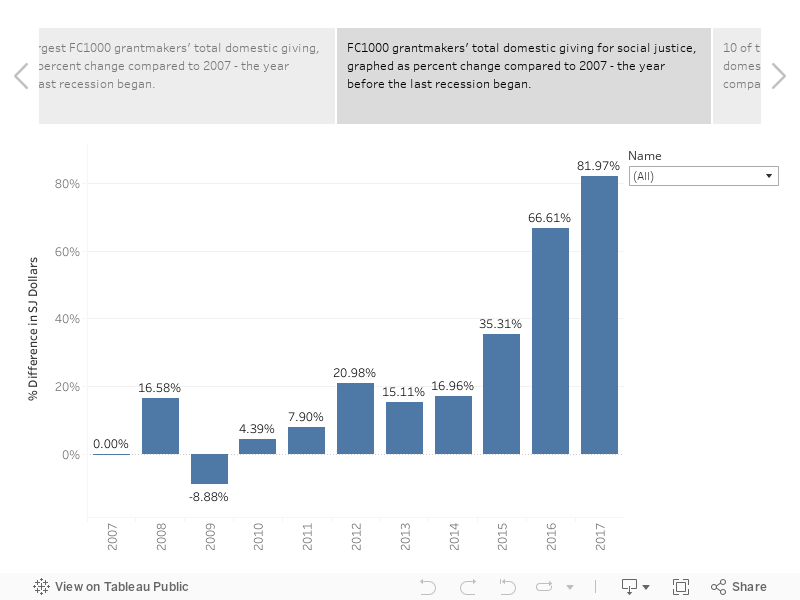
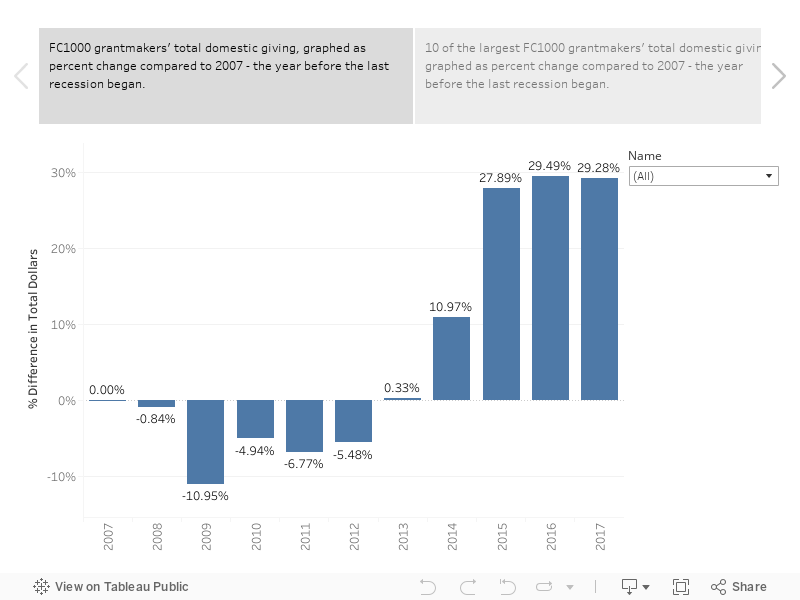
An NCRP analysis of Candid foundation data of domestic giving behavior from 2007-17 reveals that overall sector funding dipped as much as 10.5% at the height of the Great Recession. In fact, it wasn’t until 2013 that levels matched 2007 giving levels.


While some foundations’ giving plummeted, some grantmakers like The Susan Thomson Buffet Foundation (85%), the Bill and Melinda Gates Foundation (51%), the Silicon Valley Community Foundation (26%) and the Walton Family Foundation (22%) increased their giving that year.


On the whole, social justice groups saw an initial increase of 16.5% in 2008, before experiencing an 8.8% drop in 2009. Groups began to recover in 2010, slowly increasing their donations through the rest of the decade. Once again, The Susan Thompson Buffet Foundation was a strong contributor in 2008 and 2009, as were The California Endowment and the Carnegie Foundation, helping to solidify that space for communities.


However, a deeper look into these social justice numbers and giving to people of color and the poor reveals some differences in support between the types of funders.

TYPE COMPARISON – For social justice groups and groups of color

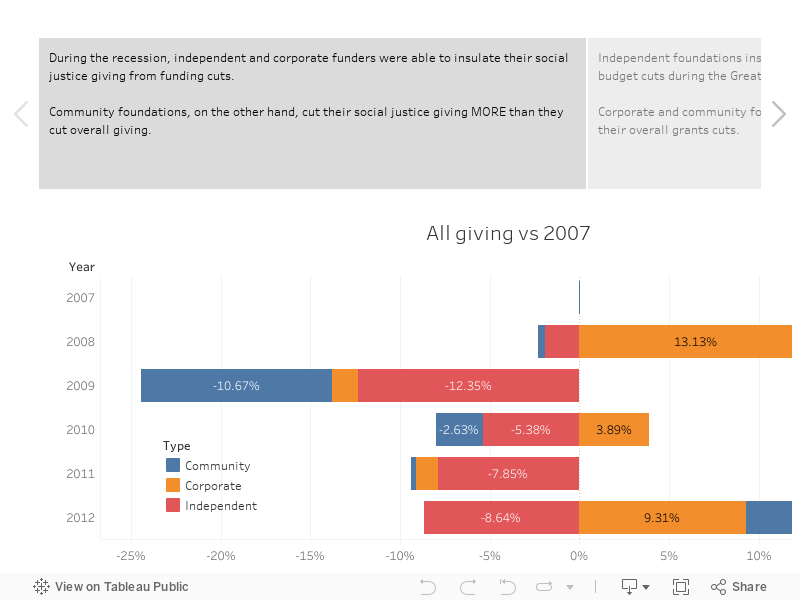
From 2008-10, corporations (and to a lesser degree, independent donors) were mostly able to insulate their social justice giving from funding cuts. Community foundations, on the other hand, cut their social justice giving more than they cut overall giving.


In the worst year of the Great Recession, 2009, independent donors insulated their giving for communities of color from grants budget cuts, while corporate and community foundations cut their grants to communities of color more than their overall grant cuts.

One thing all grantmaker types did was keep their overall spending cuts from negatively impacting grantmaking to people. While community foundation giving to poor people dipped 2.2% in 2009, it was sandwiched by increases of 31.2% and 36.5% in 2008 and 2010 respectively.

Here are the trends highlighted another way – as a percentage of total giving changed compared to the 2007 baseline.

General support comparison

As many in the sector know, general support dollars are incredibly helpful in helping nonprofits stay afloat. So how did foundation giving as general support fare? Well, that depends.

During the Great Recession, independent and corporate funders gave general support less often when they were giving to benefit poor people, people of color or social justice. As the graphs below indicate, their general support giving for those vulnerable populations and causes *diverged* from overall general operating support during the recession.

The interactive graphic below allows us to visualize the change in the percentage of funding given as a general support during the Great Recession (with 2007 as the baseline) for specific regions and specific types of funders. Adjust the filter and the top 10 funders by total giving for your selected criteria.


The difficult but morally clear road ahead

The mission before us is clear. Just because some groups and movements survived past cutbacks doesn’t mean they will this time. Responsible CEOs and trustees must begin planning for an increase in funding, instead of passing on the economic shock of the crisis to grantees. They should resist the sector’s ephemeral notion of preserving perpetuity and prioritize the real, immediate needs of their grantees and the communities they serve.

We shouldn’t need too many numbers to see that the current COVID-19 crisis is seeding an economic depression that could be an extinction event for many organizations. Let’s buck up, break the emergency glass and roll up our sleeves to do tough job that lies ahead.

Ryan Schlegel is NCRP’s Director of Research. Follow @r_j_schlegel and @NCRP on Twitter.

It’s safe to say that at this point, the nonprofit sector has been pulled into a discussion about COVID-19, as leaders urgently strategize about how to slow the outbreak and help those directly affected.  

However, beyond the need to fund cure, care and containment, we also have a responsibility to the movements and causes that we hold dear to think through how the outbreak will affect our sector more broadly — specifically the intersection of achieving our mission and financial sustainability.

A perfect storm of nonprofit challenges

The economy, natural disasters, big breaking news, election cycles, etc. all make catching potential donors’ attention and investments more difficult. In the course of a normal year, these dynamics are commonplace and even anticipatable. We know how to reschedule campaigns, we’re getting better at planning for the boom and bust of electoral cycle funding and have learned to lean into more resilient sources of independent revenue like sustainer giving to get us through the ups and downs.

But what happens when a boom election year, a global pandemic and a looming recession are on a collision course with your fundraising plans and will ultimately impact if you can fully deliver on your mission in this moment? 

Most of the progressive nonprofit staffers with whom we spoke are not seeing impacts on their revenue just yet, but they are seeing increased demand to deliver on their missions. Jobs With Justice (JWJ), an NCRP nonprofit member that recently secured a $1.3 million planned giving commitment from a project funded by the Progressive Multiplier Fund, is grappling with how hourly workers will be affected by the economic impact of the public health response. JWJ Development Director Brenden Sloan says that the current crisis provides an added sense of urgency to the state and local coalitions work that they are doing on the ground with low-wage workers and other members who don’t have paid family or medical leave. “We have been in talks for a while now about starting a national hardship fund to give direct support to groups of workers affected by natural disasters or events outside of their control,” said Sloan. “This outbreak really puts more urgency on finding funding for that.”

Andrea Hermann, director of development at Clean Water Action and Clean Water Fund, is immediately concerned with how crisis response will impact the organization’s recruitment of members and donors that can help move the political needle in 2020. “We have a pretty diverse revenue source between our field operations, phone operations, direct mail, online, major donors, foundations and corporate donors – but the field is our a significant way of getting new donors in and achieving our programmatic goals in 2020,” said Hermann.  

For the immigrant justice community, the coronavirus outbreak has only added to the constant, fast changing challenges from white nationalists, hate groups and the Trump administration. Even previously agreed to legislative efforts, like the language enshrined in the House’s NO BAN ACT that would stop President Trump’s Muslim ban, are being slowed down by the crisis response.  A full floor vote on the NO BAN ACT that was expected this week now hangs very much in doubt.

“The House Judiciary Committee is adding language in response to the coronavirus that would open up executive authority to exercise discrimination by exploiting public health concerns,” said Lakshmi Sridaran, Executive Director of South Asian Americans Leading Together (SAALT), who has been a leader in promoting the NO BAN ACT. “Our coalition is working hard to fight back, but there is strong bipartisan consensus around this language.”

How philanthropy should respond

Organizations like SAALT are already under-sourced. According to NCRP’s Movement Investment Project brief, the State of Foundation Funding for the Pro Immigrant Movement, less than 1% of the giving from the 1,000 largest foundations went to work that is intended to benefit immigrants or refugees even though immigrants make up 14.4% of the U.S. population.

How can philanthropy help?

Rapid response funding

As this current crisis demonstrates, what organizations need most are additional flexible funds that will quickly allow them to deal with the immediate intersectional challenges posed by the coronavirus outbreak. Funders should specifically provide rapid response funds to organizations or intermediaries such as the Emergent Fund who can move money quickly to the grassroots efforts that focus on areas where:

  • The Trump administration may use this crisis to push an agenda against the will of the American people (i.e. Muslim ban).
  • Corporations may act in such a way that exacerbates the problems that we face (i.e. not paying hourly employees).
  • We can push our own agenda (the need for universal health care, paid leave and more).

A stimulus package for nonprofits

With a potential recession approaching, the philanthropic community must seriously consider moving resources into supporting a nonprofit stimulus package that would diversify and scale nonprofits’ revenue generation. A combination of grants, recoverable grants and loans could help nonprofits raise a multiple of the dollars invested through a variety of techniques. The investment does not need to be more than the annual 5%, although we would encourage that. The Progressive Multiplier Fund, which funds revenue generation efforts, is helping its grantees raise nearly $4 for every $1 that the PMF grants out.

What can nonprofits do now?

While it’s not time to panic, it’s definitely time to prepare, even if that preparation is just in the “form of thought experiments and what-ifs to think through the possibilities and get aligned around the possible outcomes and impacts,” as direct marketing and fundraising consultant Miriam Magnuson said in a recent blog post.

Three things that they should immediately consider doing:

1. Make sure there are no holes in the current revenue generation bucket and learn into sustainable revenue resources.

2. Talk to your organization’s management about revenue forecasts: Whether it’s a shifting internally of resources from fundraising to mission delivery, or a downturn in foundation support or a dip in individual giving as the stock market stumbles, it’s highly likely your fundraising forecast will need to change.

3. Talk to funders specifically about what you need: You will need more funds of course. Take the time to prepare the business case that supports what you need to meet this moment.

At this moment of need, it is our ability to reach out and help each other that will help organizations and the communities continue to do the work of making this world better. We owe it to the long sustainability of these vital movements to not just help the public survive the current challenge, but to also help organizations come out stronger for the future.

Aaron Dorfman is president and CEO of NCRP. Bethany Maki is the director of programs at Progressive Multiplier. Follow @NCRP and @multiplier_fund on Twitter and share your thoughts.

Photo by Malik_Braun. Used under Creative Commons license.