A Q&A with National Birth Equity Collaborative’s Dr. Joia Crear-Perry 

NCRP’s Movement Investment Project initiative has been committed to hearing the experiences of Black, Indigenous people of color-led organizing in the reproductive access space.

And while NCRP has been vocal and responsive to the current threats against abortion access, we must remember that the reproductive justice framework is not simply a catalyst for abortion services. This work expands across sectors and movements like most topics, but is often reduced to 1 or 2 mainstream issues.

The reproductive justice framework consists of several pillars that hold up this work, and a major part is held by those committed to addressing the maternal mortality crisis through a birth justice lens.

NCRP Impact Award Winner Groundswell Fund describes birth justice as core to achieving reproductive justice and the disparities that birthing people of color experience that lead to their harmful experiences and their deaths are at the core.

This trend has caused an influx of distrust and unease within the movement amongst organizations and leaders. But we must address what systems are responsible for the turmoil.   

As much as philanthropy removes itself from movement politics and tensions, the sector can no longer recuse itself especially when its existence is harming both the narrative of the work and the Black leaders on the frontlines.  

A consistent pattern that the movement has raised suggests that philanthropy’s presence dehumanized the maternal mortality crisis and that current grantmaking practices aren’t saving us, just romanticizing our deaths and trauma. 

The data and numbers that the sector collects are more than learning tools or justification for grantmaking. They are the deaths and traumas of marginalized people, and it is philanthropy’s responsibility to ensure that their proximity to power does not overshadow or manipulate the messaging from the frontlines and those most impacted. 

National Birth Equity Collaborative logoDr. Joia Crear-Perry, founder and president of NCRP nonprofit member National Birth Equity Collaborative and contributor to Black Maternal Health Research Re-Envisioned: Best Practices for the Conduct of Research With For, and By Black Mamas in collaboration with other Black Women Scholars and the Research Working Group of the Black Mamas Matter Alliance, spoke with NCRP about what trends she has seen as someone leading national work focused on the maternal mortality crisis and the safety of Black birthing people. 

Editor’s note: Some of the responses were edited to fit the format of the article. 

How can the sector ensure the narrative around maternal mortality not be dehumanized and use their proximity and power as a catalyst for the voices of leaders like you to control the narrative? 

Improving maternal health — including maternal mortality — requires that we understand the root causes of the inequities observed in maternal health outcomes. Structural determinants of health including structural racism are the root causes of inequities in maternal mortality and maternal morbidity.  

Women and birthing people are most burdened by the maternal health crisis and thus should be centered in developing solutions to improve maternal health outcomes.  

Centering the voices of Black women and birthing people and partnering with Black-women-led community-based organizations allows us to identify not only the gaps in health care systems, but also community-level resources to optimize their pregnancy and birthing experiences.  

Relying on quantitative data and only centering clinical outcomes (e.g., maternal mortality and morbidity) and not maternal well-being is at a detriment to Black birthing populations. Black feminist thought requires that we center the narratives of Black women and birthing people to understand their experiences.  

To have the largest impact, philanthropic organizations may invest in Black-women-led community-based organizations, Black researchers, Black scientists and Black evaluators to examine the efficacy of models of care and interventions proposed by directly impacted populations.  

In what ways have you seen philanthropy center the realities of the maternal mortality crisis in their funding practices?  

Dr. Joia Crear-Perry

Dr. Joia Crear-Perry

We have not seen the sector address the realities of maternal mortality in their grantmaking. Foundations have failed to center those who are the most marginalized and refrain from following the leadership of Black-led reproductive justice organizations that are committed to maternal health.  

To effectively address the reality of the crisis, philanthropy would have to invest in Black women and provide them with the resources to lead, the sector would have to yield their power and remove themselves to avoid interfering with the work.  

Grantmakers have the tendency to group maternal mortality into reproductive health funding or create portfolios focused on maternal child health, with an emphasis on the child, neither allows for the work of Black-led maternal health leaders to base build truly sustainable efforts.   

What funding patterns is the sector currently committed to that leads them to neglect the many levels to the maternal mortality crisis? 

Now grantmakers are largely focused on high profile, white-led organizations that have not grounded their work in the reproductive justice framework.  

Philanthropy’s commitment to erasing Black-led organizations and the misuse of the reproductive justice lens has led the sector to advocating around provisions that are not Black-women-centered, such as optional extensions of Medicaid postpartum coverage.  

There has been a consistent pattern of the sector reinforcing and replicating systems of disadvantage by acting as gatekeepers and choosing who gets to hold the work regarding to maternal mortality. According to the Centers for Disease Control’s latest data, maternal mortality steadily increased between 2011 and 2014 with significant racial disparities.  

In 2011, funders designated only $2.5 million specifically to Black maternal health, and that was tapered by more than 50% in 2014. And while funding for Black maternal and perinatal health increased again and more than doubled between 2014 and 2018, the proportion of funding that was designated for Black people has remained at only 1.5% of total funding for maternal health in the same years. 

Is there other data pertaining to maternal mortality or birth disparities that you would urge the sector to add to their focus? What points are they and why? 

A recent study published in November 2020, suggested that physician-patient racial concordance is associated with infant mortality. The study found that Black infants cared for by Black doctors were more often to survive to their first birthday than Black infants cared for by white doctors. 

In fact, the infant mortality rate was also reduced for white infants when the attending physician was Black compared to when the attending physician was white. These data are compelling and support the need for diversifying the health care workforce and specifically supporting clinical training pipeline programs for Black trainees and other trainees of color.   

How can the sector ethically invest in maternal mortality without erasing the stories of those we lose and dehumanizing the work that leaders such as NBEC are holding? 

The following calls to action are simply a starting point to ethically investing in this work, it will take major shifts and accountability to truly fund this work without erasing the narrative of the lives lost to this crisis:

1. Allocate more funding to Black-led organizations and ensure the sector is following the leadership of Black women, they hold the solutions but are severely under-resourced.

2. Invest in community-based organizations to allow them to continue to do the work and build upon community by harnessing their power within the sector.

3. Center the voices of the most marginalized, specifically Black birthing people and birth workers.Solutions to the crisis should be driven by those closest to the crisis.

4. Create more funding streams for Black-led reproductive justice groups.Currently the few streams of funding available create competition among the organizations as each attempt to secure funds. The sector cannot continue to use funds to cause tension or distrust amongst leaders of the movement.

5. Recognize philanthropy’s anti-Black sentiment and the structural forces it creates.

We ask that the sector look to leaders like the National Birth Equity Collaborative and Groundswell Fund for examples of ethical, trauma-informed organizing and grantmaking that is grounded in birth justice.  

Foundations should be more proactive in this work, such as upcoming opportunities like the Black Mamas Matter Alliances and Black Maternal Health Virtual Conference, “the premiere assembly for Black women, clinicians, professionals, advocates, and other stakeholders working to improve maternal health using the birth justice, reproductive justice, and human rights frameworks.”  

Philanthropy can no longer wait on organizations to hold the emotional and intellectual labor to collect these stories and data points for their grantmaking practices, they must be intentionally present in spaces that focus on the issues.  

How can philanthropy step up to improve the quality of sex ed?

The U.S. has long been considered a leader in higher education systems worldwide, but every year we send young people to college with a dearth of knowledge about something that is often considered a hallmark of the college experience: sex. 

This isn’t just a blip that leads to awkward moments. It can cause real harm in the lives of young people. Miseducated and unaware adolescents cause harm to others, which in and of itself has individual and community costs.  

One or 2 examples of the ripple effect of miseducation would appear to strengthen the case for a systematic reimaging of how we educate young people to not just live to the best of their potential, but also maintain safe and healthy communities.    

Sex education varies widely by where someone went to school: not just geographically, but public versus private and city versus suburbs, too. We know that some states have different standards by county or district, or no standard at all, so education can differ widely based on grade, school or even individual teachers.  

Often though, these programs offer an abstinence-only approach, leaving young people poorly equipped for sexual decision-making, and often instead treating them to scare tactics, shaming and enforcement of strict gender roles and harmful sexual stereotypes.

The most recent data from trusted movement resource Guttmacher reportsthat only 30 states and Washington, D.C., mandate that, when provided, sex and HIV education programs meet certain general requirements: 

  • 17 states require program content to be medically accurate.  
  • 26 states and D.C. require instruction to be appropriate for the students’ age.  
  • 9 states require the program to provide instruction that is appropriate for a student’s cultural background and that is not biased against any race, sex or ethnicity.  
  • 3 states prohibit the program from promoting religion.  

At best, students in a comprehensive sex education program are taught the basic mechanics of sex, reproductive anatomy and a wide array of sexually transmitted infections along with other topics in their health education or similar class. However, comprehensive does not mean detached from stigma and humiliation.   

Sometimes, the same companies make materials for “non-judgmental” sex education programs as the shame-filled abstinence-only sex ed programs, but even the former have been known to offer incorrect, incomplete or stigmatizing materials for students to learn from.  

Would we accept this in any other category of education? 

Sexual education word concepts banner. Instruction and guidance on human sexuality. Infographics with linear icons on green background. Isolated typography. Vector outline RGB color illustration

A lot of the fault is in the funding.  

While many states have their own funding programs and there are federal dollars available as well, the nature of those programs is heavily dependent on who is in charge at the executive level.  

During the late 1990s and through the George W. Bush years, for example, more than $1.5 billion in federal dollars went to abstinence-only sex education programs.  

Some school districts simply don’t have sex education programming in their budgets, so they accept free or low-cost materials made available by hundreds of groups around the country that are opposed to comprehensive sex ed.  

These curricula, often faith-based, are notorious for promoting shame and misinformation through “sexual risk avoidance” trainings. Some of these programs are run through a local crisis pregnancy center – or anti-abortion fake clinic – and include harmful lies about abortion, contraception and other reproductive health decisions. 

Aside from simply not working, programs that stigmatize sexual activity have damaging, even traumatic, impact on young people who have been sexually active, or who have experienced abuse.  

Commonly, these programs teach young people – and particularly young women – that if they’ve had sex, they are like chewed gum, dirty sneakers, used toothbrushes or tape that’s been stuck to other people’s skin, picking up loose hair and skin and grime along the way.  

Telling young people that they’re unclean and unwanted for having experienced sex leaves emotional scars that could stay for life.  

What is philanthropy doing to support sex ed? 

While the sector cannot fill every gap that those elected to lead create, we know that philanthropic support for sex education exists. From 2015-2019, $195 million was allocated to sex education focused work, however only 22% of total funding was designated specifically for comprehensive sex education.   

Philanthropy can not only shift what funding access to comprehensive sex education looks like from foundations, this is an opportunity for philanthropy to develop a blueprint for federal and state funding to follow. The sector has been a system that sets the mold for government funding practices in the past and should use its power to encourage change.   

Sexual education concept icons set. Human sexuality and physiology idea thin line RGB color illustrations. Anatomy and reproductive health teaching. Vector isolated outline drawings. Editable stroke

There has to be a better way.  

Leaders of this work along with the funding support of the sector can create and sustain programs that promote truly comprehensive sexual health education, affirming that having sex is an individual decision that one should neither be shamed for choosing nor for holding off on.   

Investing in this work must be rooted in nuanced, honest conversations about consent in how we teach young people about sex, and model that boundary-setting is healthy, normal and will make their sexual lives better, not restrain them.  

We also need to support education on LGBTQ identities and relationships, so students can feel affirmed in their sexuality and prepared for what to expect, regardless of whether their sexual life takes heteronormative shape.  

This is a vital part of the sector’s larger responsibility to center reproductive health care as basic health care, including the full range of access to all methods of contraception and abortion. 

Philanthropy owes it to young people to respect their individuality and autonomy, to give them the tools to become experts of their own bodies and build better futures. 

Shireen Rose Shakouri is deputy director of Reproaction, a national organization leading bold actions to increase access to abortion and advance reproductive justice.

How Funders Forget Migrant Marginalized Identities

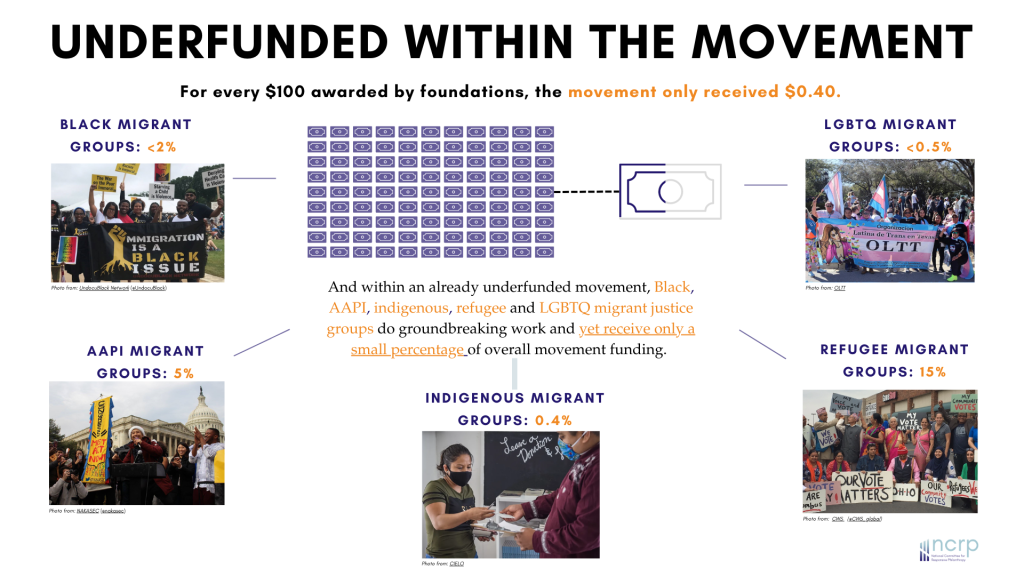
Within an already underfunded movement, Black, AAPI, Indigenous, refugee, and LGBTQ migrant justice groups do groundbreaking work, and their budgets deserve to be made whole.

For years, migrant communities with marginalized identities have labored to ensure that their needs are prioritized at the bargaining table. Inside an underfunded movement, these leaders answer the phone when few others can. They provide sanctuary to folks who have nowhere else to go. They build brilliant campaigns, and the movement is so much stronger for it. But philanthropy is still catching up:

Black migrant justice groups received less than 2% of all funding for the movement, 0.04% of funding explicitly granted for Black communities in general, and overall less than 0.01% of all foundation grants given during 2016-2020. It’s a missed opportunity. In centering Black communities moving across borders – especially Black women and Black trans folks – these groups lift up every person caught in the crosshairs of our broken immigration and criminal justice systems. For years, Black migrant movement leaders have called on philanthropy to trust them, echoed by sector advocates like A Philanthropic Partnership for Black Communities (ABFE) and Grantmakers Concerned with Immigrants and Refugees (GCIR), most recently with the Black Migrant Power Fund’s $10 million call to action. By funding Black migrant justice groups, funders who spoke out against anti-Black racism during the nationwide uprisings in the wake of the murder of George Floyd in 2020 have an opportunity to deepen that commitment.

In the same time frame, migrant justice groups rooted in the Asian and Pacific Islander diaspora received just 5% of the movement’s funding. This underfunding mirrors broader trends, including the fact that AAPI communities only account for 0.20% percent of all U.S. grantmaking. AAPI-led groups in the pro-immigrant and pro-refugee movement are already combatting anti-Asian violence, overcoming persistent exclusion and pushing for wins that reflect dozens of communities’ distinct needs. Philanthropy must step up too, providing data that honors the radical diversity of the diaspora and funding folks at the levels they need to thrive.

• LGBTQ migrant justice groups also received less than half a percent of the movement’s funding. While this is double the share they received 5 years earlier, it’s a small fraction. This funding was 0.6% of all funding for LGBTQ communities during this time. This too was triple the share from 5 years prior, but pennies of pennies are a hollow victory. This, too, is a shame: LGBTQ justice and migrant justice are inextricably linked. Especially as anti-immigrant and anti-trans attacks increase, LGBTQ migrant communities deserve philanthropic allies ready to back up their words with action.

• Refugee justice groups in the movement, in turn, received 15% of the movement’s funding in the last 5 years. Support from philanthropy will be crucial as refugee-led groups continue to rebuild and re-organize after the Trump administration’s decimation of government-funded resettlement agencies. As Basma Alawee from NCRP nonprofit member We Are All America noted, “when funders build, share and wield power with refugee leaders in the South like myself, progress – and systemic change – can be achieved.”

And while current foundation reporting makes calculating specific numbers difficult, philanthropy also particularly underfunds Muslim, Arab, and Middle Eastern migrant justice groups. The same is true for groups led by undocumented folks, immigrants with disabilities, and migrant communities with criminal records, which see the cracks and organize solutions at the places where our legal and moral systems fall short.

These communities obviously overlap. And immigrant communities and the pro-immigrant and pro-refugee movement deserve much more funding as a whole. But by knowing where grants have fallen short before, philanthropy can start filling this funding gap and avoid these blind spots at the same time.

By Karundi Williams and Kavita Khandekar Chopra, re:power* 

Karundi Williams

Karundi Williams

In a year like 2022, it is simply impossible to turn our attention away from the relentless attacks on our democracy and our people. While this country has never fully realized a democracy that represents us all, for the last 50 years a strategic, a well-funded, and deeply organized effort has been building to erode any progress that we have made. In just the last two years, states across our country have been systematically restricting voting rights through gerrymandered redistricting, laws targeting who can register voters, increased voter ID laws, and more. And they are not stopping there – moving swiftly to restrict [or erode] other personal freedoms like the right to protest, the right to live in our identities and love whomever we choose, and of course our right to the autonomy of our own bodies.  

Kavita Khandekar Chopra

Kavita Khandekar Chopra

But let’s be clear – this American democracy was never built for us. It was not built for the Black, Indigenous, Native, Latiné, Asian & Pacific Islander communities who have always supported but never benefited from this democracy. Still though, we fought to build power for our people and started transforming our democracy by getting the 13th, 14th, 15th, 19th, 24th and 26th amendments ratified. Despite these advancements, the cornerstones of our democracy – the rights to vote, to dissent, to be treated equally under the law – have never been equitably applied to BIPOC communities. And this battle remains central to the narratives at play in 2022 and beyond.  

When things feel so bleak, it is hard for even the most politically educated of us to remain engaged in a system that does not see our humanity. But the question at hand for us now is not ‘How do we get more people to vote?’ The question we must ask ourselves is What hope can we offer our communities about the outcomes of this rigged system? How can we bring about real change for our people through civic engagement?

What role can philanthropy play to overcome these seemingly impossible barriers? 

For too long, philanthropy has been focused on civic engagement as an activity that is typically done in even-number years between May and November. Money begins to flow in with purpose – to engage as many voters as is possible to achieve the best outcomes for our communities. But this cyclical, dump-truck style funding doesn’t work because it makes far too many assumptions about who is engaged, how communities will vote, how to engage different communities, and ultimately what this engagement is for.  

Part of the problem is that philanthropy is often measuring the wrong things. They’re focused on voter engagement as the outcome, instead of recognizing it as the lever by which we see transformational change for our people. As head of the New Georgia Project Nse Ufot said recently in her panel at the Funders Committee on Civic Participation, voting is a “flex” of the power that communities have built over time. Voting is not the end. 

A Data Strategy course, one of the trainings re:power offered in response to the pivot to virtual.

If philanthropy is actually concerned with changing the material conditions of Black, Indigenous, Native, Latiné, East, South and Southeast Asian, & Pacific Islander communities – as opposed to focusing on holding and retaining power for elected officials- then the philanthropic sector must do the following:  


  1. Move the majority of  civic engagement dollars to organizations that are led by and serve Black, Indigenous, Latiné & AAPI communities.  
  2. Transform your understanding of civic engagement beyond the transaction of voting. Invest in power-building, base-building, narrative-shifting, governance, and racial justice work as a part of your civic engagement portfolio. 
  3. Recognize the long-arc of civic engagement and create a civic engagement strategy that is longer than the 2- or 4-year cycle. Include training, capacity-building, and pipeline strategies for the whole movement, not just elected officials, as part of this strategy. 
  4. In addition to your c3 grants, begin moving c4 money out of your institutions to the movement. C4 dollars are more flexible and allow organizations to do more meaningful and engaged work with our communities.  

Let’s break these down even further. You might be curious as to why I’m calling on you to invest the majority of your civic engagement dollars to organizations that are led by People of Color – don’t worry, I’ll tell you. According to census projections, the United States will no longer have any one racial group in majority by 2045. In certain states, like Georgia, this transformation will happen even sooner. It is imperative that the money of philanthropy, wealth that has been extracted from communities of color, is redistributed appropriately back to these communities.   

And this money must come with the trust that has long been afforded to white leadership. Unrestricted money that allows for leaders to serve their communities best is essential. We have been surviving for decades and not only do we know what we need, we know how to achieve it. Philanthropy can support power-building and boost civic engagement by treating BIPOC-led organizations and leaders as real partners, worthy of long-term investment, and not just the trend du jour. 

Believing, and I mean GENUINELY believing, that civic engagement work can move beyond being transactional, but in fact to being transformational, must be embodied in your funding strategy as well. If your strategy is just focused on voters, you overlook important community leadership, and ultimately undermine your own strategy of engaging as many people as possible. Communities of color know, and have known, that elections are just one strategy that can be used to move us toward the changes we really need to see. And that strategy hasn’t achieved the results we need for decades. This lack of transformation has led to deep distrust of the electoral and civic engagement apparatus as a whole.   

For us to build trust in the civic engagement system within communities of color, philanthropy must recognize the need for a multi-prong approach that incorporates large-scale and community-level narrative shifting, strong base-building that engages communities year-round, and strategies that help communities hold our leaders accountable, recognizing that elected leaders are our partners. Voter engagement campaigns aimed at mobilizing voters of color in a one-off way to elect candidates who have zero commitment to represent the interests of communities of color is not an original or effective means of winning social change. Additionally, this approach assumes that communities of color will vote a certain way and assumes we’re a monolith. Political education and ongoing engagement is key in a civic engagement strategy. And, it’s not enough to just invest in one organization serving a specific population, invest in numerous organizations serving the same specific populations.  

In addition, a robust civic engagement strategy also needs to address the deep racial injustices that have kept our communities from liberation. It is unconscionable how little funding is directed towards groups working towards racial justice and racial equity. According to a recent report from the Philanthropic Initiative for Racial Equity, there remains a mismatch between the kind of support the movement is calling for and what funders are supporting. Only 1.3 percent of racial equity funding and 9.1 percent of racial justice funding supported grassroots organizing. Preliminary data from 2020 also indicated that much of the increase in overall funding did not reach movement organizations led by and for communities of color.  

Digital Organizing School

Strong civic engagement strategies, and ones that are currently creating wins for our people, like we see out of Georgia, Wisconsin, and Michigan, are centering Black liberation – in recognition that Black liberation means liberation for all people. re:power made the decision several years ago to shift our focus to center the needs of BIPOC communities and leadership. And that decision has resulted in wins and real change, even as white supremacy has tightened its grip on so many of our sectors. As an organization we had the audacity to believe that BIPOC leaders, particularly women of color, needed the space to organize and advocate for themselves. Because of this many of the people we have trained delivered key wins in their communities and are poised to be leaders of the future, transforming this country, block by block, city by city. 

What would it take for philanthropy to set a 10-year, maybe even a 20-year, strategy around civic engagement and fully commit their dollars to this work? This means you don’t change course at year 4 when we didn’t win the seats we had hoped to win. You don’t arbitrarily push money around from one Latiné group to another because you think their work overlaps too much in states like Texas that are so massive it will literally take every single organization working non-stop year-round to see any real shifts. And you recognize that movement leadership, from top to bottom, doesn’t just develop on its own. 

re:power knows that our movement leaders and organizations are constantly searching for highly-skilled folks to help fulfill their missions. We train people interested in running for office as well as people who want to manage campaigns and help raise money for campaigns. We train people on the basics of grassroots organizing, how to tell their stories, and how to do computer programming. We get real about data and how we can harness its power to work for our communities, instead of against. We make sure folks have a digital component to their organizing so they can reach more people, and we train newly elected leaders on how to govern effectively and stay accountable to their people. BIPOC leaders and BIPOC-led organizations invest in our communities year round. Philanthropy needs to have that same kind of energy. We need multi-year investment in organizations that train, coach, support and connect BIPOC leaders that speak up, speak out, and organize our communities. 

Finally, let’s get real about civic engagement dollars. c3 civic engagement work can only go so far and do so much. As I’ve laid out in this article, for philanthropy to fund transformational civic engagement work, they need to be willing to push beyond the c3 line. More and more philanthropic organizations are learning about ways in which they can move c4 dollars to their grantees and this is an essential step to winning real change for our people. c4 dollars are more flexible and allow organizations to do the full breadth of their work with their communities. Organizations like Alliance for Justice have been helping foundations understand how they can move c4 funding to their grantees. And that funding needs to come in ADDITION to the c3 funds they are already providing, not as a replacement of those funds.  

Elections are not the beginning or end of our work — they are simply a measurement of where we are as a country. And the upcoming midterms, though important, are no different.  

As Amanda Gorman would say – our democracy is “not broken but simply unfinished.”  It is up to us to continue building this democracy and progressive philanthropy can help shift the power into the hands of Black, Indigenous, Native, Latiné, Asian and Pacific Islander communities to build a democracy that works for us.  


Karundi Williams (she/her) is the Executive Director of re:power. Her focus is on creating systems for communities of color to build their political power to create social change – whether it be community organizing, connecting everyday people to policy platforms or investing in infrastructure and resources. 

Kavita Khandekar Chopra (she/her) is the Managing Director, Organizational Strategy for re:power – a national training organization building power with and for Black, Indigenous and People of Color organizers across the country.  In her role at re:power, Kavita oversees the Development, Communications, Operations/Human Resources & Finance functions of the organization.

*NCRP President Aaron Dorfman currently serves on the Board of  re:power.

Frequently Asked Questions (FAQ)

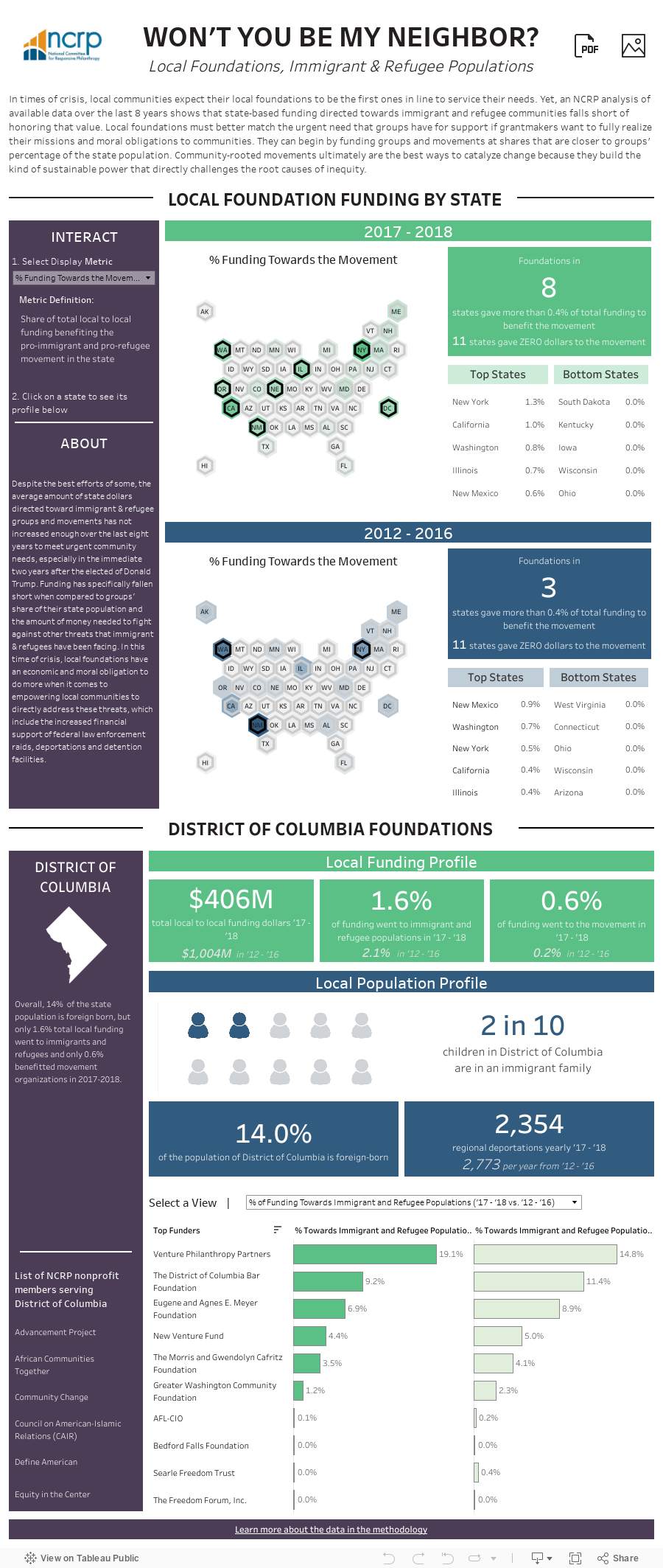
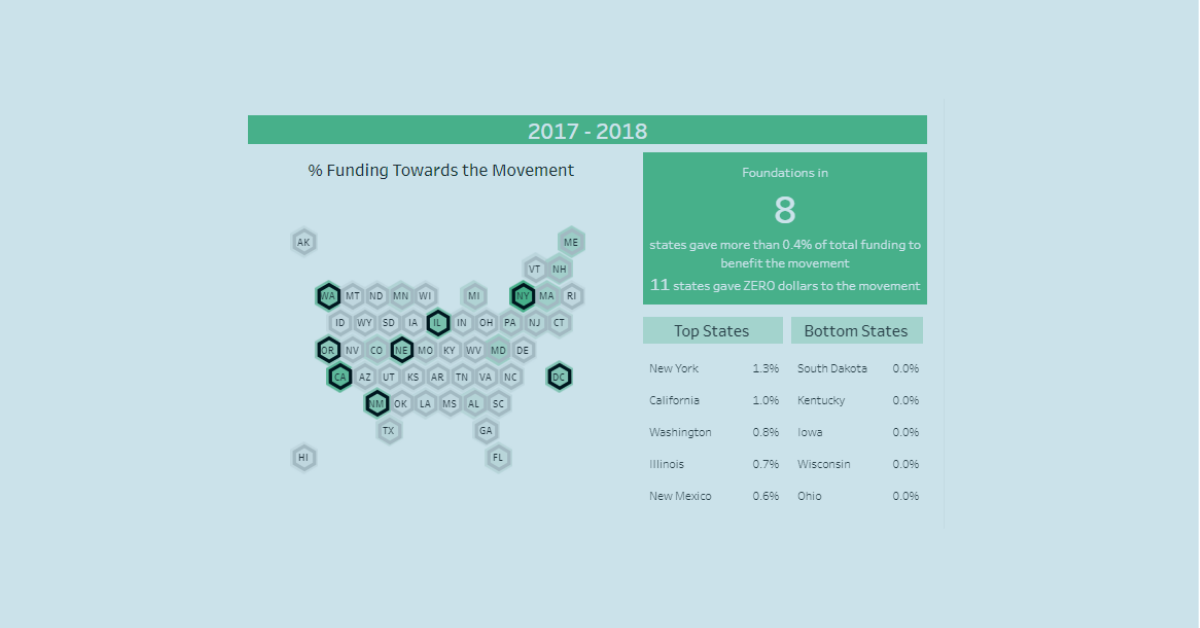
Here are some answers to Frequently Asked Questions around our 2020 Data tool that explores local foundation giving for immigrant and refugee groups.

While every foundation is different, we believe foundations should come together and ensure their collective local giving better matches the demographics of their local community, which includes immigrants and refugees. As they do so, they should prioritize giving to the pro-immigrant, pro-refugee movement as one of their most effective strategies, no matter what their portfolio looks like. The best place to start is by building relationships with the immigrant and refugee justice community in your backyard.

Yes, there are plenty of ways foundations can wield and share their power with immigrants, refugees and this movement, from speaking out about local ICE actions to asking movement leaders to serve in positions of leadership.

There’s always a delay in foundation reporting, and this is the most recent year where we are confident with the available data. We also don’t think overall trends have changed drastically since then, though there are always exceptions. As more data become available, we hope to update this dashboard.

Deportation and detention figures in the dashboard reflect the number of individuals who are deported from a region or detained in a specific state. The figures do not reflect the number of residents from that state who are deported from a different region or detained in a different state, and may not reflect the total number of people deported or detained from the state. NCRP relies on US Government statistics for these numbers, and we recognize their reporting may be intentionally or unintentionally flawed. We welcome other sources of information and will continue to work with our members and allies to present data that describes the impact that local and federal government policies are having on immigrant and refugee communities.

We have many nonprofit members active in this movement who we can connect you to (they’re on the dashboard for each state too). The below list is also a great place to start:

Grantmakers Concerned with Immigrants and Refugees (GCIR) and their Delivering on the Dream pooled fund network.

State of Foundation Funding for the Pro-Immigrant, Pro-Refugee Movement (2019) (NCRP)

Movements 101 (NCRP)

COVID-19 Hub (NCRP)

CHANGE Philanthropy coalition


We analyzed grantmaking by foundations based in a state to benefit that state. Learn more about our Methodology.

This dashboard does not include philanthropy’s response around COVID-19. However, we highly encourage local foundations to ensure immigrants, refugees and the pro-immigrant, pro-refugee movement are consulted and prioritized in their COVID-19 response, in the short and long-term.

Get in touch with us at bbarge[at]ncrp.org to share your analysis. Publicly available data about foundation giving will always be imperfect, and we welcome additional data.

Yes! We’re always looking for great stories about local foundations going above and beyond. Email Ben Barge at bbarge[at]ncrp.org.

GCIR is an incredible resource and a long-standing partner to NCRP. This tool is designed to complement their critical work. We highly recommend strengthening your relationship with the GCIR team and learning more about their efforts, from GCIR’s COVID-19 response to their Delivering on the Dream pooled fund network.


Watch this video where we explain each data point in the dashboard. We also share how this tool relates to our “State of Foundation Funding” release.

Yes! We created a mini-guide for activists and nonprofits in this movement called “How to Meet Collectively with Local Funders.” Email immigrantrefugee[at]ncrp.org to receive a free copy.

Yes! We’ve created a handy Social Media Kit that has several ways for you to spread this information to others.

Tell NCRP! We’d love to know how it goes, connect you with peers and additional resources, and help you share any lessons learned you have had in this process with other people around the country doing the same thing. Email Ben Barge at bbarge[at]ncrp.org.

Methodology

“Won’t You Be My Neighbor: Local Foundations, Immigrants and Refugee Populations,”  analyzes the last 7 years of publicly available data (2012-2018) to provide a snapshot of total local foundation giving for immigrants and refugee-servicing organizations and the pro-immigrant, pro-refugee movement in all 50 states and the District of Columbia. It also details the share of funding that went to these groups by each state’s largest local grantmakers.


Definitions

Local foundations are 501(c)3 grantmakers whose funding footprint is primarily local- or state-focused funding (as opposed to national grantmakers like the Ford Foundation, e.g.). The list of local foundations that we are gathering data about in this report excludes hospital and university foundations that exist to support their sister 501(c)3 and do not have a diverse grantmaking program.

Local to local funding refers to funding by grantmakers to recipient organizations located in and serving the population of the same state (e.g. an Alabama-based funder giving to an Alabama-based organization).

Organizations that serve, service or benefits immigrants and refugees are nonprofits who have received funding to either directly provide services for, or whose work benefits, immigrants and refugees in the U.S. They include but are not limited to those that are led by those impacted communities.

Pro-immigrant, pro-refugee movement groups refer to organizations that whose mission is dedicated to protecting and honoring the civil and human rights of immigrants and refugees in the U.S. Organizational activities include but are not limited to state-based advocacy campaigns, civic engagement, community organizing and grassroots leadership development. For more information on movement groups and the pro-immigrant movement, read NCRP’s 2019 brief, the State of Foundation Funding for the Pro-Immigrant Movement.

More On: Our Sample of Largest Local Funders

“Our sample of funders” or “Sample of largest local funders or foundations” refers to a set of a state’s largest 501(c)3 foundations that distribute grants to nonprofits by total funding in the foundation’s state. In this report, that set includes the 10 largest foundations in 48 states and D.C., and the 20 largest foundations in California and New York for a total of 530 nationally. We expanded the field of examined foundations to 20 each in these 2 states to factor in the large size of the state, its foreign-born population and the number of immigrant and refugee servicing nonprofits in those areas. 

Total funding figures for each state may be overestimated because the data may include funding to national organizations located in the state that also serve other states

More On: Candid

We gathered funding data primarily from Candid, a database on U.S. grantmakers and their grants. The data is divided into 2 sets of years: 2012-2016 and 2017-2018. Data for the years 2017-2018 may not be complete because data from 2018 is still being collected by Candid. 

Candid data on philanthropic funding in Puerto Rico, the U.S. Virgin Islands and other U.S. territories is unfortunately limited. The territories’ legal status also contributes to some confusion when it comes to how foundations describe funding for local immigrant populations. For these reasons, they have been excluded from this analysis. 

For more information on how we gathered data on funding specifically for the pro-immigrant and pro-refugee movement, see the Methodology section in NCRP’s first brief, “the State of Foundation Funding for the Pro-Immigrant Movement.

Other Data Sources

All data on population, immigrant detention and deportation figures were gathered from public data sources. They include:

Government spending on ICE and CBP 

Immigrant detention figures

Immigrant deportation figures

Children in immigrant families by state

Immigrant population figures

Deportation and detention figures in the dashboard reflect the number of individuals who are deported from or detained in a specific state. The figures do not reflect the number of residents from that state who are deported or detained in a different state, and may not reflect the total number of people deported or detained from the state. NCRP relies on US Government statistics for these numbers, and we recognize their reporting may be intentionally or unintentionally flawed. We welcome other sources of information and will continue to work with our members and allies to present data that describes the impact that local and federal government policies are having on immigrant and refugee communities. (updated May 15, 2020).

The Trump Response: Short-lived & Shallow Allyship

The 2016 election was a wake-up call for funders, but not a watershed. What will it take for philanthropy to fund our communities and the pro-immigrant and pro-refugee movement at the level we deserve?

Spooked by Donald Trump’s election and his anti-immigrant attacks, foundations started to give more money to explicitly benefit immigrants and refugees after 2016. Average yearly funding for the movement more than doubled from $130 million during 2011-2015 to $280 million during 2016-2020. For those who received it, this new money was meaningful as groups faced increased pressure from all sides. Many funders also signed petitions and made public statements in solidarity, which were valuable messages that at least some in the sector stood in solidarity with this community.

Once the headlines faded, however, far fewer foundations made migrant justice a core part of their mission or an intersectional piece of their racial equity grantmaking. This may be because relatively few funders understand that the Trump administration’s violence belongs to a bigger tradition that predates him. Anti-immigrant attacks, by both government agencies and political actors, have occurred for generations in both Democratic and Republican administrations, and they persist today.

As a result, this new support was less of a wave and more like a ripple. Funding to explicitly benefit immigrants and refugees only grew from 1.3% of all foundation funding in 2011-2015 to 1.8% in 2016-2020. Similarly, money for movement advocacy and organizing never exceeded 0.4% of U.S. foundation funding in any of these years. Given that 14% of the people living in the United States were born abroad, this continued underfunding is striking, and a missed opportunity.

The ripple may be fading as well. These new resources peaked in 2017 and 2018, often via one-time special grants, in the years immediately following Trump’s election. According to available data, annual funding for immigrants and refugees and for the pro-immigrant and pro-refugee movement decreased in 2019 and 2020. Anecdotally, that trend appears to have continued in the years since. The exceptions NCRP has seen as of publishing appear to mostly come from COVID-19 relief funds – crucial and necessary, but also time-limited.

Finally, this growth did not keep pace with foundations’ own wealth. Total foundation grantmaking in the United States quadrupled over the last 10 years – a reflection of growing wealth accumulation for the richest people and institutions across America.

Put another way: Even as grantmakers have gotten richer, the pro-immigrant and pro-refugee movement’s share of total foundation funding is actually smaller today than it was a decade ago.

Many of the nation’s most savvy grantmakers and donors who seek to make lasting structural change on important issues give to 501(c)4 organizations, in addition to their sizable investments in more traditional 501(c)3 nonprofits. In their own words, here’s why they do it and why it matters for the communities and causes they support.  

Editor’s note: This article was written before the murder of George Floyd by police in Minneapolis and the subsequent uprisings in more than 400 cities. Please see the dear colleague letter that accompanies this issue of Responsive Philanthropy for more context.

Open Society Foundations 

The Open Society Foundations supports advocacy organizations because good policy saves lives, advances equality and protects our democracy. When government budgets run into the billions of dollars and affect millions of people, effective and lasting change only happens when laws and policies are revised, approved or defeated.   

Through the Open Society Policy Center (OSPC), our 501(c)(4) arm, we back creative and courageous efforts to advance a more just, inclusive and democratic America. 

We are proud of our partnership with frontline organizations demanding better lives for all Americans and our neighbors around the world.  

Together, we have helped to reduce racially disparate sentencing laws, check executive war powers, humanize our immigration system, protect voting rights and anti-corruption rules, advance reforms of the pharmaceutical industry and Wall Street, and block countless efforts to enshrine hate, repression and division into federal, state and local law.  

Working to influence U.S. foreign policy,OSPCsupported the expansion of bans on funding foreign military units that have engaged in extrajudicial killing and kidnappings, and supported Sen. JohnMcCain’s successful effort to end the CIA’s detention and interrogation program. 

The powerful often have enough advocacy muscle and money to choke out the voices of the people, especially the marginalized. Open Society is proud to have increased our spending in the face of recent escalations of bigoted and anti-democratic policies, and hope other philanthropic institutions will do so as well. 

Tom Perriello, Executive Director 

Open Society-U.S. 

Civic Participation Action Fund 

The Civic Participation Action Fund (CPAF) is exclusively a c(4) grantmaker. When the Atlantic Advocacy Fund (AAF) created CPAF, it did so because it recognized that changes in public policy are often necessary to create the kind of change AAF was seeking.  

Because c(4) organizations can engage in much more direct advocacy than c(3) organizations, they are key players in achieving policy change. These groups can directly lobby elected officials, and they can ask their members and communities to lobby and engage in elections. 

Early on, CPAF focused on issue-based work but soon decided to adopt a civic engagement approach to the work.   

We recognized that the people and communities whose interests we sought to promote, mostly people of color and low-income communities, often participated in civic engagement activities at rates far lower than their representation in the general population and far lower than their white counterparts.  

If their voices were to be heard by the policymakers who were making decisions about issues that directly impacted their lives, they needed to be engaged, and policymakers needed to understand they would be held accountable for their policy positions.   

Some voter engagement efforts, such as voter registration and voter education, can be done with c(3)funding.  

However, the kinds of messages that directly link candidates to their policy positions, and work on direct issue advocacy like ballot measure campaigns, require c(4) funding.  

This type of work can then by translated into political power as the organizations doing the work demonstrate their ability to win elections by mobilizing their communities.  

For example, CPAF provided early support for a minimum wage/paid sick leave ballot measure in Arizona in 2016 by giving a grant to LUCHA, an emerging Latinx-led immigrant rights group in the state.  

The ballot initiative was overwhelmingly supported by the voters that year and because of LUCHA’s leadership role, the organization has grown in stature, membership and financial viability to become one of the leading powerhouse organizations in the state.  

Stephen McConnell and Katherine Peck 

Civic Participation Action Fund 

Ms. Foundation for Women 

After 46 years, the Ms. Foundation expanded out to develop a c(4) arm, and is venturing into supporting c(4)s through our newly formed Ms. Action Fund (MAF). The strategy of the MAF was constructed around the idea of building political power for women of color.   

Political power is not just about representation, but the ability to influence outcomes, to change the landscape – the ability to move transformational change on behalf of our communities. We believe that building a more reflective democracy moves us closer to a country where communities of color — women and girls of color, in particular — have political influence. 

It has been proven that the health of any nation depends on the support and existence of strong independent women-led structures. Simply put, women of color must have increased power to influence outcomes on the policies and institutions that affect their lives. 

We believe that shifting the makeup of U.S. political institutions is tied to increased power among organizations empowered to do 3 main things: hold institutions accountable; govern in partnership with elected officials; and ultimately leverage influence for systemic transformation.  

Therefore, while our analysis takes into account electoral opportunities, power for women of color must also include strengthened capacity, infrastructure and influence across the country. 

Ms. Action Fund is coming out of the box to put more money into the people closest to the solutions. To build political power for women of color that is truly transformational we have decided to focus on tackling challenges centered around funding, aligned training and infrastructure, and building accessible and culturally competent tools. 

Teresa C. Younger, President & CEO 

Ms. Foundation for Women 

Organizers from Alliance for Youth Action affiliate MOVE Texas distributed voter guides for the 2018 Midterm Elections.

Organizers from Alliance for Youth Action affiliate MOVE Texas distributed
voter guides for the 2018 Midterm Elections.

Ian Simmons 

Our smartest opponents have utilized the c(4) playbook for decades. With c(4) resources the Kochs built Americans for Prosperity, spending about $100 million per year persuading voters, writing laws and winning elections throughout the U.S. In states like Wisconsin, their c(4) infrastructure mobilized voters key to Trump’s surprising 2016 election. 

The Kochs chose to build their strongest organization with c(4) resources because c(4) resources enable clear and persuasive conversations with voters and lawmakers. Tax-deductible c(3) resources come not only with a tax-deduction but a gag order — restrictions that neuter public conversation. 

When we combat agendas fueled by hate or corruption, we must enable organizations to talk plainly with voters, empower the best candidates and win better laws. That usually means using c(4) dollars. If we don’t fight with c(4), we fight with our stronger arm tied behind our backs. When we use c(4), we win more fights.  
  
That’s how the best progressive organizations operate. For example, The Alliance for Youth Action deploys millions of voter guides around the country with c(4) resources, enabling organizers to engage voters directly, unencumbered. They talk openly about candidates who are awful on the issues and those who are awesome; young voters, like all citizens, respond better with clarity. Research shows organizing with such tools is more effective, helping progressives win more power.  
 
Whether we seek to strengthen climate standards, defeat a corrupt president’s re-election, recruit inspiring, diverse candidates or fight for fair elections, building an inclusive America requires the proven power and precision of c(4) fuel. 

Ian Simmons, Co-Founder & Principal

Blue Haven Initiative and Democracy Alliance Partner 

A major investment of 501(c)4 resources in groups like Florida Rights Restoration Coalition enabled the Voting Rights Restoration for Felons Initiative to be passed in Florida in 2018.

A major investment of 501(c)4 resources in groups like Florida Rights Restoration Coalition enabled the Voting Rights Restoration for Felons Initiative to be passed in Florida in 2018.

Jason Franklin 

Most of my personal giving and that of the donors I advise is c(3) giving supporting community organizing and advocacy to advance racial, social, economic and environmental justice. But I have increasingly layered in c(4) (and political) giving alongside that c(3) funding to help build a more robust ecosystem of work towards social change. 
 
Tax-deductible c(3) giving remains critical for so much work as it supports community building, research, issue education, communications and more. But all of that work gets a powerful boost when we also fund movements to expand into the c(4) realm with lobbying, ballot measure campaigns and electoral work from endorsements to independent expenditures. Growing our c(4) investments into social change movements yields bigger wins and that is worth far more than the tax deduction that we lose. 
 
Take for example Amendment 4 in Florida, the Voting Rights Restoration for Felons Initiative that passed in 2018 and stands to restore the right to vote to an estimated 1.4 million people. We have funded civic engagement efforts in Florida for years (and will continue to do so!), but it took a major investment ofc(4) resources into the Florida Rights Restoration Coalition, New Florida Majority and others to pass the biggest voting rights enfranchisement campaign in a generation. And we must continue to fund their work to implement this landmark law as conservatives attempt to undermine it with illegal modern-day poll taxes and other tactics.  
 
When I review my own giving or help a client develop their philanthropic strategy, a key question I ask is whether shifting types of giving could lead to greater change. Over and over, increasing c(4) and political giving is the answer.  
 
Jason Franklin, Co-Founder & Co-Chair

Solidaire Donor Network and President, Ktisis Capital 

The Shifting Funding Landscape

Who are the biggest players in pro-immigrant, pro-refugee movement funding after 2016?

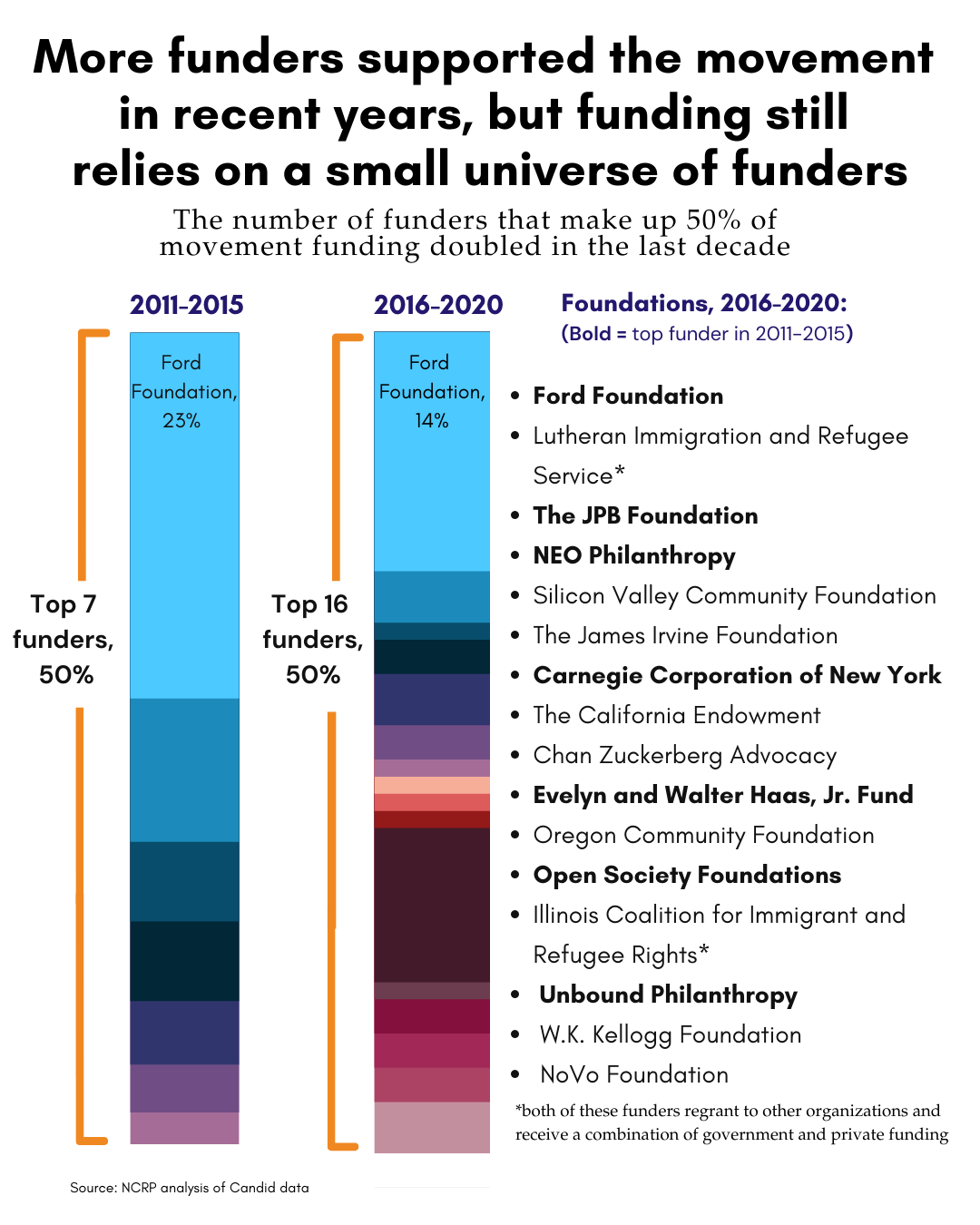
The Ford Foundation is still consistently the largest funder of the movement. But as more funders join in, Ford Foundation’s share of the movement’s grants has decreased from roughly 25% to 10% in recent years.

This is a good thing. In the last 5 years, funding for the movement became slightly less top-heavy, with 16 funders making up half of all movement funding rather than just 7. In fact, the total number of funders who have given at least once to the movement grew from around 500 in 2011 to about 2,500 at the funding peak in 2018, mostly through small, scattered grants.

Movement leaders should be proud of their own leadership in making this happen, speaking truth to philanthropy and making bolder asks that reflect their needs. Philanthropic groups like GCIR, Four Freedoms Fund, and Hispanics in Philanthropy stepped up, too. These networks recruited more funders to give consistently to the movement, and they even set up innovative funds of their own, often prioritizing undocumented, Black, and indigenous migrant communities transnationally. Immigrant leaders within foundations have also begun to create important political homes in the sector, like the Undocumented in Philanthropy Network.

But the movement’s ongoing reliance on a relative handful of foundations creates instability as well as increased pressure on the top funders. If just one major foundation shifts its priorities, as we’ve seen in other movements before, it affects the entire ecosystem.

And because big funders tend to give bigger grants to better-known groups, movement funding is also top-heavy. At the movement’s funding peak in the years after Trump’s election, the top 50 movement recipients received over half of the funds. National organizations focused on federal policy and litigation still dominate that list as well.

Because this is an underfunded movement, many of the biggest groups are still relatively small for the scope of their work. This includes policy, communications, and litigation groups, whose work is important and deserves much more funding. But community-accountable power-building groups – particularly at the local level – consistently shoulder the most critical work, and they are the most under-resourced.

Every federal policy push, narrative campaign, and legal strategy ultimately relies on grassroots community-driven groups to build the power and political will for change. And while power-building groups’ share of the movement funding pie did increase slightly in recent years, they only made up 40% of the top 20 recipients between 2016-2020.

Furthermore, only a handful of these top recipients were regional or local, rather than national groups.