Community organizer and historian Corey Shaw reflects on how the stories that often don’t get recorded can push philanthropy to address its own history of harm. 
Corey Shaw - DC Legacy Project Director at Empower DC
Corey Shaw – DC Legacy Project Director at Empower DC

As a researcher and community organizer, I have spent the last five years working with African American communities across the United States—mobilizing them towards achieving reparation and restorative justice for gross human rights violations as defined by international law.

At the start of my organizing career, I was focused on Washington, DC where I helped co-found the Black Broad Branch Project (BBBP) alongside descendants of two African American families who resided in Chevy Chase, DC from 1840 to 1936. In that effort, I was fortunate enough to have the support of descendants, the authors of Between Freedom & Equality (Barbara Boyle & Clara Green), and Historic Chevy Chase DC.

At the same time, I joined the African American Redress Network (AARN) where I began cutting my teeth in the national reparation movement. In my time with AARN, I became invested in understanding international law, reparations, remedies, and the political levers that can be used to achieve structural change and repair. I took this newfound perspective to communities in Virginia, Alabama, and Georgia. I worked with a community in each state to help them build a case for reparations and to mobilize towards real solutions. This work allowed me to bear witness to the struggles of a country which has failed to reconcile an often-hazy history of oppression, despotism, and neglect of Black folk and our communities. It was work that was often exhausting in the short term but enriching in spirit.

These experiences were all educational for me, both as a scholar and a young Black man. More than anything, though, they were perplexing. In each community, a complex web of land use decisions, community development, suburbanization, and industrial encroachment had stifled the growth of African American Communities. I struggled to understand how entire swaths of a community could be erased or end up surrounded by harmful industry.

Patterns of Exclusion

In Brown Grove, Virginia—zoning decisions and comprehensive plans completed by Harland Bartholomew & Associates inundated a historic Black community with a county airport. In Africatown, Alabama, the landing site of the last ship of enslaved people from Africa in the United States and the community those formerly enslaved folks built after emancipation. These land-grabs amongst industries have manufactured circumstances that have resulted in increased rates of cancer and a community that is surrounded by industry on all sides. In both instances, policy makers created the present circumstances using land use decisions.

These patterns around land use decisions hold true in Washington, DC—particularly as it relates to housing and the development of the city. As I’ve found my way back home as DC Legacy Project Director at Empower DC and as the Co-Chair of the DC Chapter of the National Coalition of Black’s for Reparations in America (DC N ‘COBRA), my work has come to focus on uncovering these lost histories of the city.

These patterns have reminded me of a few important things:

1) Our city looks the way that it does, demographically and architecturally, because of deliberate decisions—not by chance.

2) Our present circumstances were molded by a myriad of private-public partnerships which have forged diverse and homogenous communities across every demographic strata and it is those same partnerships that hold the potential to rectify the inequities present in the city.

3) Residents of the city have inherited these decisions, quite literally, for better or for worse.

The damage done by decisions I’ve enumerated in brief are cause for a revelatory change that begins with reparations.

Captain, George Pointer and His Enduring Legacy

To demonstrate the need, I want to share an excerpt of DC’s history that will make clear the harmful policies of the past and how these patterns have persisted into the present.

In an era of historical rediscovery, the nation is reckoning with histories long past that have been covered up or forgotten. For centuries, the history of Captain George Pointer and his descendants had been lost to time. However, thanks to the interest of the late, great, James Fisher, descendant of George Pointer, Tanya Hardy, his best friend, and two researchers in Barbara Boyle & Clara Green, that story has been revived.

Pointer, born enslaved in 1773, bought his manumission at the age of 19 and lived the rest of his life as a freeman—working for George Washington’s Potomac River Company. Captain Pointer, alongside other formerly enslaved and enslaved people, is responsible for the construction of [one of] the first maritime transportation networks in US History. His legacy also includes raising three beautiful, manumitted, children, captaining a fleet of boats up and down the Potomac and Shenandoah waterways with materials for the construction of Washington, DC. He also helped to plan and construct what is now the C&O canal and ascended to be the Supervisor Engineer for the Potomac River Company.

The collective history of the family at this moment is one of persistence and beauty in the face of a city that sought to deny them basic human rights. However, this is interrupted as the family’s life in a cabin in Montgomery County, MD bumps against the reality of being Black in America. You see, when George Washington died, the Potomac River Company went bankrupt and was acquired by the Chesapeake & Ohio Canal Company (hence the name C&O Canal). The acquisition was followed up with a route revision for the canal which would have seen the destruction of Pointer’s family cabin. Even in the early 19th century, the capitalist interest was seen to outweigh the rights of Black folk. Pointer penned a letter chronicling his life in great detail in September of 1829. Pointer and his wife, Elizabeth “Betty” Townsend, died in 1832 during the Cholera outbreak in DC. Their cabin was destroyed shortly thereafter.

Pointer’s life is one that highlights the indomitable spirit of African Americans throughout history, and the debt that this country owes. It makes plain two things which Washington, DC is actively reckoning with.

On one hand, it lays bare the simple fact that African Americans have always been integral to the fabric of the city. They toiled in fields and raised children during enslavement, made many of the bricks used during the city’s construction boom in the early 20th century, and have consistently enriched DC’s cultural heritage.

Yet, in spite of that fact, their positionality—that is, their proximity to economic opportunity and the treatment they receive in society—has been consistently undermined by private institutions and governmental actors (and factors) at the Federal and local level. African American communities have been displaced, sometimes repeatedly, in Washington, DC with the intention of building spaces that would be explicitly white. It is the latter, which has sparked a conversation around place making in Washington.

Dry Meadows, DC and the Vision for a White Suburb

Mary Harris, the granddaughter of George Pointer, settled in the village of Dry Meadows, in what is today, Chevy Chase, DC. She and her husband, Thomas, bought that land in 1840. Their immediate neighbors, Laura and Robert Dorsey, were a family of Black folk who were related to Caroline Branham, the “dower slave” of Martha Washington.

The Harris family bought a parcel of roughly 3 acres and the Dorsey family bought a substantially smaller part.
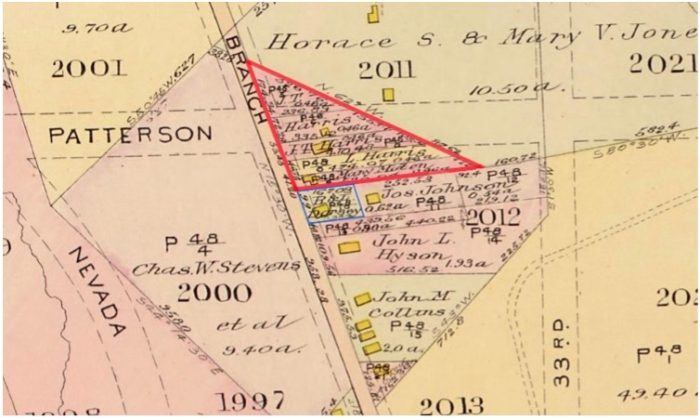
Map of Chevy Chase, DC

Mary and her husband were farmers. They raised 4 children to adulthood and were married for more than half a century by 1890. Two of their sons, John and Joseph, had fought in the civil war—laying siege to Richmond, the capital of the Confederacy. In the late 19th century, the Chevy Chase Land Company (CCLC) laid plans to build a segregated, whites-only, suburb in Maryland. When the sons returned home from the war, they were helping to rebuild a community which had been attacked by the Confederacy in their absence. What they had not known was that by 1890, a new front in a different war would be opening. The racialized development of suburbs was on its way to Washington and Dry Meadows was one of the first communities in the cross hairs of landowners and developers looking to make top dollar.
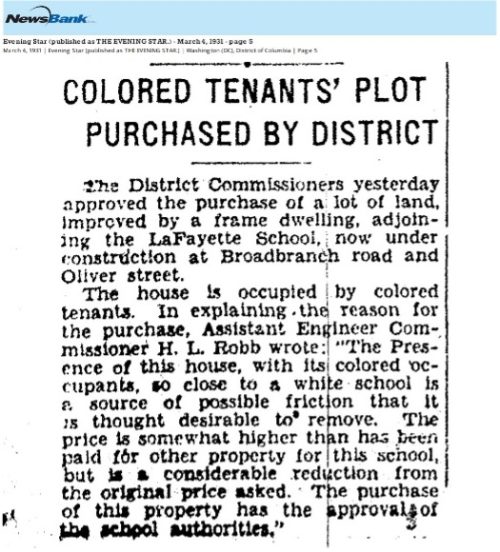
Evening Star Newspaper publication about plot

In 1928, after a successful Federal and local lobbying campaign from white residents of the new suburb of Chevy Chase, the National Capital Parks and Planning Commission (NCPPC) seized their land using eminent domain. Faced with the ultimatum of taking an arbitrary sum of money or nothing, The Harris’ were paid $6,862.50. The reasoning for the displacement of the village of Dry Meadows is made clear in a newspaper article of the time which notes “the presence of this house, with its colored occupants, so close to a white school is a source of possible friction that it is thought desirable to remove.” 

They lost their home so that Lafayette Elementary School, then a segregated white school, could be constructed for the white suburb that had been built around them. This initial instance of land seizure sets forth a violent pattern of household instability and economic deprivation for both families.

Barry Farm: From Thriving Self-sufficiency to State Manufactured Poverty

After generations of displacement, Mary Harris’ descendants had gone from Chevy Chase (where today the average home price is about $1.1 million), to Reno City (where they were renters), to Georgetown, to Southwest (where they were displacing by urban renewal) and had landed in Barry Farm in the mid 1950s. It is clear, the city’s development is a story of serial displacement—as demonstrated in the history of the Harris family. However, this history of repeated removal is a story of African American communities. Many Black folks migrating from the old South and those who had been homeowners in Washington found their way into public housing communities in the early 1940s—for which in 20 years they were demonized as burdens of the state and later as welfare queens.

One such community was Barry Farm. The community was initially created by the Freedman’s Bureau in 1867 under the leadership of General Oliver Otis Howard, the namesake of Howard University. It was established as a space for African American civil war veterans and their families. Those veterans were able to purchase lots in a larger 375-acre parcel and build a community along the waters of the Anacostia River. During the 74 years that Barry Farm was a land-owning community, it was self-sufficient. In those early years especially, the Anacostia River was an economic engine for the community—the bank was frequented by fisheries who would sell fish in the community. Residents also farmed the back portion of their lots to provide additional wares for consumption.

It is critical to understand that Barry Farm as it was established was a Black community in the rural and overwhelmingly white enclave of Southeast Washington in post-civil war America. That comes with all of the horrors one might imagine of the South, as DC was (and is) a Southern city. Despite manumission, residents were still subject to discrimination, the risk of racial terrorism, and black codes of the time.

The community was impacted by two distinct but equally destructive development projects in the 1940s: the construction of Suitland Parkway and later the Barry Farm Dwellings. More than 100 families were forced from their land by the federal government to build the parkway as a connector to military installations in Maryland and the Nation’s capital. The rest of the community was cleared for additional development. What had been a land-owning, 375-acre, African American community was demolished and reduced to a 32-acre segregated public housing project for African Americans. The justification given by the National Capital Housing Authority (NCHA) at the time was that Barry Farm was a slum—and thus warranted clearing.

Despite the displacement, the newly named Barry Farm Dwellings and its residents persisted. This iteration of the community no longer had access to the Anacostia River as the Anacostia Freeway was built, cutting off direct access. And even if they had, the river had been so polluted by industry (i.e. old River Terrace PEPCO power plant, Kenilworth Landfill), that anything caught from the river would have been entirely unsafe to consume. Instead of farming their backlots, they had small back yards which led to an alley for trash pick-up.

Constructed between 1943-1944, The Dwellings, similarly to the community’s initial iteration, existed in immediate proximity to the segregated, white, Uniontown (today, historic Anacostia) in the era of Jim Crow. Again, bear in mind all that comes with that. The KKK had been photographed in Southeast Washington 20 years prior—and in the 50s white students and parents from John Phillip Sousa High School and Anacostia marched through the streets of Southeast Washington to protest integration with vulgar signs. While DC was not Mississippi—the challenges of being Black in America were still present, real, and disgusting.

In the early days, life inside the boundaries of Barry Farm was a blissful paradise for residents. Children played in the allies, there were yard presentation competitions, and double dutch leagues. Overtime though, following the trend of national austerity and disinvestment in the social safety net, Barry Farm began to fall into a state of disrepair. By the 1980s the community was unrecognizably dilapidated. This disinvestment was intentional and ultimately led to a plan to redevelop the community (and others) know as the New Communities Initiative. The NCHA began developing these in the late 80s. They became actionable in the 2010s, when relocation efforts began—moving residents of Barry Farm out of the complex so that they could demolish the community to build a mixed-income development. The justification for the demolition of the properties? As classified by Federal Law, Barry Farm was “dilapidated”. Thus, the mass disposition of the site was justified.
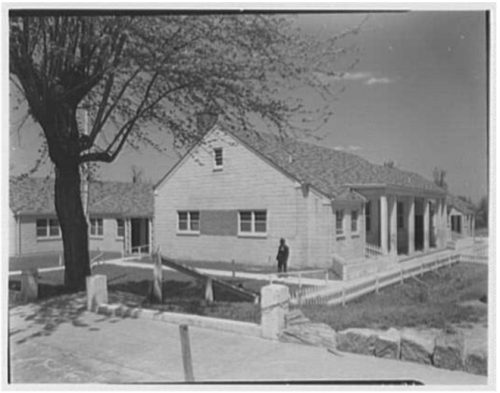
Barry Farm photo
Barry Farm

Empower DC, alongside a core group of residents, led the charge to try and save the traditional public housing model at Barry Farm. When it became clear that renovations were not an option (as a result of decades of neglect) and that neither the DC Housing Authority (successor to the NCHA) nor their federal counter part, The Department of Housing and Urban Development, had an appetite for a build-in-place strategy, Empower DC changed gears.

For us and the residents our mission became clear: if they won’t save the housing—we’ll make sure they never forget who lived here. A coalition of historians and preservationists was mobilized by Empower DC to seek an historic nomination for the property. While the developer, Preservation of Affordable Housing (POAH) wrote in “strong opposition” to the nomination, noting that the property had no inherent historic significance—they were overruled.

Today, the five buildings that sit on Stevens Road stand as a reminder of the successive iterations of the Barry Farm community and their legacy. Residents of Barry Farm led the fight to desegregate schools, bolster the social safety net for mothers on welfare, advised Dr. King, and helped found the National Welfare Rights Association. In the ranks of these people was one of the first Black women to receive a PhD, Fredrick Douglass’ children, survivors of the largest escape attempt by enslaved Africans in US history.

Denying this history in the interest of profit is disgusting. Feigning an interest in preserving buildings you fought to see rendered to rubble is a dereliction of morality and an insult to residents. More importantly, it demonstrates that the cycle of displacement continues.

The questions for nonprofits, residents, organizers, and philanthropic foundations alike are:

1) What can we do to stop displacement?
2) How can we uplift residents to help them keep up with the changing tides?
3) How does reparations fit into a larger and equitable plan for the city?

Bridging the Past and the Future

In response to uncovering these narratives, I have embarked on a journey of research and activism towards two ends: achieving redress for African Americans and their communities that have been impacted by historical harms and empowering Black communities that have been deprived of equal access to opportunity to be their own liberative advocates. There are structural inequities that are baked into the fabric of Washington, DC as a result of the inequalities of decades past (i.e. concentrated poverty in Ward 8, displacement of Black communities, discriminatory housing practices, et al).

These instances of harm present an opportunity for philanthropic organizations, particularly those with a less than desirable relationship with principles of equality and equity, to help drive a fundamentally reparative movement. 

In Wards 5, 7, and 8, there are African American communities that have suffered from disinvestment and a deprivation of resources—it is there where foundations can be critical agents of change by providing low-barrier funding opportunities for organizations that are working to bridge the several gaps for impacted residents and their neighborhood.

Organizations like Empower DC are directly involved in championing the cause of residents of Ivy City, Deanwood, and Barry Farm. Empower DC’s mission is to build the power of DC residents through resident-led community organizing to advance racial, economic, and environmental justice. Toward this end, we work with people with lived experience who can speak directly about the faults in the city’s systems and what should be done to repair them.

Empower DC is not the only group that is working to solidify community power through activism and community engagement. There are a plethora of organizations working to shine a light on the resulting inequities and potential solutions to policy missteps (W8CED, Anacostia Coordinating Council, Martha’s Table, Ward 8 Health Council, Anacostia Parks and Community Collaborative, and a litany of others.).

How Philanthropy Can Act

The challenge, of course, is not in the amount of community expertise that exists on this issue but the resources these organizations have to do their important work. The time has long since passed for institutions to not just take the recommendations of residents under advisement, but to actively find ways to bridge the gap between ideas and reality.

To usher a new era of change, foundations should:

  • Remove barriers to applying for funding. Resources from the philanthropic sector are often tied to laborious reporting requirements and restricted to certain areas of focus.  Foundations should make funds available with a low reporting barrier and few restrictions, allowing communities and the organizations supporting them to engage with what radical change may look like.
  • Offer not just money, but a long-term change making relationship. Beyond funding, foundations are networking engines—open that wealth of connections to these groups that are working for fundamental change and redress. Imagine with communities like Barry Farm, what can the last remnants of the community do for the area?
  • Be Active Listeners of Community Voices & Needs: Many past prescriptive solutions have, in many cases, already failed these communities. As noted in NCRP’s report, Cracks in the Foundation: Philanthropy’s Role in Reparations for Black People in the DMV, the role of funders in these spaces should be to join calls, participate in meetings, and listen—truly hear the needs of residents. To whatever degree possible, approach each community without a preconceived notion of the problem.
  • Build towards self-sufficiency – If we’re going to honor the cultural heritage, what does that mean for restoring the community’s self-sufficiency? Stepping beyond normative funding models provides an opportunity for residents to direct and control their own futures in a way that they have been precluded from for decades.

For foundations, there is a chance to chart a different path forward—you have the chance to redress histories of discrimination, denial of housing, segregation, and unequal treat (to name a few) which have helped build your wealth.

When it comes to reparations and redress, we have to understand two adjacent notions. For one, if we are committed as a city to achieving racial equity—we too must be focused on the issue of reparation. For those that are struggling with the notion of reparations: the question before you, our city, and the nation is not what do you owe.

Rather the question is: what can you do?


Corey Shaw, Jr is a DC native with lifelong roots in Ward 7. Corey got his start working with communities in 2020 as the Co-Founder of the Black Broad Branch Project. He continues working on that project, advocating for reparations for two families whose ancestors were displaced from Chevy Chase, DC in 1928. Shaw also joined the team at Empower DC in 2023 as the DC Legacy Project Director focusing in on preserving the Barry Farm Historic Landmark in Ward 8.

NCRP VP and Chief External Affairs Officer Russell Roybal and LGBTQIA+ advocate Dolores Huerta
NCRP VP & Chief External Affairs Officer Russell Roybal and lifelong LGBTQIA+ advocate Dolores Huerta

A few weeks ago, I presented an award to Dolores Huerta at the annual Harvey Milk Diversity Breakfast in San Diego. Dolores co-founded the United Farm Workers, and at 94 is still fighting the good fight. In my remarks I said, “For Dolores, justice is indivisible, and she has long recognized that the struggle for LGBTQ rights is inseparable from the broader fight for human dignity and liberation.”

Dolores and Harvey were contemporaries. They marched together, organized together, and they called attention to the injustices faced by farmworkers and queer people…they dissented…together. That was nearly 50 years ago.

Fast forward to today, to a world where dissent is increasingly criminalized as we continue the annual season of Pride celebrations — the vibrant tapestry of lesbian, gay, bisexual, trans, queer (LGBTQ+) pride stands as a testament to the power of resistance. From its humble beginnings as a commemoration of the riots at the Stonewall Inn in 1969 to the global celebrations we see today, pride has always been, at its core, a protest. However, as governments and institutions around the world clamp down on dissent, the very essence of pride – its radical roots – is under threat.

The criminalization of dissent takes many forms, from outright suppression of protests to the enactment of laws targeting marginalized communities. In recent years, we’ve witnessed a troubling trend of governments stifling dissent under the guise of maintaining order or preserving so-called traditional values. This crackdown is particularly pronounced when it comes to LGBTQ+ rights, as authoritarian regimes and conservative lawmakers seek to erase the hard-won gains of the queer community and literally criminalize our very lives.

But pride refuses to be silenced. It stands as a defiant declaration of existence in the face of oppression, a celebration of diversity, and a demand for liberation. Each pride parade is a reclaiming of public space, a rejection of shame, and a reclamation of power. It is a reminder that the personal is political and that our very existence is an act of resistance.

Pride is Political

At its core, pride is a protest against the criminalization of our identities. It is a refusal to be confined to the shadows, to be denied our humanity, and to be stripped of our rights. In countries where being LGBTQ+ is still illegal, pride takes on an even greater significance, serving as a beacon of hope for those living under the shadow of persecution.

But pride is not just a protest against external forces; it is also a call to action within our own communities. As we fight against the criminalization of dissent, we must also confront the ways in which oppression manifests within our own ranks. Pride must be inclusive, intersectional, and accessible to all members of the LGBTQ+ community, especially those who are most marginalized. We must all advance together and leave no part of us behind.

In recent years, we’ve seen a growing push to depoliticize pride, to turn it into a sanitized, corporate-sponsored spectacle devoid of its radical roots. But to do so is to betray the very essence of pride and the countless activists who risked everything to make it possible. Pride was born out of struggle, and it must remain a space for protest if it is to retain its power.

A Call to Action – This Pride Month and Beyond

As we navigate these turbulent times, it is more important than ever to remember the radical origins of pride and the ongoing fight for LGBTQ+ rights. We cannot allow ourselves to become complacent or apathetic in the face of injustice. We must continue to resist, to organize, and to demand change.

The bottom line is that philanthropy has a role and responsibility in the creation of this change. Funders for LGBTQ Issues continues to be a leader in this change. They are releasing the 2022 Resource Tracking Report: Lesbian, Gay, Bisexual, Transgender, and Queer (LGBTQ) Grantmaking by U.S. Foundations in the next two weeks. The 20th edition of the annual Resource Tracking Report not only provides a snapshot of funding for queer communities and issues across the country in 2022, it also reveals gaps in funding and highlights opportunities for US-based foundations to make strategic funding decisions that best support domestic LGBTQ communities and issues within the current philanthropic and political landscape.

If philanthropy hopes to become a place of refuge for LGBTQ+ people, they must include more LGBTQ+ staff. A 2022 survey from Change Philanthropy showed that while gay and transgendered people are protected against employment discrimination under the Title VII Civil Rights Act of 1964, nearly half of all LGBTQ people working in philanthropy are not open about their sexuality to most of their coworkers and trans people working in philanthropy account for a just 1.5% of board and staff in philanthropic institutions.

With wealthy right-wing extremists gearing up through Project 2025—for the elimination of LGBTQ+ civil rights law agencies and offices, it is clear that the attack on bodily autonomy is at dire risk. That is why philanthropy must take action now.

As Audre Lorde reminds us, “your silence will not protect you.” We must speak out against the criminalization of dissent, both within our communities and in the world at large. We must stand in solidarity with all those who are fighting for justice and equality, knowing that our struggles are interconnected.

Pride is more than just a parade; it is a symbol of hope, resilience, and resistance. It is a reminder that despite the forces arrayed against us, we will not be silenced. As long as injustice exists, pride will endure as a beacon of hope, lighting the way forward towards a more just and inclusive world.


Russell Roybal is the Vice President and Chief External Affairs Officer at NCRP. As a Latinx, male-bodied, non-binary queer leader, their activism is rooted in a tradition of public service and the pursuit of social justice.

CONTACT (S):  Russell Roybal rroybal@ncrp.org 
                           Jennifer Amuzie, jamuzie@ncrp.org

NCRP Showcases Community-led Effort to Hold
Billionaire Climate Funders Accountable to Frontlines

Good, Bad, Bezos, and Beyondtells the story of how communities can respond to  
billionaire climate funding models that underresource impacted communities and movement groups

WASHINGTON, DC – As the world commemorates Earth Day this week, the latest report by the National Committee for Responsive Philanthropy (NCRP) offers an important case study in how power-building intermediaries are mobilizing to hold billionaire climate solutions accountable to impacted communities.

Co-published with the Regenerative Economies Organizing Collaborative (REO), Good, Bad, Bezos and Beyond: Climate Philanthropy and the Grassroots aims to shed light on the complexities of climate funding, particularly in the context of initiatives like the Bezos Earth Fund (BEF). The report details the unprecedented movement organizing that went on in the wake of the Bezos Earth Fund announcement in 2020, explores some history of philanthropy’s relationship to grassroots funding, and identifies some of the attempted early shifts in responding to the rise in billionaire climate philanthropy.

Recommendations include a powerful call to action for grantmakers to make bold and meaningful investments in grassroots leaders, organizations, and solutions.

“This report helps answer a frequent, but simple question – how can philanthropy navigate its role in addressing the climate crisis while ensuring equity, justice, and community empowerment?” says NCRP VP & Chief External Affairs Officer, Russell Roybal.  “By examining past efforts, highlighting grassroots interventions, and presenting actionable pathways, this report invites funders and activists to critically engage with the dynamics of climate philanthropy and its effect on impacted communities.”  

Cover of NCRP 2024 Report, Good, Bad, Bezos and Beyond: Climate Philanthropy and the Grassroots, designed by Darius Wilmore.

Click here to read the report online


The report was written by writer and philanthropic consultant Jennifer Near and designed by artist Darius Wilmore, in collaboration with NCRP and REO.

IMPORTANT LESSONS FOR PHILANTHROPY 

Good, Bad, Bezos and Beyond: Climate Philanthropy and the Grassroots focuses on how climate justice leaders and allies mobilized quickly to resource frontline needs. The report also describes how collaboration among stakeholders led to the formation of the Fund for Frontline Power (F4FP) as a grassroots-led vehicle for supporting community-based, equitable climate solutions.

The organizing effort after the initial BEF announcement moved $141 million into grassroots-accountable intermediaries which represent over 500 grantee partners. While this doubled U.S. climate philanthropy for equity via intermediary funds, it was only a fraction of the cumulative $500 million in grants that five already disproportionately resourced, predominantly white–led, Big Green organizations directly received.

The examination in community action and intermediary power building and sharing has strong implications for funders’ future organizing in partnership with movement leaders. Jacqui Patterson, organizer leader of the Chisholm Legacy Project and a TIME 100 Person of the Year, sees a lot of important lessons in the report.

“One must only look at the annual reports/impact statements of The Hive Fund, The Solutions Project, NDN Collective, and other recipients of the Earth Fund to see the proof of concept that when we resource the frontlines, we all win!” says Patterson. “Through facilitation by the Climate Justice Alliance, these groups were able to utilize these resources with the blessing and collaboration with worker groups such as Athena that comprise some of the very Amazon workers who are being egregiously harmed in the production of the profits that wrought this funding.”

CENTERING FUNDING DECISIONS ON COMMUNITY EXPERTISE 

Patterson applauds setting a sunset for the the inception of a fund, agreeing that more funders should recognize that “waiting until a rainy day to spend is a bit antithetical to the fact that we are currently in a deluge, literally and figuratively.” She also applauds the “willingness to break away from the formulas mired in the old unproven ways of philanthropy that have system scale transformations on environmental and climate justice hampered by lack of investment.”

“Ultimately, we need all funders and donors to take more bold actions and release control of philanthropic resources as well take a consultative stance at the outset, rather than forcing grassroots leaders to intervene,” adds Patterson. “This is a lesson in what’s needed in terms of frontline organizations speaking truth to power unapologetically, and philanthropy paying heed and following the lead of the frontlines!”

Good, Bad, Bezos and Beyond is part of  a multi-year NCRP campaign encouraging grantmakers to prioritize a just transition away from an extractive to a regenerative economy that invests in frontline community power, redistributes resources equitably, and upholds deep democracy and self-determination. The report is just the latest example of how, working with funders and non-profits, NCRP researchers and organizers amplify intersectional efforts that are leading the shift away from false solutions and toward community-centered, grassroots projects.

“Without much public fanfare or resources, frontline organizations and organized impacted communities are finding some success in building community resilience and pushing back against some of the worst impacts of climate crisis,” says NCRP’s Movement Engagement Manager for Climate Justice Senowa Mize-Fox.  

ABOUT NCRP
The National Committee for Responsive Philanthropy (NCRP) has served as philanthropy’s critical friend and independent watchdog since 1976. We work with foundations, non-profits, social justice movements and other leaders to ensure that the sector is transparent with, and accountable to, those with the least wealth, power and opportunity in American society.

Our storytelling, advocacy, and research efforts, in partnership with grantees, help funders fulfill their moral and practical duty to build, share, and wield economic resources and power to serve public purposes in pursuit of justice.


ABOUT THE REGENERATIVE ECONOMIES ORGANIZING COLLABORATIVE (REO) 
The Regenerative Economies Organizing Collaborative (REO) is a group of domestic and international funders working to shift philanthropy to support locally-rooted Black, brown, Indigenous and working class-led movements through political education, peer-to-peer-organizing, joint action and collective thought pieces, calling in philanthropic colleagues toward accountability, transparency and solidarity with frontline communities.

As we commemorate Earth Day, it’s important to hear directly from leaders working on the frontlines of changing how we care for not just our physical environment, but life that inhabits it.  So, we sat down with Thalia Yarina Cachimuel (she/her, Kichwa-Otavalo), Director of Philanthropic Networks at NDN Collective to discuss the importance of this annual event, especially for indigenous communities.

A current student at the Harvard School of Education, Thalia’s professional career has been rooted in the realm of reimagining philanthropy, uplifting BIPOC organizations, and advocating for Indigenous communities through political policies.  

This written conversation has been edited for clarity. 

Thalia Carrol-Cachimuel, Director of Movement & Strategic Partnerships - NDN Collective

Suhasini: Thank you for sitting down to share this Earth Day. Can you tell us a little bit about NDN Collective’s work and mission?

Thalia: NDN Collective is a national Indigenous-led movement infrastructure organization dedicated to building Indigenous power. Our team ecosystem is made up of interrelated strategies working in tandem toward our shared vision and mission. NDN Collective operates under the three pillars of Defend, Develop, and Decolonize.

On Earth Day, NDN Collective honors the Indigenous land defenders and water and environmental protectors who put their lives on the line to protect Mother Earth.

Indigenous Peoples account for 5% of the global population yet safeguard 80% of the world’s biodiversity through traditional ecological knowledge. Today and every day, Indigenous Peoples, communities, and Nations’ fight to be free from oppressive systems. Our mission at NDN is to “build the collective power of Indigenous Peoples, communities, and Nations to exercise our inherent right to self-determination, while fostering a world that is built on a foundation of justice and equity for all people and Mother Earth.”


Suhasini: If you could ask anything of your philanthropic partners this time, what would those asks be?

Thalia: To our philanthropic partners, we ask that our mission be supported by centering grassroots and movement-led organizations that are on the frontlines working to protect Mother Earth.

Suhasini: Can you give us some examples of work already being done on the frontlines by Indigenous peoples to combat the climate crisis?

Thalia: LANDBACK, Stop Cop City, and supporting the Mineral Withdrawal in the Ȟesápa are just a few examples of how our frontline movements are working to protect our sacred lands. LANDBACK, in particular, is a long-standing movement that has existed for generations with a legacy of organizing and sacrifice to get stolen Indigenous lands back into Indigenous hands. This movement ensures that the rightful stewards of the land have complete autonomy and control over their prospective territories, as we are the experts in how to care for La Tierra. When we support the infrastructure of Indigenous-led solutions to the climate, such as LANDBACK, it benefits all people.


Suhasini: What is the approach towards protecting La Tierra and how essential is Indigenous wisdom to that approach?

Thalia: The approach to understanding how essential Indigenous wisdom is with regard to climate change is multifaceted and intersectional. Some of our suggestions:

Support Indigenous-led initiatives. Encourage partnerships and collaboration across sectors. Recognize that we as Indigenous people have a sacred relationship with our ancestral homelands. Therefore, hold the most critical position in the management of climate, biodiversity, and the environment. Move mutual aid funds to grassroots community-led organizations. Prioritize General Operating support. Implement trust-based philanthropy in practice, not just in promise. Center Indigenous solutions to the impending climate crisis will be the way forward.

Indigenous perspectives are often overlooked and intentionally excluded, despite the fact that Indigenous environmental defenders assume some of the greatest risks in undertaking this deeply challenging and spiritual work. Recently, NDN Collective launched the Indigenous Climate and Just Transition Fund – a major philanthropic endeavor to ensure that Indigenous-led frontline organizations are prioritized in federal investments such as the Inflation Reduction Act. NDN Collective will use the Fund for regranting, fund matching, technical assistance and capacity building to help frontline organizations apply for IRA grants, and more. Ensuring Indigenous Peoples have direct access to climate finance globally and safeguarding their rights in fund development and evaluation are essential.


Suhasini: Any last remarks to leave with us – the philanthropic sector – this Earth Day?

Thalia: We, as a sector, must be committed to the ongoing fight for environmental justice, Indigenous sovereignty, and a sustainable future. As we reflect on the interconnectedness of all life on Earth, let us remember that our actions shape the world we live in. Together, we hold a sacred responsibility to protect and preserve Mother Earth for generations to come.

Let it be known, Earth Day for Indigenous Peoples around the globe is every single day.

Additional Resources

Thalia Yarina Cachimuel (she/her, Kichwa-Otavalo) is the Director of Philanthropic Networks at NDN Collective. Thalia’s professional career has been rooted in the realm of reimagining philanthropy, uplifting BIPOC organizations, and advocating for Indigenous communities through political policies. 

She is the curator of “The Fight to Free Leonard Peltier – Honoring Indigenous Culture & Heritage” and “Free Leonard Peltier” political advocacy exhibitions.

Thalia is an alumnus of the Fellowship for Emerging Leaders in Public Service at NYU Wagner and holds a Bachelor of Arts Degree in Human Services from Northeastern University. She is currently a student at the Harvard Graduate School of Education.

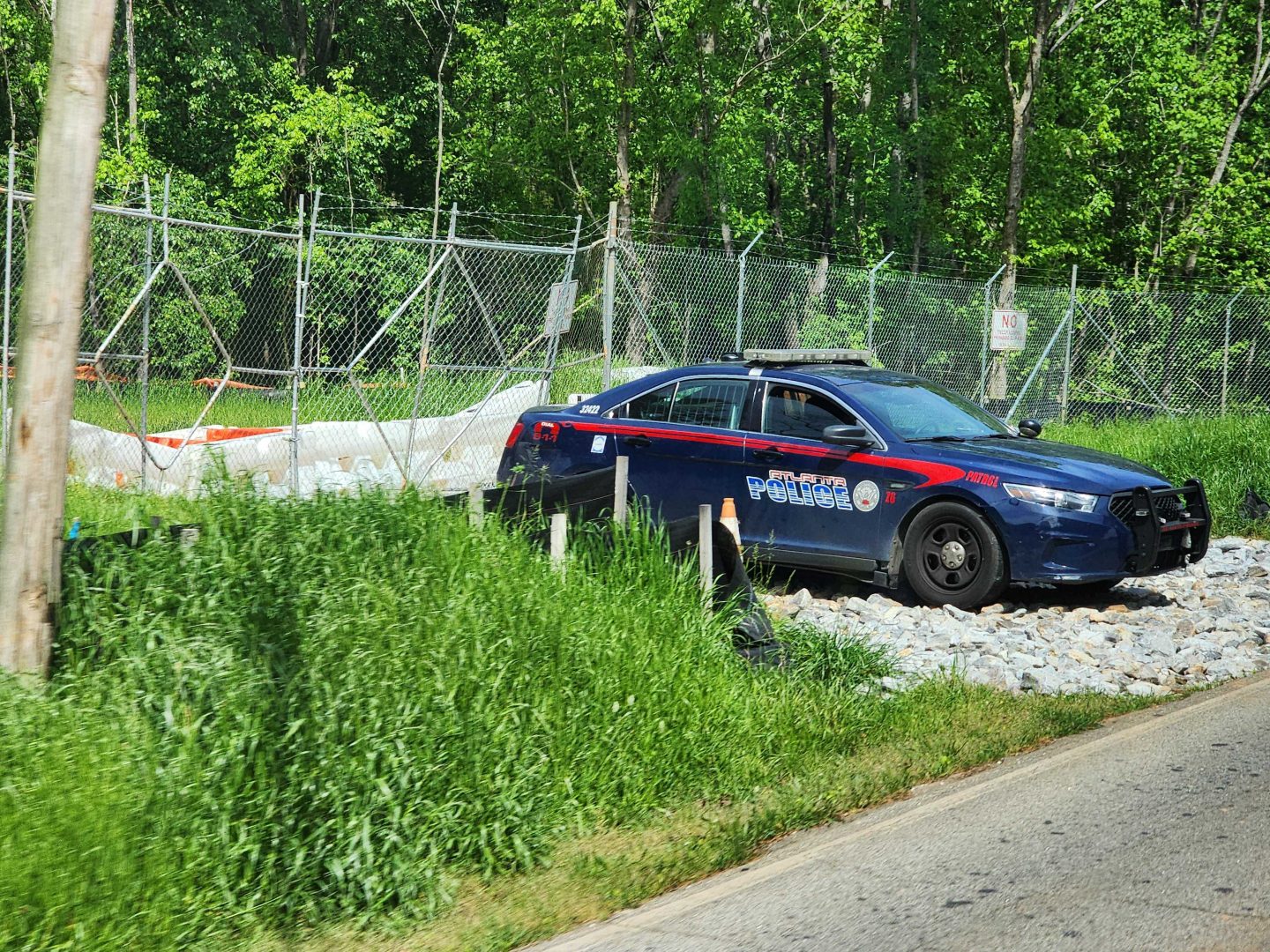
photograph taken at Cop City in Atlanta in April 2024 image credit: Senowa Mize-Fox

When the City of Atlanta proposed an 85-acre spot within the Weelaunee South River Forest in Dekalb County, Georgia as the site of a new “public safety” training facility, the backlash was swift. There were questions about what the training facility would be used for, including militarized training, concerns over unnecessary deforestation, and what it meant to build a police training facility in a predominantly Black community. As protests escalated, in January 2023, forest protector Manuel Esteban Paez Terán (also known as Tortuguita or “Little Turtle”), was executed by police adding fuel to an already very hot fire. 

Despite these concerns and avoidable tragedy, construction on Cop City began in the spring of 2023. 

How much more extraction must Black, Indigenous, and other People of Color endure before there are no more spaces left to live in peace? Cop City is but one example of sacrifice zone. It is important to recognize that the forest is not just a place for recreation, but also an important indicator of a thriving, healthy community.

In the South River area of Atlanta where the training facility is being built, “71-88% of the population is Black, with asthma rates in the 94th percentile and diabetes in the 80th percentile nationally.” Furthermore, most residents in these zip codes live below the federal poverty line. Removal of the forested land only to be replaced by a military-style training facility complete with shooting ranges and 24/7 police surveillance means removal of one more sanctuary for populations already pushed to the margins through economic exclusion and over policing. What does it mean when a source of refuge for so many becomes a source of fear and hypervigilance? How does further militarization bring about clean air, safe drinking water, bountiful outdoor space, and affordable housing? How does increased policing support thriving connected communities with abundant food security? How do the environmental impacts of Cop City consequentially affect the reproductive freedoms of communities in Atlanta as well? 

Sacrifice Zones for Marginalized  

The concept of these sacrifice zones immediately challenges one of the key pillars of the reproductive justice framework, the right to parent children in safe communities. In the long term, it threatens to disrupt the remaining pillars of upholding the rights to have children, to not have children, and bodily autonomy. 

When communities of Black, Indigenous and other People of Color are surrounded by pollution and environmental hazards, the risk of many existing reproductive consequences extends from miscarriages, maternal mortality, birth defects, and infant deaths.  

The increase in police and surveillance in the area will also directly impact those seeking abortion services in a region that is historically committed to using the power of the state to criminalize limits on bodily autonomy, including abortion care. This can also look like organizers and activists being charged with racketeering for pushing back against the construction of Cop City, abortion organizers, and practical support providers especially considering that they rely so heavily on tactics named in the initial Stop Cop City indictment. Of these arrestees, gender non-confirming activists will face harsher police violence.  

Those parenting their children will be raising their families in overpoliced communities while living in the constant fear that the state will take their children from them across systems of policing from child protective services to prisons, or state violence at the hands of police resulting in the deaths of their children. 

We must remember that those on the frontlines of these kinds of projects are also those living on the frontlines of climate and reproductive injustice. The deforestation of hundreds of acres for the purpose of further scrutinizing Black, Indigenous and People of Color communities and families for existing is alarming within itself.  

In June 2023 $30 million in city funding was approved for the project, which now has a total budget of $111 million. The primary source of the funding comes from the Atlanta Police Foundation, which has several corporate sponsors, donors, and foundation-based funding including AT&T, Waffle House, and the Robert W. Woodruff Foundation. This brings up a larger issue, should philanthropy really be funding policing?  

Fund Frontline Communities Not Cops  

As we look toward philanthropy to be more responsive and shift significantly more resources to the frontlines, what does it mean for funders to continue to support and uphold systems of police violence and militarization at the expense of those communities? Putting funding behind such projects only increases the dominant power vacuum that is the police-industrial complex. 

Police departments do not need more funding. Community members surrounding the forest need more funding for their healthcare needs, especially as they continue to deal with polluted air, water and soil. Organizers and activists fighting racketeering charges need more funding for bail funds and legal representation. 

Abortion funds and independent abortion clinics that will continue to serve abortion seekers in the state of Georgia need more funding as access to care is further criminalized and surveilled. There are many groups that are fighting this intersectional issue and that are in dire need of funding as this fight continues: 

  1. ATL Solidarity Fund
  2. Community Movement Builders
  3. American Friends Service Committee
  4. Forest Justice Defense Fund
  5. NAACP Legal Defense Fund

The fight to Stop Cop City is not a singular issue; the building of Cop City has an impact across margins and movements. The construction of this dangerous military facility knows no borders or margins and seeks to harm Black, Indigenous and People of Color communities for years to come. Philanthropy has a responsibility to repair the harm done to these communities, not exacerbate it.  

For Further Reading:  

  1. Cop City and the Escalating War on Environmental Defenders (Sen, Colchete 2023) 
  2. Atlanta’s ‘Cop City’ and the relationship between place, policing, and climate (Love, Donoghoe 2023) 
  3. Military equipment flowing to local law enforcement raises questions (Cook, 2013) 
  4. Environmental impact targeted in new push against ‘Cop City’ (Alcorn, 2023) 
  5. Atlanta community members warn of environmental damage from ‘Cop City’ (Uyeda, 2022) 
  6. Environmental pollution lawsuit may pump the breaks on Cop City construction (James, 2023) 
  7. Anger, Protests, and Vandalism Break Out Over Philanthropy’s Support of the Police (Rendon, 2024) 
  8. Activists Lock Themselves to Construction Equipment to Protest “Cop City” (Garrison, 2024) 
  9. Atlanta wants to build a massive police training facility in a forest. Neighbors are fighting to stop it  (Maxouris et al, 2022) 
  10. The Companies and Foundations behind Cop City (American Friends Service Committee, 2023) 
  11. The Green to Blue Pipeline: Defense Contractors and the Police Industrial Complex (Rahall 2015) 
  12. Police Shot Atlanta Cop City Protester 57 Times, Autopsy Finds (Lennard 2023) 
  13. This is the Atlanta Way: A Primer on Cop City (Herskind 2023) 

  __________________________________________________________________________________________________

Brandi Collins-Calhoun is a Movement Engagement Manager for Reproductive Justice and Gender Violence at the National Committee for Responsive Philanthropy (NCRP). A writer, educator and reproductive justice organizer, she leads the organization’s Reproductive Access and Gendered Violence portfolio of work.

Senowa Mize-Fox is a climate justice organizer and activist and the Movement Engagement Manager for Climate Justice and Just Transition at NCRP. 

Showing Up for Women this Women’s History Month and Beyond

Every March, we celebrate and honor Women’s History Month by focusing on the incredible accomplishments of women. Our focus should go beyond the generosity of women like MacKenzie Scott, who has promised to give away most of her fortune by challenging traditional grantmaking. It stretches further than celebrating talented athletes like Caitlin Clark, who by breaking the Division I record for total points scored defied gender barriers and roles in college basketball, right in time for the most sacred season of March Madness. 

Amid the celebrations are also the cold, harsh economic realities of too many talented, yet underpaid leaders. Pay inequities are not just a Hollywood story. Across all sectors, we can find women like actress Taraji P. Henson who shared a decades long history of being undercompensated compared to her white and male counterparts.  

When we talk about leveling the playing field, what is it we really mean?   

Women’s Equal pay day fell on March 12th in 2024, but even that pay day is misleading. It really should be called White Women’s Equal Pay Day, because that is who earns 79 cents to every white male counterpart’s 1 dollar. Black women today earn just 64 cents to every dollarLatinx women earn 52 cents to every dollar. Indigenous women are paid 55 cents to every dollar. Often, women’s funding does not include race as a factor. Initiatives like The Black Girl Freedom FundGrantmakers for Girls of Color, and Women & Girls of Color Fund are helping to repair that harm. 

As the world rightly focuses on pay equity, representation and full decision-making power over our lives and bodies, philanthropy has an obligation to just how little funding there is for gender justice causes. Despite 2017’s #MeToo movement, philanthropic investments have been dismal and barely kept up with inflation. 1.6% of funding goes to support women and girls, .5% goes to women and girls of color, and funding for trans communities was a teeny .015% in the last decade.  

This Women’s History Month let us especially celebrate, honor, and remember women and gender nonconforming people who stand on the frontlines of every social movement in this country. Those who use their First Amendment right to speak loud and clearly in favor of real gender equity and reproductive justice 

Afterall, the origins of Women’s History Month in the US began as a demonstration to commemorate an economic strike. According to the National Women’s History Alliance, the 2024 theme for Women’s History Month is “Women Who Advocate for Diversity, Equity and Inclusion.”  

How will your philanthropy demonstrate this advocacy – in March – and beyond?  


Suhasini Yeeda is the Editorial Manager at the National Committee for Responsive Philanthropy. 

February 12th-18th launched this year’s annual #BlackGirlFreedomWeek. Hosted by the Black Girl Freedom Fund and the #1Billion4BlackGirls campaign, the hybrid event is a week-long celebration of Black girls and gender-expansive youth, and what is possible when philanthropy invests abundantly in their dreams and safety. The week of Black joy and liberation is selected not just in honor of Black History Month, but in celebration of the late Toni Morrison and Audre Lordes birthdays.  

It was only right then that I spent the afternoon of Valentines Day in a space that felt like a love letter to Black feminism and the reproductive justice framework. The intergenerational space titled Reproductive Justice or Nothing: The Fight for Bodily Autonomy and Freedom” featured the transformative voices of Ashlei Spivey and Lolah-Belle Bunch (from iBeABlackGirl) Ponny White,(Girls for Gender Equity) and was moderated by Loretta Ross (a professor at Smith College and a co-creator of the term Reproductive Justice).  


Offerings of Healing Justice 

Each speaker gave offerings of how the reproductive justice framework brought them into this movement, what the movement’s legacy meant to them and how it guides their work, how they navigate respectability politics while living the Black feminist Praxis, and what healing justice means to this space.   

As a Black feminist and reproductive justice organizer, I am thankful that space was curated to amplify conversations about the experiences of those on the frontlines of reproductive justice, specifically what it looks like to hold this work as Black women and gender-expansive people. And while I am certain that the conversation reached across sectors within the audience, my PSO listening ear couldn’t help but interpret what the panelist shared into call to actions for my funder comrades. 

New Voices for Reproductive Justice, Executive Director Beulah Osueke grounded the space by sharing her Black Girl Freedom Dream. Her love offering details her dream that “Black girls and young femmes across the globe recognize that the limitations placed on them are lies and unjust. She hopes that they’ll be able to sever whatever person, place or thing that does not fully serve them, and that they’ll intimately know their worth and potential, and that they’ll be surrounded with the support needed to exceed their highest aspirations.” 

Osueke’s words reflected my time and experiences as a reproductive justice organizer and prepared myself and other attendees for the thoughtful word that was about to be delivered by the panelist.  

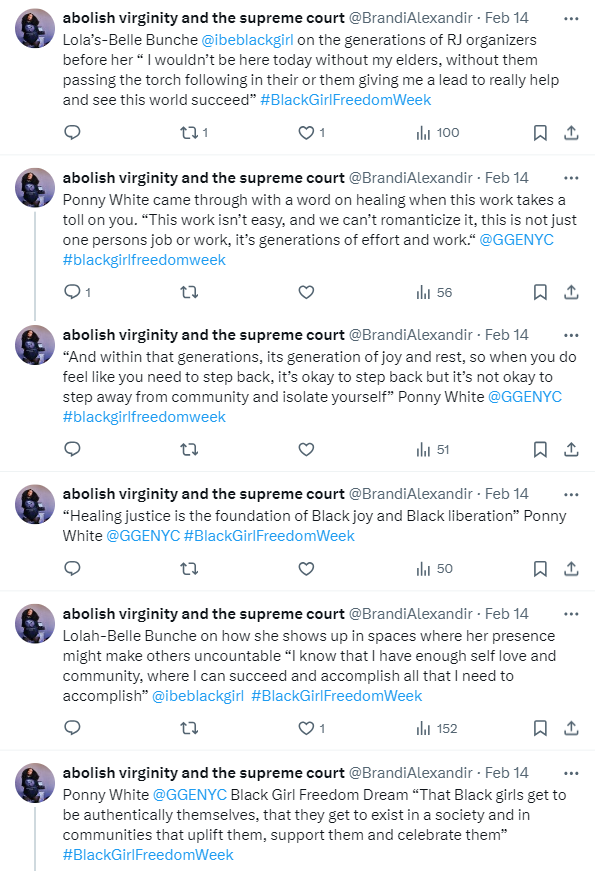
Below is the transcribed X thread:  

In hope my funder counterparts are watching Reproductive Justice or Nothing: The Fight for Bodily Autonomy and Freedom #BlackGirlFreedomWeek #philanthropy 

@newvoicesrj grounding and opening the space is only right 

Hearing how the panelists saw themselves and what they were experiencing in real time in the RJ framework is a reminder that if Black women and femmes don’t see ourselves in the work, it’s not actually RJ #blackGirlFreedomWeek #philanthropy 

“Inter-generational work in the RJ movement is imperative, the passing of knowledge and space, support and healing make a difference in how we show up” AshleySpivey-Arthur @ibeblackgirl #blackgirlfreedomweek #philanthropy 

Also on intergenerational organizing in RJ “We innately don’t believe in letting one another go, it’s so important to know where you come from, know the work of your ancestors and be able to shout-out the work of the people that came before you” Ponny White @GGENYC 

Lola’s-Belle Bunche @ibeblackgirl on the generations of RJ organizers before her “I wouldn’t be here today without my elders, without them passing the torch following in their or them giving me a lead to really help and see this world succeed” #BlackGirlFreedomWeek 

Ponny White came through with a word on healing when this work takes a toll on you. “This work isn’t easy, and we can’t romanticize it, this is not just one person’s job or work, it’s generations of effort and work.“ @GGENYC #blackgirlfreedomweek 

“And within that generations, its generation of joy and rest, so when you do feel like you need to step back, it’s okay to step back but it’s not okay to step away from community and isolate yourself” Ponny White @GGENYC #blackgirlfreedomweek 

“Healing justice is the foundation of Black joy and Black liberation” Ponny White @GGENYC #BlackGirlFreedomWeek 

Lolah-Belle Bunche on how she shows up in spaces where her presence might make others uncountable “I know that I have enough self-love and community, where I can succeed and accomplish all that I need to accomplish” @ibeblackgirl #BlackGirlFreedomWeek  

Ponny White @GGENYC Black Girl Freedom Dream “That Black girls get to be authentically themselves, that they get to exist in a society and in communities that uplift them, support them and celebrate them” #BlackGirlFreedomWeek 

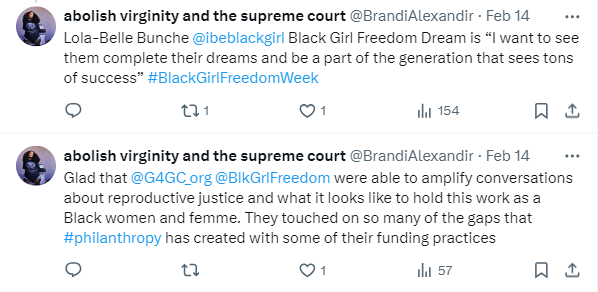
Lola-Belle Bunche @ibeblackgirl Black Girl Freedom Dream is “I want to see them complete their dreams and be a part of the generation that sees tons of success” #BlackGirlFreedomWeek 

Glad that @G4GC_org @BlkGrlFreedom were able to amplify conversations about reproductive justice and what it looks like to hold this work as a Black women and femme. They touched on so many of the gaps that #philanthropy has created with some of their funding practices 

Attending this panel on reproductive during #BlackGirlFreedomWeek reminded me why holding space for Black joy and liberation is such a crucial part of the work we do. It allows us to imagine a world where philanthropy invests in the possibilities of Black girls and the safety they deserve to pursue those dreams.  

Janine Lee

The staff, board, and partners of the National Committee of Responsive Philanthropy (NCRP) were deeply saddened to hear earlier this month about the passing of one of philanthropy’s most impactful leaders, Janine Lee.  

Janine was the longtime president and CEO of Philanthropy Southeast, one of the country’s largest networks of philanthropic foundations and leaves a lasting impact on all who knew her. 

“The warmth of her personality, combined with an unwavering commitment to the Southeast and a steadfast belief in the power of philanthropy, made her one of our field’s most impressive and inspiring leaders,” wrote Kristen Keely-Dinger, Chair of Philanthropy Southeast ‘s Board of Trustees. “Words cannot convey how much we will miss her.” 

A Steadfast Warrior for a stronger South 

Colleagues and friends remembered Janine first and foremost as a mentor and builder of deep relationships in the service of justice. 

“Part of Janine’s legacy is that she worked to prepare new generations of leaders dedicated to racial equity and making a greater difference for the people of the South,” said Southern Education Fund Chief Operating Officer Kenita T. Williams, a Philanthropy Southeast board member and former staff member. 

Keely-Dinger described Janine’s sector leadership as expansive, singling out among some things, her adoption of Equity Framework, and co-founding Grantmakers for Effective Organizations (GEO). Always a strategic advocate for racial equity, Janine used her talents and vision to shape not only the work of Philanthropy Southeast, but also the United Philanthropy Forum, and philanthropy’s reach overall.  

“Her leadership both within foundations as well as within key philanthropy serving organizations will live on as Janine never just “held a seat”; rather, she fully utilized every position she had to exercise leadership and voice according to her values,” said ABFE in a recent statement emailed to its membership 

She also left a lasting impact at grantmakers like the Ewing Marion Kauffman Foundation and the The Arthur M. Blank Foundation. “Janine was a wonderful colleague. Kind. Warm. Always with a keen moral compass.  She was a strong Black female leader in philanthropy at a time when there were precious few. She held her own and always with immense grace,” said Fay Twersky, president of the Arthur M. Blank Family Foundation. 

Janine’s Impact on NCRP 

Staff at NCRP had the privilege of experiencing Janine’s leadership firsthand on a number of occasions over the last two decades.  

NCRP President and CEO, Aaron Dorfman fondly remembers her as “a master at knowing just how far she could push the envelope without getting fired,” a critical skill for someone dedicated to causing what the late Congressman and civil rights activist John Lewis called “good trouble.”  

NCRP Vice President and Chief Strategy Officer, Timi Gerson remembers Janine’s role in the release of Philanthropy at Its Best, NCRP’s seminal standard-setting report detailing key benchmarks for grantmakers. Janine, Timi (then at Fenton Communications) and Aaron orchestrated placement of an op-ed by Janine in the Atlanta Journal Constitution during that year’s Council on Foundations conference, with NCRP staff placing a copy of the paper at every door of the conference hotel!

“Janine was a firebrand, in the best possible sense of the word. She was willing and able to disrupt the toxic ‘civility culture’ and unspoken rules of philanthropy that allow funders to avoid tough conversations – instead she used her position to speak truth to power and force her peers to listen,” said NCRP Vice President and Chief Strategy Officer, Timi Gerson.  

Her kindness and warmth extended to everyone she interacted with, regardless of their positional powerDirector of Research Ryan Schlegel was a research associate when he first met Janine while working on our As the South Grows report series   

“I met Janine when I was working on the As the South Grows as a relatively unqualified, young, privileged white man and she was always kind to me and interested in my point of view,” Schlegel recalls. “A true leader!”  

Another longtime staffer, Ben Barge shared that what he remembered most about Janine was how much of a tireless advocate she was for justice.  

“She built deep relationships, spoke truth to those who needed to hear it, and always kept her eye on the horizon,” said Barge, NCRP’s current Field Director.  “We’re not just losing a titan in the field – we’re losing a beloved friend.” 

Our deepest condolences go out to Janine’s family, friends, and community at this time. Janine’s advocacy, persistence legacy will continue to inspire us all. 

NCRP Field Manager Trey Gibson

In September 2023, Executive Director of Movement Voter PAC, Billy Wimsatt, penned an incredibly moving letter about the current state of funding for voter engagement. Since then, NCRP has shared this “Bat Signal” far and wide.  

NCRP Field Manager Trey Gibson, a former civic engagement organizer in North Carolina, agrees. As she wrote soon after in Fund Organizing Like Our Democracy Depends on It…Because It Does, foundations and high net worth donors must focus on investing in communities, not just issues.  

Whether it is an election year or not, funding organizers is as urgent and necessary as ever.  

Pouring in from their own unique experiences in the world of democracy, Gibson and Wimsatt sat down to talk about just what has happened since the memo went live and where progressive funder organizers can go from there.  

Below is their conversation in its entirety.  


Trey Gibson: Our view is that your memo is such an important piece and I’d love to know how it has been received since you released it. Have you noticed any questions or changes from donors in response to the memo since it dropped?

Billy Wimsatt: Wow – thank you so much for reading it and asking! 

I’ve been really encouraged by the response. The good news is that a few handfuls of donors really took the message to heart and are making their biggest donations ever – including a handful of heroic people who are really stretching themselves and giving at the million-dollar level.  

I just heard from another unexpected person who wants to give a million dollars today! Hopefully this will be a trend! 

Seeing donors who were typically giving $1,000 or $25,000 donors decide to give $1 million or some other number that is truly a stretch for them has been incredibly inspiring. And there were lots of other people who increased their giving substantially (eg from $50,000 to $100,000) and were intentional about giving early in January – that was great to see. 

The bad news is that we still have a loooong way to go to get the frontline electoral organizers hundreds of millions of dollars they need to do their work.  

We need a movement of at least a few hundred seven-figure donors to “see the light” from the Bat Signal and make the decision – with their families and their financial advisors – to make their largest donation ever. And to understand clearly that in historical terms, 2024 really is that moment we have all been waiting for. It’s time to stop being reluctant bystanders, to strap on our superhero capes, and become major protagonists in the 2024 story. 

In short, we need many more people to read it, share it, get together with their folks, and ask themselves the question: “What is the biggest thing we can do – individually and as a group?” in terms of donating and inviting others to join us. 

One of the other most encouraging trends we have seen is people inviting their friends and family. People are getting their folks together to do a “Zoom Salon” to discuss this idea with a small group of friends or networks. That’s how we’re going to do this – through hundreds of smaller conversations that add up to the hundreds of millions of dollars that are needed.  

We can do this – but we gotta do it fast! 

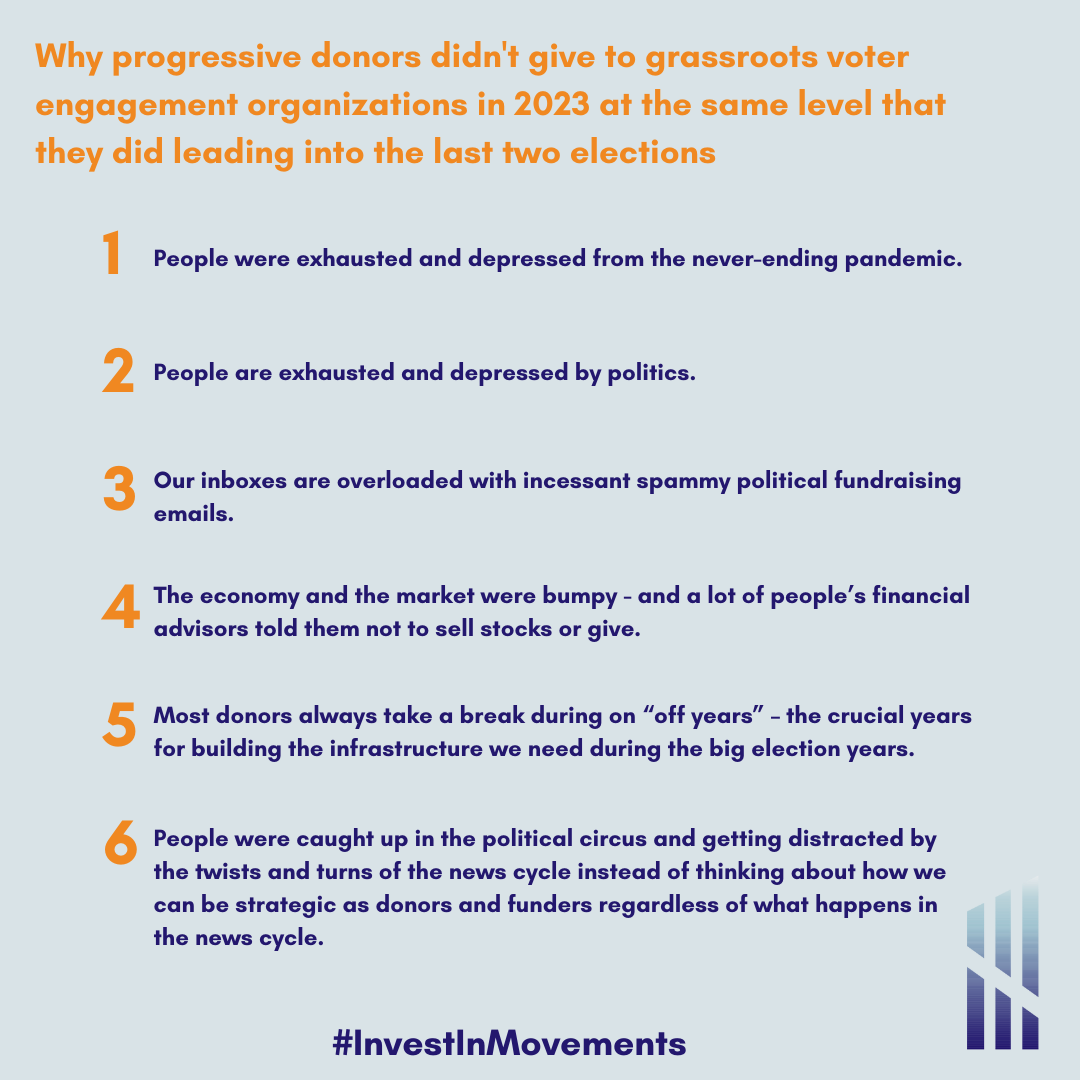
Trey Gibson: Why do you think progressive donors didn’t give to grassroots voter engagement organizations in 2023 at the same level that they did leading into the last two elections? 

Billy Wimsatt: I think it was a confluence of reasons – none of which are surprising:  

One, people were exhausted and depressed from the never-ending pandemic.  

Two, people are exhausted and depressed by politics.  

Three, our inboxes are overloaded with incessant spammy political fundraising emails.  

Four, the economy and the market were bumpy – which contributed to a feeling of uncertainty – and a lot of people’s financial advisors told them not to sell stocks or give.  

Five, people were caught up in the political circus and getting distracted by the twists and turns of the news cycle instead of thinking about how we can be strategic as donors and funders regardless of what happens in the news cycle.

Six, most donors always take a break during on “off years” – which we know, of course, are actually the crucial years for building the infrastructure we need during the big election years.  

And then when the horrors of October 7th happened. Everyone was stunned and in huge pain and fear. It divided our communities and suddenly we had the coalition of people who weren’t going to donate, people who weren’t going to organize, and people who weren’t going to vote… which is not a winning combination.  

We have to find a way to resolve this as soon as possible so that we can pivot and all work together to secure our democracy at home. I’m seeing some promising signs. We are in the most acute phase of the crisis right now. And my hope is that we can take steps to de-escalate fast enough to bring the family back together before the fall.   

The other thing that a lot of groups are worried about is 2025. They lived through the funding drought of 2023. It’s still fresh on everyone’s minds. We need organizations to have a sense of financial security in 2024 to be ambitious and run their biggest programs. We need local voter engagement groups to run their most ambitious programs this year – especially because our base is demoralized and pissed off. We are going to need to train canvassers to do a really skillful version of deep canvassing and persuasion conversations, not just turnout. And we’re going to need to frankly give them combat pay because they’re going to be out there in the streets dealing with a lot of hard conversations, more than they have in past years, and facing attacks from right-wingers – from violence to doxxing.  

So the more that funders can either promise groups 2025 funding – or even better, give groups their 2025 funding outright in 2024 so they have it in the bank, that will go a long way toward giving voter engagement organizations the security they need to go all out in 2024 without worrying that they’re going to fall off a cliff and have to do layoffs again in 2025 like they did in 2023. 

The past few decades of growth in US wealth is astronomical and unprecedented in human history. We have 5 million US families with $5 million or more who could be making way bigger donations than they are making. I asked my parents. It’s time for everyone who has access to wealth to talk about how much we need, and then to do bold and strategic things with the rest of it – or we’re not going to have a democracy and a livable climate. Existential times call for existential donations! 

Movement Voter PAC Executive Director Billy Wimsatt


Trey Gibson: I recently read that funders should shift away from measuring civic engagement work solely by the outcomes of elections and should instead emphasize measuring the power that organizations build through the community leadership that they develop. I’m curious, what do you think progressive donors need to understand about building long term political power? 

Billy Wimsatt: For me, it’s very much a both/and. We don’t have to choose between short-term impact and long-term impact, electoral focus, and community power-building focus. We are so lucky to have a generation of incredibly effective and strategic local organizations and leaders who are deeply committed to doing both. All we have to do is get them the resources they need to do it, and then we can sit back and read in the newspaper about all the amazing things they accomplished and won.  

Not really sit back – because a big part of our job as funders and donors and people who work in this space is to always be organizing others to join us so we can 2X and 10X whatever money we are moving to the field. And to create inviting on-ramps for others with access to money to get connected to the kinds of leaders, organizations, and solutions that are proven to leverage modest sums of money into massive structural change.  

Minnesota is a great case study that a lot of people are talking about. Organizers spent ten years getting aligned with each other and with their elected leaders. They ran big values and issue campaigns. They ran big electoral campaigns cycle after cycle. They built relationships with elected leaders so that they could co-govern. And because of all that work over ten years, when they finally secured a governing coalition, they were able to pass ten years’ worth of incredible legislation in just a few months: A billion dollars for affordable housing, free school breakfasts and lunches for every student, 100% clean energy standards, drivers licenses for undocumented Minnesotans, the right to vote for 50,000 returning citizens, the strongest abortion and LGBTQ protections, new laws guaranteeing family and medical leave as well as earned sick and safe time (including for temporary and part-time workers!), making public college free for families earning less than $80,000/year, expanded background checks and a new “red flag law” for gun ownership, automatically expunging misdemeanor marijuana convictions.

So much goodness! We can have nice things. 

That is what power-building and co-governance looks like. It’s not just looking narrowly at tactical efficiencies to get the lowest cost per vote under idealized conditions. It’s about having a comprehensive strategic program to transform a state – and if you do that in enough states, it can transform our federal system of governance in the same way. We are talking about shifting a multi-trillion-dollar political and economic system.  

There is nothing more effective, more impactful, or with greater ROI for philanthropic actors than to make a strategic intervention with that. 


Trey Gibson: In your memo, you referred to staff at local progressive organizations as the “essential workers” and “first responders” of our democracy. What would you say to the staff and volunteers who will be knocking doors and registering voters this year, who might be feeling discouraged by this downward trend in giving? What words of hope or encouragement can you offer? 

Billy Wimsatt: I love this question. I think funders speak loudest with our actions and with our money.  

The best words of hope and encouragement we can give are in the form of checks that are as big as possible and as early as possible. I’m afraid nothing else we have to say will be very encouraging or hope-inspiring right now.  

But I will try:  

You all are the unsung heroes of the world. For the life of me, I don’t understand why everyone with a brain and a conscience isn’t focused on getting you all the money you need as early as you need it so you can run the biggest, best voter engagement program possible.  

MVP will do everything we can. And I hope that many others will join us in building a movement of donors and funders that is worthy of the incredible organizing you do – on behalf of all of us. 

“The word ‘love’ is most often defined as a noun, yet we would all love better if we used it as a verb… Imagine how much easier it would be for us to learn how to love if we began with a shared definition.” 

– bell hooks,  All About Love 
bell hooks on the PBS’ Charlie Rose Show in 1995
bell hooks on PBS’ Charlie Rose Show (1995)

As an artist and organizer, I have always been drawn to those authors who see writing itself as a vehicle of change and impact on larger social issues. bell hooks is one of those trailblazing writers whose work on race, feminism, and class have influenced me and countless others to tap into our creativity in order to bring about a more just and equitable world 

It seems fitting to draw upon bell hooks as we celebrate Valentine’s Day because of her exploration into what the practice and promise of love looks like. In fact, her writings on a just, community-centered love are especially appropriate for the philanthropy to consider all year around.  

Philanthropy is supposed to reflect our love of humanity. So, what would it look like if the sector took bell hooks’ advice and rooted grantmaking in love as a verb, not just a noun. 

Why Center Love 

In its purest form, philanthropy is etymologically defined as ‘love for humanity.’ So, it follows that the best model for philanthropists is one who acts out of love for humankind. If philanthropy really is all about love, our support, our investments and other funder/donor actions must be seen – and judged – as a reflection of that love. 

Love is absent in many places in the sector. When I was introduced to bell hooks’ work, I was a 19-year-old educator learning what it meant to be in a classroom. In her book Teaching to Transgress, she often speaks about how love was a missing ingredient from the classroom, that there was indeed enough love to go around. However, often many education institutions were so caught up in raw data, cold hard facts, they did not realize how a culture of love could impact the community.  

Similarly, philanthropy’s relationship with love is, at best, inconsistent. At worst, it is dehumanizing to those in need, hypocritical about how much is possible.  

“Abuse and neglect negate love. Care and affirmation, the opposite of abuse and humiliation, are the foundation of love. No one can rightfully claim to be loving when behaving abusively.” 

Philanthropy makes many bold statements about their support for diversity and building the power of impacted communities. Yet those who sit at the margins are still often treated as interlopers in the nonprofit and foundation spaces. Even in the best circumstances, they are just one gathering or annual report away from being used as tokens, put on display in order to make foundation trustees look good or grantmaker mission statements actually mean something tangible.  

cover of All About Love by bell hooks

The examples of the sector’s disconnect are all around us. Too many are happy to just say that Black Lives Matter but roll their eyes at the concept of reparations being a reality for their organization. Many say they support queer communities but won’t listen to trans people when they say their very existence and lives are in danger. Those on the left are quick to share graphic visuals of violence on their IG stories of families at the Mexico-US, border, but how many are using their generational wealth, resources, or connections to support the very same frontline migrant justice organizations that are grappling with increasingly hostile environments and limited resources.  

Philanthropic love means utilizing grantmaking as a means for freedom rather than an avenue to reinforce existing dominations. It means lifting caps and restrictions on the way that we give and having greater faith and flexibility with the way we give. It means going beyond the initial impact of digital activism or using the right keywords on X. 

To fully center the work on love, more philanthropic intuitions will have to take real accountability for their role in past missteps and harm.

For philanthropy to be a true expression of our love for humanity, it will need to acknowledge this uncomfortable history. While the first steps on that journey are noteworthy and important, multiple, vocal steps are needed for that love to deeply take root.  

Love means honesty – and accountability 

“Love and accountability work in tandem, especially as you are trying to revise the way your institution functions….” 

The very first step in really showing love when harm has been done, when there’s a history of gaining wealth by extracting it from existing communities, is to say you’ve done it. Denying or minimizing it or making it hard for others to discover it is just as bad as directly lying about it. And lying about this reality and your connections to it really serves nobody.  

Real change sets aside neutrality. It takes a clear and vocal position, for all to hear and read. 

“Choosing to be honest is the first step in the process of love. There is no practitioner of love who deceives. Once the choice has been made to be honest, then the next step on love’s path is communication.

Choosing Love 

Scholars of her work will say that of the nearly 40 books written, All About Love is the most raw, unfiltered book bell hooks ever wrote. Yet, the impact is undeniable. It reminds us that while we all have different starting points and all carry different baggage, it is never too late to learn and do better.  

If we believe that another world is possible and want the dream of that world to sustainably come to pass, we need philanthropy to exemplify their mission as verbs – not just nouns. Communities need consistent actions – not just carefully word smithed intentions. We must be clearer about the way this love looks and operates for all, not just for the connected few or when we are in a state of crisis.  

As bell hooks reminds us, “The moment we choose to love, we begin to move against domination, against oppression. The moment we choose to love we begin to move towards freedom, to act in ways that liberate ourselves and others.”  

Let’s not waste any more time. Let us make a commitment to center more love in our philanthropy.

Can we really define the work any other way? 


Suhasini Yeeda is the Editorial Manager at the National Committee for Responsive Philanthropy. 


Screenshot of bell hooks on Charlie Rose Show sourced at https://www.youtube.com/watch?v=1ShWJf8BIqI&t=184s via https://bellhooksbooks.com/